On this page
How to identify it
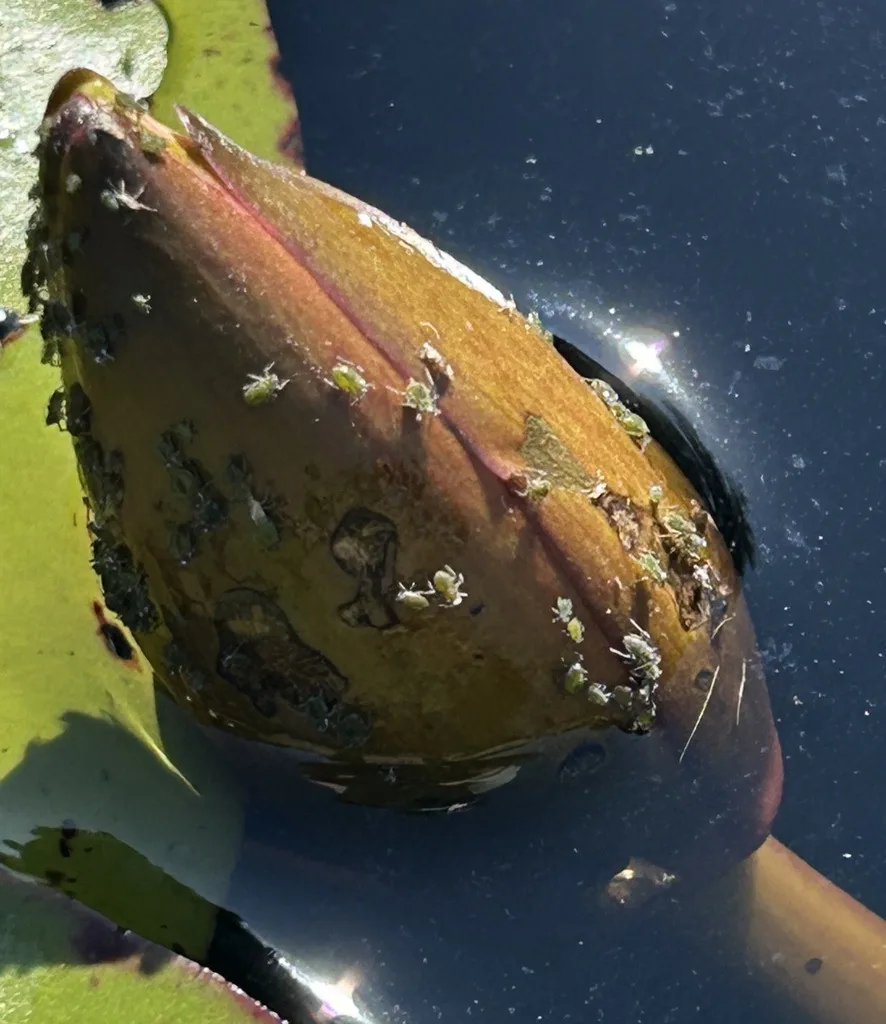
- In summer, look for dense aphid colonies on floating lily pads and other pond plants; the aphids walk on the water's surface and crawl down emergent stems to feed underwater.[1]
- Hairs on the body trap air, which lets the aphids stay underwater for a time.[1]
- On fruit trees in spring the same species is known as the reddish-brown plum aphid.[1]
- The Royal Horticultural Society describes it as a small aphid, 1.5-2.5 mm long, reddish brown or dull green, sucking sap from the upper surface of the leaves and from flower buds.[4]
Where it lives
Nearly cosmopolitan, found in all but the coldest land habitats and damaging Prunus fruit trees and aquatic plants worldwide. In the United States, Texas A&M AgriLife Extension has written about it as a pest of water lilies in ponds, and in the UK the Royal Horticultural Society lists it among waterlily pests.[2][5][1][4]
Biology and life cycle
It alternates hosts. In late fall, winged adults leave the pond for fruit trees in the genus Prunus, such as peach, apricot and almond, and females lay eggs in cracks in the bark. The eggs are the only stage that survives the winter.[1]
In spring, several generations feed on the trees. In mid- to late summer the aphids move back to the water, onto waterlilies, cattails, buttercup and knotweed.[1]
It prefers rosaceous plants and plants that grow in or near water, and has been recorded on plants in at least 45 families.[2]
Reproduction can be rapid enough to blanket plants.[1]
Fun fact: it is unusual among aphids in thriving on both land plants and water plants, which is why scientists have sequenced its genome to study how it adapts to such different hosts.[5][6]
Damage and signs
- Heavy feeding in late summer and early fall can brown and dry out the leaves of water plants, though the damage often comes as the plants are starting to die back for winter anyway.[1]
- It can be extremely destructive in aquatic gardens and nurseries, and it is a pest of rosaceous plants in spring.[1][2]
- It has been implicated in spreading several plant viruses.[1][2]
- Researchers describe it as a pest of Prunus fruit trees and of cultivated aquatic plants worldwide, damaging them both by feeding and by carrying plant viruses; one study calls it a highly polyphagous herbivore that causes severe damage to lotus.[5][6][7]
- In the UK, the Royal Horticultural Society says damage usually happens only in summer, when dense colonies build up on the leaves and buds, and that waterlily pests tend to be sporadic rather than returning year after year.[4]
Health risk
The sources describe it only as a plant pest; neither mentions any risk to people or pets.[1][2]
Control
Traps and physical control
Swish infested leaves in the pond water or wash the aphids off with a stiff stream of water. This likely works best in ponds with fish or other aquatic predators that eat the floating aphids.[1]
On small ponds where the lily leaves are within reach, wipe the aphids off the leaves and buds by hand. In larger ponds they often have to be tolerated, and the plants usually recover.[4]
Biological control
Fish and other aquatic predators eat aphids knocked into the water. In a 2024 lab study, fourth-instar larvae and adults of the multicolored Asian lady beetle (Harmonia axyridis) were highly efficient predators of waterlily aphids; the authors note that chemical control of this aphid raises water-pollution concerns.[1][7]
Pesticides
Don't use malathion or other common aphid sprays on pond plants: few insecticides are labeled for aquatic plants because most are highly toxic to fish and aquatic invertebrates. Soaps or oils can be used by lifting plants out of the water, spraying and rinsing them, and returning them quickly.[1]
Texas A&M's entomologist suggests that if Prunus trees grow near the pond, treating them with a soil-applied systemic insecticide such as imidacloprid might help, as long as the trees are not too close to the water, but notes that this approach has not been validated by research.[1]
Where sources disagree
Timing: Texas A&M says the aphids move back to the water in mid- to late summer, while the Royal Horticultural Society says they migrate from Prunus to waterlilies by early summer.[1][4]
Viruses: Texas A&M, citing a USDA bulletin, says it transmits at least five plant viruses; AphID says it has been implicated in transmitting at least 6.[1][2]
Common questions
- What are the tiny bugs covering my water lily pads?
- Likely waterlily aphids, which build up on waterlilies and other pond plants in late summer and early fall.[1]
- Can I spray the aphids on my pond plants?
- Not with ordinary aphid insecticides, which are mostly highly toxic to fish and aquatic invertebrates. Swishing the leaves in the water or hosing the aphids off is the usual fix.[1]
- Where do waterlily aphids go in winter?
- Winged adults fly to Prunus trees such as peach, apricot and almond in late fall and lay eggs in bark cracks; the eggs survive the winter.[1]
- Will waterlily aphids hurt my plum or peach tree?
- Sources differ. AphID calls it particularly important on rosaceous plants such as Prunus in spring, while the Royal Horticultural Society says it does not usually have a noticeable effect on its spring host.[2][4]
Sources
- Texas A&M AgriLife Extension Service, “Aquatic aphids, Insects in the City (August 22, 2011).” citybugs.tamu.edu/2011/08/22/aquatic-aphids/ (accessed 2026-11-12)
- USDA APHIS PPQ Identification Technology Program (idtools.org), “Rhopalosiphum nymphaeae fact sheet, AphID: Identification guide for cosmopolitan and polyphagous aphid species (C. Favret and G. Miller).” www.aphid.aphidnet.org/Rhopalosiphum_nymphaeae.php (accessed 2026-11-12)
- iNaturalist, “Rhopalosiphum nymphaeae taxon page (order and family).” www.inaturalist.org/taxa/142766 (accessed 2026-11-12)
- Royal Horticultural Society (UK), “Waterlily invertebrates.” www.rhs.org.uk/biodiversity/waterlily-invertebrates (accessed 2026-11-12)
- Scientific Data (2024), via PubMed, “A high-quality genome assembly of the waterlily aphid Rhopalosiphum nymphaeae.” pubmed.ncbi.nlm.nih.gov/38351256/ (accessed 2026-11-12). Cited from the PubMed abstract.
- Scientific Data (2026), via PubMed, “A chromosome-level genome assembly of the waterlily aphid Rhopalosiphum nymphaeae Linnaeus.” pubmed.ncbi.nlm.nih.gov/42151188/ (accessed 2026-11-12). Cited from the PubMed abstract.
- Insects (2024), via PubMed, “Functional and numerical responses of Harmonia axyridis to Rhopalosiphum nymphaeae and their potential for biological control.” pubmed.ncbi.nlm.nih.gov/39336601/ (accessed 2026-11-12). Cited from the PubMed abstract.