On this page
How to identify it
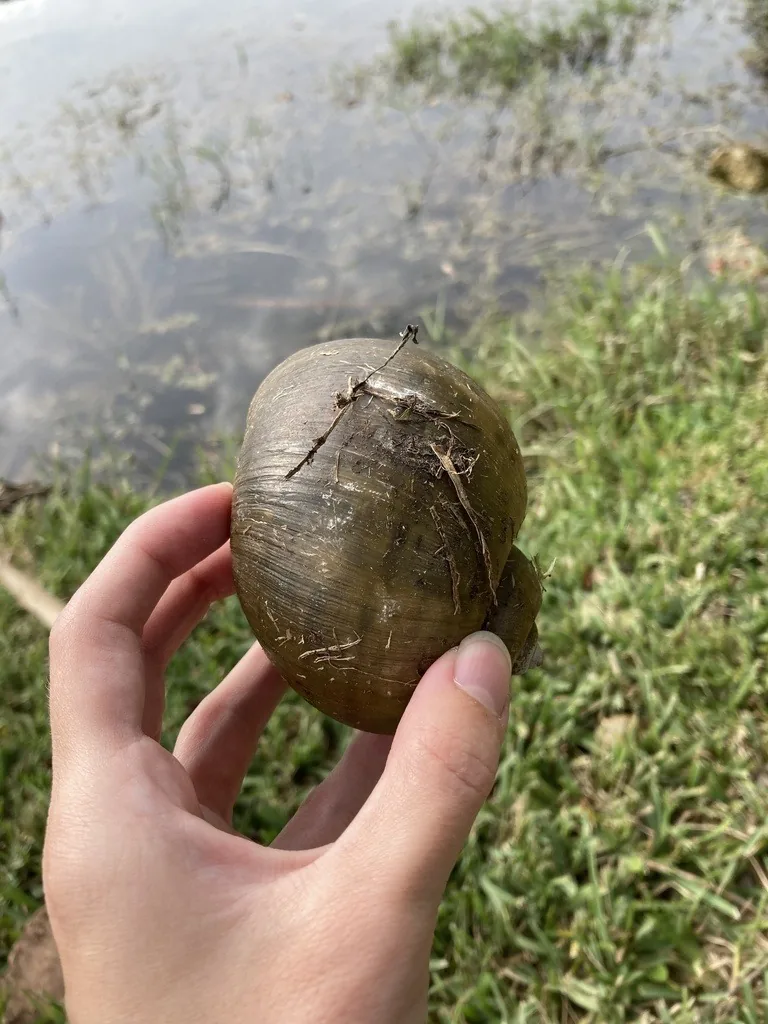
- The shell is large, round and globular with a short spire and a wide, teardrop-shaped opening. Color varies, often tan-brown to yellow or brownish black, with or without dark spiral bands. About 1.5 inches is the common size, but island apple snails can reach about 6 inches (155 mm) tall; channeled apple snails reach about 4 inches (100 mm). UF/IFAS says apple snails are larger than most freshwater snails and can be told from other freshwater species by their oval shell with an open (perforated) umbilicus, the hollow space inside the coiled whorls.[1][2][4][3]
- A thin, brown trapdoor (the operculum) seals the shell opening when the snail pulls inside.[1][2]
- Clusters of bright pink eggs, laid at dawn or dusk on plant stems, pilings, seawalls and other structures just above the water, are usually the first sign. Island apple snail clutches hold far more eggs than channeled apple snail clutches, which helps tell the two apart. UF/IFAS calls these grape-like clusters of eggs on solid objects above the water line the quickest way to tell that apple snails are present.[1][2][3]
- The island and channeled apple snails look nearly identical, and both were long misidentified in the U.S.; DNA testing showed that Florida, Georgia and Texas populations are the island apple snail.[1][2][5]
Look-alikes
| Look-alike | How to tell them apart |
|---|---|
| Florida applesnail (native) | Smaller, with shell whorls that sit flush instead of the island apple snail's indented ('channeled') seams. Its clutches hold fewer, larger eggs that are salmon pink when laid but quickly turn white. Old island apple snail clutches also fade from pink to white as they hatch. UF/IFAS says this native, beneficial snail has a low, strongly rounded spire, measures about 40 to 70 mm, and is the principal food of the Everglades snail kite; egg masses with large, white eggs are laid by this native snail.[1][4][3] |
| Spike-topped apple snail (mystery snail) | Still sold for aquariums as 'mystery snails'; its shell has a more prominent spire, with the angles between whorls close to 90 degrees. UF/IFAS says this Brazilian species, marketed as the 'golden applesnail', has deep grooves between the whorls, is 40 to 60 mm high, feeds mostly on decaying vegetation and is established in Broward, Miami-Dade, Monroe and Palm Beach counties.[2][3] |
| Giant African land snail | A land snail that can grow larger than a person's hand, while apple snails live in fresh water. UF/IFAS says it can reach nearly 8 inches (20 cm) long.[6][2][7] |
| Garden snails and slugs | Land mollusks that chew holes in garden plants at night, while apple snails live in ponds, ditches and other fresh water.[8][2] |
| Titan applesnail | UF/IFAS says this rare introduced apple snail is found only in southeastern Florida and lays green egg masses.[3] |
Where it lives
USGS lists island apple snail records from Alabama, Arizona, Florida, Georgia, Hawaii, Louisiana, Mississippi, the Carolinas and Texas, plus a 2024 record in Massachusetts and Puerto Rico. It was established in Texas by 1989 and in Florida by the mid to late 1990s; for Louisiana, USGS lists a first record in 2006 while a 2016 study gives 2008. The channeled apple snail is established in parts of the West and Hawaii (California since 1997), and USGS reports a small, genetically confirmed population in northeast Florida. GBIF's public records for the two since 1990 (6,435 when re-checked in November 2026) come from about a dozen states, most from Florida, Texas and Louisiana.[1][4][5][9][10]
Biology and life cycle
They live in shallow, slow-moving fresh water, including streams, bayous, ponds, canals, ditches and rice fields, and tolerate only slightly salty water.[2][1]
They don't tolerate cold: TexasInvasives.org puts the lower limit at 50 degrees F, and in cooler places they bury themselves in sediment to overwinter. UF/IFAS likewise says Florida's apple snails are not known to withstand water below 10 degrees C (50 degrees F).[2][1][3]
Egg counts differ by source: TexasInvasives.org gives 500 to 700 eggs per clutch, while USGS gives an average of 1,500 to 2,000, with over 4,500 recorded. Females may lay a clutch every 5 to 14 days, and eggs hatch in 10 to 14 days.[2][1]
Hatchlings fall or crawl into the water, and snails can mature in about three months; USGS notes they are thought to live up to three years.[2][1]
They survive drought by burrowing and sealing the shell: in a Louisiana study, half survived about 10 months out of water, and snails could crawl over dry land for at least three hours.[2][11]
In Florida, UF/IFAS says mating and egg laying of island and native apple snails starts in March and can continue through October, and females usually leave the water at night to lay eggs on tree trunks, pilings, seawalls or plant stems.[3]
Of Florida's four apple snail species, only the Florida applesnail is native. The introduced island apple snail mainly eats rooted aquatic plants, while the native snail feeds heavily on periphyton, the film of algae, microbes and detritus on submerged surfaces.[3]
UF/IFAS lists limpkins, Everglades snail kites, raccoons, turtles and alligators among their predators in Florida, and redear sunfish and certain ducks are believed to eat smaller young snails.[3]
Damage and signs
- Island apple snails strip vegetation and reproduce at tremendous rates, and they have caused ecosystem changes where they invaded in Asia.[9]
- Apple snails are known rice pests in Asia. In Texas, damage to rice has not been documented, but burrowing snails have increased levee maintenance for some rice farmers; in 2018 a Louisiana farmer shut down a crawfish harvest after snails entered his rice fields, and snails have turned up in shipments of farmed crayfish. UF/IFAS says the channeled apple snail has caused significant damage to rice and taro crops in the Pacific islands and Southeast Asia, and that both island and channeled apple snails are potential threats to Florida's aquatic ecosystems.[2][1][4][3]
Health risk
Apple snails can carry rat lungworm, a parasite people get by eating raw or undercooked snails or slugs or contaminated raw produce. It was found in island apple snails from New Orleans, but not in snails tested from Texas, Mississippi or Florida, nor in 100 snails from each of three South Carolina ponds. CDC says most infected people recover on their own, though it sometimes causes a rare meningitis. Wear gloves when handling snails, wash your hands, and wash raw produce well.[6][12][13][14][2]
Control
Prevention
Never release aquarium snails or plants into ponds, lakes or ditches.[2][1]
Aquarium dumping is not the only route: snails likely spread during floods and can move over land, so check ponds and ditches near infested water.[2][1][11]
In Florida, UF/IFAS says to remove only pink egg masses: masses of large white eggs are laid by the native Florida applesnail, pose no threat and should be left alone.[3]
Traps and physical control
Hand removal of snails and destroying egg masses can lower numbers. Remove or crush egg masses rather than scraping them into the water to drown, and wear gloves. UF/IFAS also calls hand or mechanical removal of snails and egg masses the most effective management method.[2][12][3]
Be aware that removal has limits: TexasInvasives.org notes snails reproduce and grow faster when their numbers are low.[2]
Pesticides
Chemical options are limited where they could harm native aquatic life or drinking water. In a pilot test, two molluscicides that killed apple snails also killed redear sunfish, though not crayfish. UF/IFAS says chemical elimination has been attempted, but no effective chemical recommendation has been developed.[2][9][3]
Where the sources disagree
What to do with egg masses: UF/IFAS says egg masses can be scraped into the water because submerged eggs won't hatch, while TexasInvasives.org says they should not be scraped into the water and should be removed or crushed instead.[3][2]
Telling native eggs by color: UF/IFAS says to leave masses of large white eggs alone because the native Florida applesnail lays them, while USGS notes that native clutches are salmon pink when laid before quickly turning white, and that hatched or old channeled apple snail clutches are also chalky white.[3][4]
Channeled apple snail in Florida: UF/IFAS (2011) says it has not been documented in Florida and that molecular data showed a northeast Florida population mapped by USGS was not this species, while USGS now reports a small, genetically confirmed population in northeast Florida.[3][4]
Common questions
- What are the bright pink egg clusters on my seawall or dock?
- Most likely island apple snail eggs, laid just above the waterline. In Florida, the native Florida applesnail's eggs are briefly salmon pink before turning white, so look for large, bright pink clutches.[1][2]
- Can I eat apple snails?
- Eating raw or undercooked snails can transmit rat lungworm. CDC advises not eating raw or undercooked snails and wearing gloves and washing your hands if you handle them.[6][12]
Sources
- U.S. Geological Survey, Nonindigenous Aquatic Species (NAS) database, “Giant applesnail (Pomacea maculata) species profile.” nas.er.usgs.gov/queries/FactSheet.aspx?speciesID=2633 (accessed 2026-11-14)
- TexasInvasives.org, “Apple Snail, Pomacea maculata (Invasives Database species fact sheet).” www.texasinvasives.org/animal_database/detail.php?symbol=15 (accessed 2026-11-14)
- University of Florida/IFAS Extension (Featured Creatures), “Applesnails of Florida, Pomacea spp., EENY-323/IN598.” ask.ifas.ufl.edu/publication/IN598 (accessed 2026-11-14). Used for identification, biology and management; its permit line is not used as current law.
- U.S. Geological Survey, Nonindigenous Aquatic Species (NAS) database, “Channeled applesnail (Pomacea canaliculata) species profile.” nas.er.usgs.gov/queries/FactSheet.aspx?speciesID=980 (accessed 2026-11-14)
- BMC Evol Biol, via PubMed, “The identity, distribution, and impacts of non-native apple snails in the continental United States (Rawlings et al. 2007).” pubmed.ncbi.nlm.nih.gov/17594487/ (accessed 2026-11-14). Cited from the PubMed abstract.
- Centers for Disease Control and Prevention, “About Rat Lungworm Disease.” www.cdc.gov/angiostrongylus/about/index.html (accessed 2026-11-14)
- University of Florida/IFAS Extension, “Giant African Land Snail in Florida, ENY-512/IN904.” ask.ifas.ufl.edu/publication/IN904 (accessed 2026-11-14). Used for identification only.
- University of California Statewide IPM Program, “Snails and Slugs (Pest Notes, Home and Landscape).” ipm.ucanr.edu/home-and-landscape/snails-and-slugs/ (accessed 2026-11-14)
- Bull Environ Contam Toxicol, via PubMed, “A pilot study testing a natural and a synthetic molluscicide for controlling invasive apple snails (Olivier et al. 2016).” pubmed.ncbi.nlm.nih.gov/26687501/ (accessed 2026-11-14). Cited from the PubMed abstract.
- Global Biodiversity Information Facility (GBIF), “Pomacea maculata and P. canaliculata: occurrence records in the U.S., 1990-2026 (GBIF occurrence search).” api.gbif.org/v1/occurrence/search?taxonKey=7532642&taxonKey=2292582&country=US&hasGeospatialIssue=false&occurrenceStatus=PRESENT&year=1990%2C2026&facet=stateProvince&facetLimit=400&limit=0 (accessed 2026-11-14). State counts are records reported (iNaturalist research-grade, museum specimens, surveys), not abundance.
- Biol Bull, via PubMed, “Physiology of the apple snail Pomacea maculata: aestivation and overland dispersal (Mueck et al. 2018).” pubmed.ncbi.nlm.nih.gov/30160996/ (accessed 2026-11-14). Cited from the PubMed abstract.
- Centers for Disease Control and Prevention, “Preventing Rat Lungworm.” www.cdc.gov/angiostrongylus/prevention/index.html (accessed 2026-11-14)
- Hawaii J Med Public Health, via PubMed, “The occurrence of the rat lungworm in nonindigenous snails in the Gulf of Mexico region of the United States (Teem et al. 2013).” pubmed.ncbi.nlm.nih.gov/23901374/ (accessed 2026-11-14). Cited from the PubMed abstract.
- J Aquat Anim Health, via PubMed, “Frequency of occurrence of the rat lungworm parasite in the invasive island apple snail in South Carolina (Underwood et al. 2019).” pubmed.ncbi.nlm.nih.gov/30719754/ (accessed 2026-11-14). Cited from the PubMed abstract.
- iNaturalist, “Pomacea maculata taxon page (order and family).” www.inaturalist.org/taxa/461265 (accessed 2026-11-14)