On this page
How to identify it
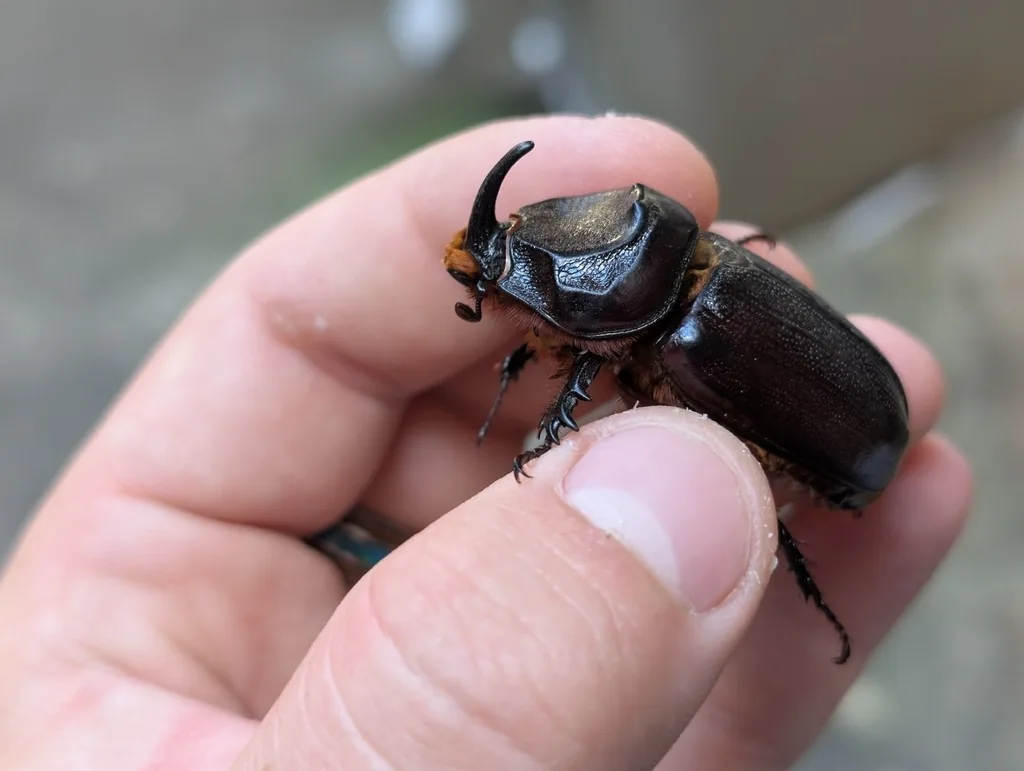
- Adults are stout, shiny black or dark brown beetles with a single distinctive horn on the head, and they fly at night; see where the sources disagree on size.[3][1][2]
- The clearest sign on palms is V-shaped cuts in the fronds as damaged leaves unfold, along with holes through the midrib and bore holes into the crown.[1][3]
- Grubs are white with a brown or reddish head and live in decaying organic matter such as mulch, compost, green waste and rotting palm stumps; the grubs of the common Oriental flower beetle look similar.[1][3][4]
- Bags of mulch, compost or soil with chewed entry holes can mean grubs are inside.[2]
Look-alikes
| Look-alike | How to tell them apart |
|---|---|
| Oriental flower beetle grubs | Common grubs in Hawaii compost that resemble coconut rhinoceros beetle grubs, so suspicious grubs should be identified by the state.[4] |
Where it lives
First detected in Hawaii in December 2013 at Joint Base Pearl Harbor-Hickam on Oahu, then at Barbers Point, Campbell Industrial Park and Diamond Head in 2014. HDOA reported it on Kauai in May 2023, a dead adult in compost shipped from Oahu to a Maui retailer in fall 2023, grubs in Kihei, Maui, in November 2023, grubs at Waikoloa on Hawaii Island in October 2023 and a trapped beetle there in September 2024. In 2026 dead beetles were caught in traps at Kahului Airport in April and at Waikapu in June, on Maui, and traps on Molokai also caught beetles. Native to the Asian tropics, it is a major palm pest in India, the Philippines, Palau, Fiji, Samoa and Guam.[1][5][2][4]
Biology and life cycle
Grubs breed in mulch, compost, green waste, tree stumps and other decaying plant material; compost becomes suitable for them once it cools to around 110 °F.[1][3]
Adults fly at night and bore into the crowns of palms to feed on the sap.[3][2]
Damage and signs
- Feeding injures the young growing tissue in the crown, and if the beetles kill or damage the growing point, the palm may die.[1][2]
- Coconut palms are preferred, but HDAB names royal palms and the native loulu (fan) palm, and Plant Pono notes native and endangered palms such as loulu. Hala, banana, sugarcane and taro are secondary food plants, and The Maui News adds pineapple.[1][3][4]
- HDOA says palm deaths after attack have been reported at anywhere from 10 to 50 percent, and wounds can let fungal or bacterial pathogens in.[2][5]
Health risk
It damages palms and crops. HDAB, Plant Pono and HDOA describe plant damage and don't mention any direct risk to people or pets; HDOA notes that palms killed by the beetle can fall unexpectedly once the trunk rots, risking injury or property damage.[1][3][2]
Control
Prevention
Inspect mulch, compost and bagged soil before buying or using them, especially bags with holes, and check compost and green-waste piles and nearby palms for signs of the beetle at least every four months. HDAB also advises chipping incoming green waste within 48 hours, composting it at 131 °F or more, and spreading material no more than 4 inches deep instead of stockpiling it.[2][1]
Limit moving green waste, mulch and compost, which can carry grubs to new areas.[4][1]
Report suspected beetles, grubs or palm damage on any island right away; the state's CRB Response site (crbhawaii.org) and the 643-PEST line take reports.[1][3][2]
Current regulatory status (checked November 2026)
Oahu: HDOA said on October 4, 2023, that a new interim rule, effective immediately and valid for one year while a permanent rule was finalized, designated Oahu a CRB-infested area and restricted moving palm plants, compost, wood or tree chips, mulch, potting soil and other landscaping material that may harbor the beetle from infested to non-infested areas.[5]
West Hawaii Island: the Board of Agriculture and Biosecurity approved Interim Rule 26-1 on March 24, 2026. It restricts moving host palms, plants with organic material on the roots, and decomposing plant material such as mulch, chips, compost and bagged potting media from and within a designated infested area (roughly Waikōloa Road south to Laʻaloa Avenue, between the coast and Highway 11), subject to a DAB permit or compliance agreement. DAB's IR 26-1 page gives the effective date as March 25, 2025, as written, though the rule was approved in 2026.[6][7]
On July 2, 2026, DAB reminded anyone who transports, generates, processes, collects, sells or grows CRB host material in the West Hawaii infested area that they need a valid compliance agreement, which requires a Big Island Invasive Species Committee training session first.[8][7]
Maui and Lānaʻi: the board approved Interim Rule 26-2 on July 28, 2026, in effect from July 29, 2026. It restricts moving host plants with organic material on the roots, untreated compost, wood, chips and mulch, and potting media from any other part of the state to Maui and Lānaʻi, and prohibits shipping coconut fruit there; some treated material may go after DAB inspection. It sets no restrictions between Maui and Lānaʻi.[9]
Where the sources disagree
Adult size: Plant Pono says 1.5 to 2 inches; HDAB says 1.5 to 2.5 inches; HDOA says about 2 inches.[3][1][2]
Grub head color: HDAB says brown; Plant Pono says reddish.[1][3]
Where it occurs: Plant Pono's 2022 fact sheet says it was present only on Oahu with no known incursions on other islands; later HDOA and DAB releases report finds on Kauai, Maui and Hawaii Island and, in 2026, a designated infested area in West Hawaii.[3][2][5][7]
Heat treatment: Plant Pono says to heat-treat material to 130 °F where possible; HDAB says compost piles should reach at least 131 °F.[3][1]
Common questions
- What makes V-shaped cuts in palm fronds in Hawaii?
- V-shaped cuts in coconut palm fronds, often with holes through the midrib, are the telltale sign of coconut rhinoceros beetle feeding.[1][3]
- I found big white grubs in my mulch in Hawaii. What should I do?
- They could be coconut rhinoceros beetle grubs, though Oriental flower beetle grubs look similar; report them so the state can identify them.[4][1]
Sources
- Hawaii Department of Agriculture and Biosecurity, “Coconut Rhinoceros Beetle (Biosecurity program page).” biosecurity.hawaii.gov/coconut-rhinoceros-beetle/ (accessed 2026-11-13)
- Hawaii Department of Agriculture, “Coconut Rhinoceros Beetle Found in Waikoloa Trap (news release, September 21, 2024).” dab.hawaii.gov/blog/main/nr24-28crb-waikoloa/ (accessed 2026-11-13)
- Plant Pono (Hawaii Invasive Species Council), “Coconut Rhinoceros Beetle (Pest Prevention Training fact sheet, May 2022).” plantpono.org/wp-content/uploads/Coconut-rhinoceros-beetle-Fact-Sheet-05.22.pdf (accessed 2026-11-13)
- The Maui News, “Dead coconut rhinoceros beetles found in Waikapu traps (June 2026).” www.mauinews.com/news/local-news/2026/06/dead-coconut-rhinoceros-beetles-found-in-waikapu-traps/ (accessed 2026-11-13)
- Hawaii Department of Agriculture, “New interim rule to stop the spread of coconut rhinoceros beetle (NR23-23, October 4, 2023).” dab.hawaii.gov/blog/main/nr23-23/ (accessed 2026-11-13)
- Hawaii Department of Agriculture and Biosecurity, “Interim Rule 26-1 Restricting the Transportation of Coconut Rhinoceros Beetle Host Materials on Hawaiʻi Island (posted April 17, 2026).” dab.hawaii.gov/?p=13939 (accessed 2026-11-13)
- Hawaii Department of Agriculture and Biosecurity, “IR26-1: Interim Rule 26-1 Restricting the Transportation of CRB Host Materials on West Hawaiʻi Island (program page).” dab.hawaii.gov/ir26-1/ (accessed 2026-11-13)
- Hawaii Department of Agriculture and Biosecurity, via the Office of the Governor, “DAB reminder: compliance agreements required for CRB host materials in West Hawaiʻi (NR26-15, July 2, 2026).” governor.hawaii.gov/?p=12753 (accessed 2026-11-13)
- Hawaii Department of Agriculture and Biosecurity, “Interim Rule 26-2 Restricting the Transportation of CRB Host Materials to the Islands of Maui and Lānaʻi (NR26-17, July 28, 2026).” dab.hawaii.gov/blog/main/interim-rule-26-2-restricting-the-transportation-of-coconut-rhinoceros-beetle-host-materials-to-the-islands-of-maui-and-lana%CA%BBi/ (accessed 2026-11-13)
- Global Biodiversity Information Facility (GBIF), “Oryctes rhinoceros (Linnaeus, 1758) (GBIF Backbone Taxonomy).” api.gbif.org/v1/species/4995642 (accessed 2026-11-13)
- iNaturalist, “Oryctes rhinoceros taxon page (order and family).” www.inaturalist.org/taxa/320058 (accessed 2026-10-06)