On this page
How to identify it
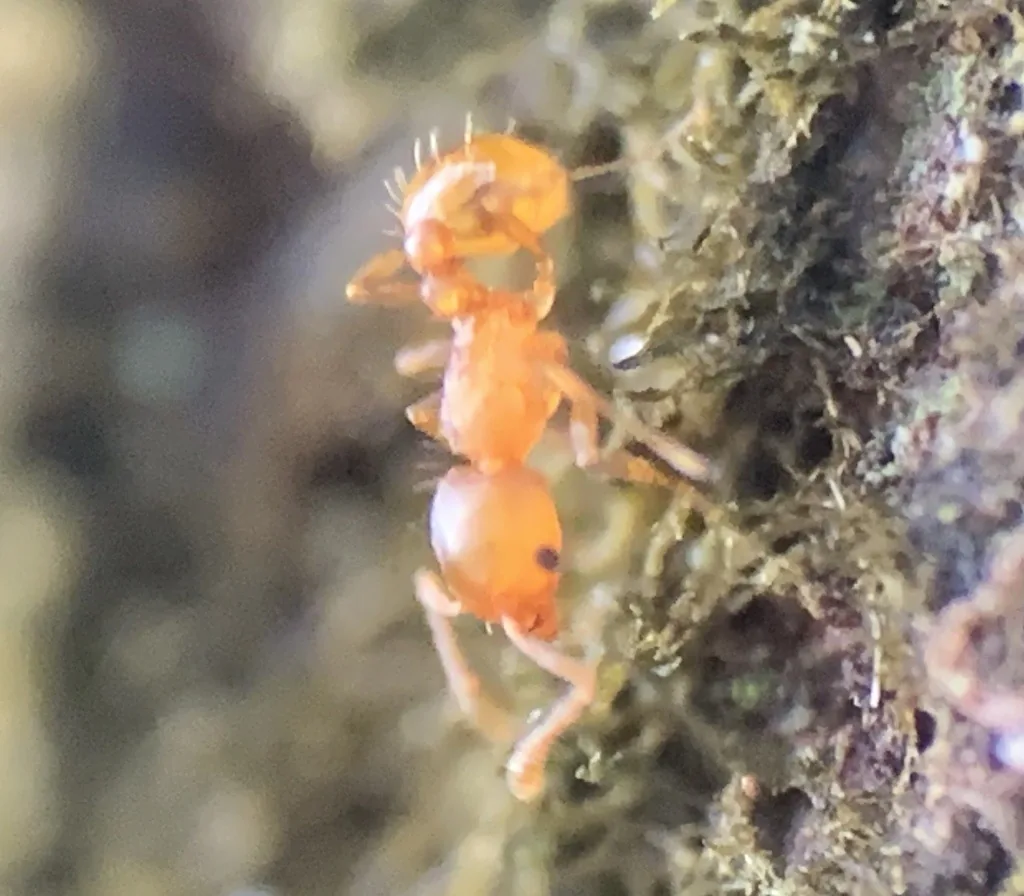
- Workers are tiny, about 1/16 inch (1.5 mm), as long as a penny is thick, and all the same size. HDOA calls them pale orange, the University of Hawaii orange-red, and the Hawaii Invasive Species Council (HISC) a uniform yellow-red to light brown.[1][3][2]
- They move slowly and are easily knocked off leaves, plants and trees.[1][3][2]
- They don't build mounded nests, and their nests have no distinct openings.[3][2]
- Under magnification, UF/IFAS says workers show a pair of spines at the back of the thorax, 11-segmented antennae ending in a two-segmented club, and a square-looking node on the first waist segment.[4]
- Queens are much larger, about 4.5 mm long compared with 1.0-1.5 mm for workers, and darker reddish brown. UF/IFAS says many queens among very dense workers help identify this species.[4]
Look-alikes
| Look-alike | How to tell them apart |
|---|---|
| Tropical fire ant | A larger stinging ant that builds ground nests with distinct openings in sunny, dry areas, while little fire ants nest in moist, shady spots without mounds.[3] |
| Red imported fire ant | Both sting, but little fire ants never build mounded dirt nests. Check for tiny, slow, uniformly orange ants on peanut butter test sticks instead. UF/IFAS adds that the two aren't closely related: both are in the subfamily Myrmicinae but belong to different tribes.[2][3][4] |
Where it lives
It is Neotropical in origin: Hawaii's 1999 pest advisory describes it as known throughout central and northern South America, the West Indies and the warmer parts of Mexico, and cites an earlier report that it is common in south Florida. Hawaii's Invasive Species Council says it has invaded tropical and subtropical regions around the world and is even a greenhouse pest in colder places such as Europe and Canada, and that the ants in Hawaii are most closely related to invasive colonies in Florida. In Hawaii it was found in Puna in 1999 and later turned up on Oahu, Maui and Lanai. UF/IFAS says it has been documented in Florida since at least 1924, when it was first recorded in Miami, and that known established colonies stretch from the Florida Keys (Monroe County) as far north as Gainesville (Alachua County), mostly in disturbed places such as highways and residential areas.[1][2][3][4]
Biology and life cycle
Where it invades, the little fire ant forms supercolonies with enormous numbers of workers. In a Hawaii fruit orchard, researchers estimated the supercolony at more than 244 million ants per hectare.[2][5]
HDOA says it doesn't form definite nests. Clusters holding several queens, workers and brood sit in cracks or under leaf litter and stones, linked by workers moving between them, and new nests apparently form by budding, since mating flights have never been observed. UF/IFAS adds that winged reproductives are produced but don't fly off; they stay close to the parent supercolony and expand its boundaries.[1][4]
Look for them in moist, shady places: in trees, under bark, rocks and logs, in leaf litter, in and under potted plants, and, HISC adds, along irrigation lines and inside electrical boxes. UF/IFAS lists nests under rocks, within logs, inside plant material or compost, in hay bales and under leaf litter, all close to the surface.[3][1][2][4]
Workers feed on dead insects and other small animals, prey on many insects, and prefer honeydew from sap-sucking insects; HISC also shows them collecting nectar from flowers.[1][2]
People spread it in infested plants, logs, green waste, gravel, cinders and soil, and even on cars. In December 2013 it turned up in hapu'u fern logs sold at nurseries and garden shops on Oahu and Maui. UF/IFAS says it reaches new places mainly through the movement of infested plants, plant material and soil.[3][1][4]
HISC says DNA studies tie the Hawaii population most closely to invasive colonies in Florida, and that it probably reached Hawaii Island on nursery plants sometime in the 1990s.[2]
UF/IFAS says invasive populations are unicolonial: they have many queens, can grow to many millions of workers, and show no aggression to members of the same supercolony. There is no central nest; many nests spread across the area and the ants move freely among them.[4]
Invasive populations reproduce in an unusual way: queens and males are produced clonally while workers come from ordinary sexual reproduction. UF/IFAS says this describes 98 percent of populations in the invaded range but only about two thirds of sampled colonies in the native range.[4]
Damage and signs
- It boosts aphids, whiteflies and scale insects by guarding them from predators and parasites in return for honeydew. In the Hawaii orchard study, mealybugs were fewer in the plots where the ants were suppressed. UF/IFAS cites a Brazil study linking it to a significant increase in mealybugs, and says that after it was deliberately released in the Solomon Islands in the 1970s to fight the nut-fall bug, scales, aphids and mealybugs increased and crop yields fell.[2][5][4]
- It can become a household pest that infests clothing, beds, furniture or food, and people have been stung inside homes in Hawaii.[1][2]
- In newly invaded areas it gradually eliminates other ants and small invertebrates. HISC adds that it can take over beehives, and in the Galapagos it eats tortoise hatchlings and attacks the eyes of adult tortoises. UF/IFAS says invasive little fire ants made up as much as 96 percent of the ant biomass after invading part of New Caledonia, and that in Hawaii they have reached over 4000 locations on the Big Island.[1][2][4]
Health risk
The sting is painful and itchy. A review of medical, veterinary and wildlife reports links little fire ant stings to small corneal scars in people and animals, long reported under names such as tropical or Florida keratopathy. Doctors in Israel note that serious reactions have rarely been reported, but describe a boy with repeated life-threatening allergic reactions to its stings.[6][7]
Control
Prevention
Check plants, soil and green waste before moving them, and quarantine and test new plants, cut flowers, mulch and soil. UF/IFAS calls inspecting plant material, soil and packing material before transport the most effective way to prevent spread, followed by inspection and monitoring around shipping ports and transportation hubs.[3][1][2][4]
Test for them with a thin smear of peanut butter on disposable chopsticks set in shady, moist spots for an hour, then bag and freeze any sticks with tiny orange ants.[3]
Pesticides
Treatment takes persistence. HISC says colonies can recover after one application and repeats a recommendation to bait every 4 to 6 weeks for a year. In the Hawaii orchard trial, no plot reached a 100 percent reduction, and ants nesting up in the trees escaped the ground treatments.[2][5]
In that trial, a broadcast bait with the insect growth regulator pyriproxyfen cut ant counts by an average of 92.5 percent and hydramethylnon in bait stations by 47.1 percent, while a spinosad ground spray did not reduce them.[5]
UF/IFAS says insecticide baits are thought to work best on small, isolated populations, and that once populations are large and widespread, eradication is unlikely. It notes the ant was eradicated on Maui only after a combination of three insecticides, and on Santa Fe Island in the Galapagos only after repeated cutting and burning of vegetation plus four insecticides.[4]
When to call a professional
In Hawaii, report suspected ants to the state's 643-PEST hotline and don't treat or disturb the area until they're identified, since that can scatter the nests.[3]
If HDOA confirms little fire ants, call them about next steps; they can help with control and need every infested location mapped to stop the spread. UF/IFAS likewise says suspected infestations should go to specialists to confirm the identification and plan control.[3][4]
Common questions
- Why do little fire ants sting me from above?
- They forage in trees and shrubs and fall onto people and animals below, so stings often land on the neck, arms and torso. Ants on the ground rarely sting, but they sting readily once they get under clothing.[2][1]
- Can little fire ants blind my dog or cat?
- Yes. Hawaii agencies warn that stings to the eyes can blind cats and dogs, and a review of the medical and veterinary literature ties the same corneal damage to these stings in people, pets and wild animals.[3][2][7]
- How do I check my yard for little fire ants?
- Use the peanut butter chopstick test in shady, moist areas and around potted plants, then send any suspicious ants for identification.[3]
- What should I do after a little fire ant sting?
- Wash the stings with soap and water and hold ice wrapped in a washcloth on them, 10 minutes on and 10 off; an antihistamine or anti-itch cream can ease itching. Call 911 if the person has trouble breathing, swelling of the face or mouth, or a tight throat.[8]
- Is the little fire ant related to the red imported fire ant?
- Not closely. UF/IFAS says both are in the subfamily Myrmicinae but belong to different tribes.[4]
- Is the little fire ant in Florida?
- Yes. UF/IFAS says it has been documented in Florida since at least 1924 and is established from the Florida Keys north to Gainesville, mostly along highways and in residential areas.[4]
Sources
- Hawaii Department of Agriculture, Plant Pest Control Branch, “New Pest Advisory No. 99-02: Little Fire Ant, Wasmannia auropunctata (updated February 2007).” dab.hawaii.gov/pi/files/2014/05/Pest-Advisory-LFA.pdf (accessed 2026-11-14)
- Hawaii Invasive Species Council, Hawaii Department of Land and Natural Resources, “Little Fire Ant (LFA), invasive species profile.” dlnr.hawaii.gov/hisc/info/invasive-species-profiles/little-fire-ant/ (accessed 2026-11-14)
- University of Hawaii College of Tropical Agriculture and Human Resources, with the Hawaii Department of Agriculture, “Detect, Report, Stop the Little Fire Ant (2014).” www.ctahr.hawaii.edu/UHMG/downloads/2014LFA.pdf (accessed 2026-11-14)
- University of Florida/IFAS Extension (Featured Creatures), “Little Fire Ant, Wasmannia auropunctata (Roger), EENY-139/IN1351 (Featured Creatures).” ask.ifas.ufl.edu/publication/IN1351 (accessed 2026-11-14)
- Journal of Economic Entomology, via PubMed, “Souza E, Follett PA, Price DK, Stacy EA (2008), Field suppression of the invasive ant Wasmannia auropunctata in a tropical fruit orchard in Hawaii, Journal of Economic Entomology 101(4):1068-1074.” pubmed.ncbi.nlm.nih.gov/18767711/ (accessed 2026-11-14). Cited from the PubMed abstract.
- Harefuah, via PubMed, “Kidon M, Klein Y, Weinberg T (2022), Little fire ant (Wasmannia auropunctata) in Israel: from nuisance to life-threatening, Harefuah 161(4):207-209 (article in Hebrew; English abstract).” pubmed.ncbi.nlm.nih.gov/35466602/ (accessed 2026-11-14). Cited from the PubMed abstract.
- Journal of Medical Entomology, via PubMed, “Rosselli D, Wetterer JK (2017), Stings of the Ant Wasmannia auropunctata as Cause of Punctate Corneal Lesions in Humans and Other Animals, Journal of Medical Entomology 54(6).” pubmed.ncbi.nlm.nih.gov/29029157/ (accessed 2026-11-14). Cited from the PubMed abstract.
- MedlinePlus, U.S. National Library of Medicine, “Insect bites and stings (Medical Encyclopedia 000033).” medlineplus.gov/ency/article/000033.htm (accessed 2026-11-14)
- iNaturalist, “Allomerus auropunctatus taxon page (order and family).” www.inaturalist.org/taxa/1704594 (accessed 2026-11-14)