On this page
How to identify it
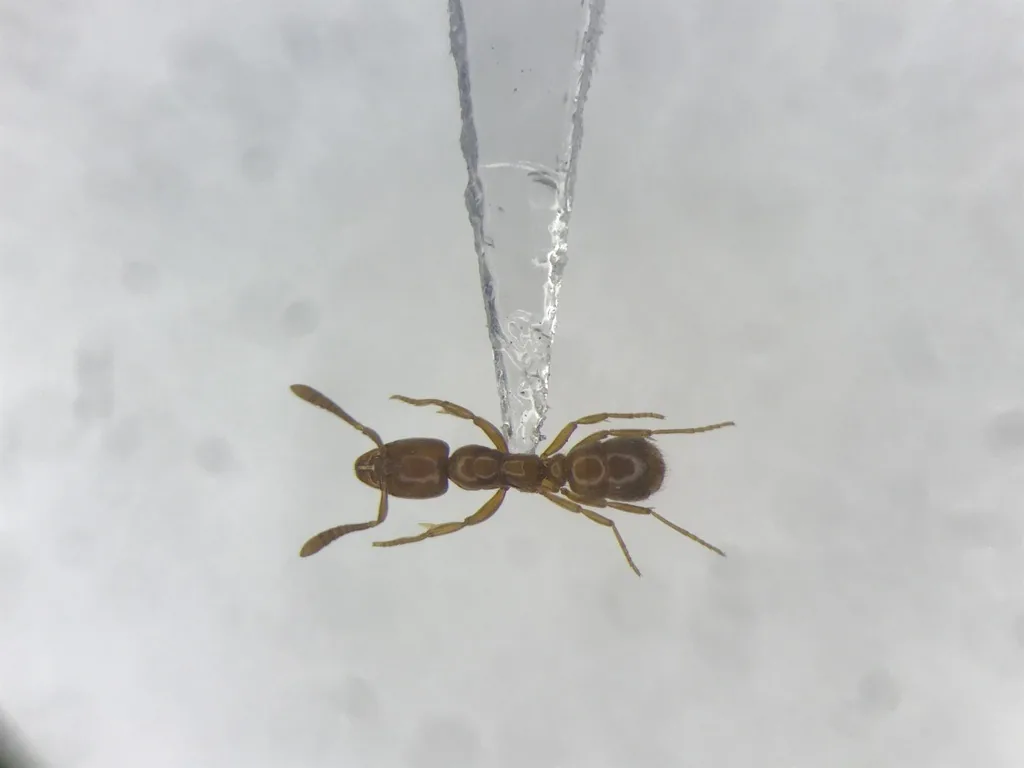
- A minute ant: the worker's head is only 0.56 to 0.72 mm long and the thorax under a millimeter, with a small elongate body, a narrowed head and a yellowish-brown to brown color.[1]
- The eyes are tiny: the Utah catalog describes them as a single facet or up to about 5 nearly fused facets, set on the front quarter of the head.[2][1]
- Shiny cuticle covered in dense flattened hairs, 12-segmented antennae ending in a three-segmented club, and triangular mandibles; the frontal lobes cover the antennal sockets, as in all Hypoponera.[1]
- A single thick waist node with a simple rounded lobe beneath it, a clear constriction between the first and second gaster segments, and a prominent sting.[1][2]
- Queens are only slightly larger, orange-brown to brown, with large eyes; males are wingless and worker-like. Winged males have never been seen.[1]
- Identification is hard even for specialists: the Utah catalog notes the group is taxonomically confused, and that in Europe a second, very similar species can be told apart only by detailed measurements.[2]
Look-alikes
| Look-alike | How to tell them apart |
|---|---|
| Other Hypoponera species | Five Hypoponera species occur in the United States; in Mississippi H. punctatissima is easily separated from the others by its much smaller size.[1] |
| Ponera exotica | A very similar tiny ponerine, told apart by the lobe under the waist node, which is simple and rounded in H. punctatissima.[1] |
| Asian needle ant | Another introduced stinging ponerine of the Southeast; Roger's crypt ant is minute, yellowish brown to brown, with a tiny eye and a head under three-quarters of a millimeter long.[1] |
Where it lives
Its native home is uncertain: the Mississippi museum suggests possibly Central Asia, while the Maui Invasive Species Committee gives Africa. It is now virtually cosmopolitan in warm regions. In the United States it is recorded from Alabama, Arizona, California, Florida, Hawaii, Iowa, Louisiana, Mississippi, New Mexico, North Carolina, South Carolina, Texas and Washington, and in Canada, but it does not appear widespread or common except in Florida.[1][3][2]
Biology and life cycle
Colonies are small and live on or just under the ground surface, in leaf litter, rotting wood, soil, compost, under stones and under bark.[1][3][2]
Successful outdoor establishment seems to need temperatures of at least 21 C (70 F), but colonies also take hold in cooler climates by nesting in greenhouses, homes, compost piles, horse manure and around other heat sources associated with people.[1]
Wingless, worker-like males mate with the winged queens, which then fly off to start colonies elsewhere.[1]
Damage and signs
Health risk
A medical review in the Annals of Allergy, Asthma & Immunology reported a severe reaction to a Hypoponera punctatissima sting in an adult woman in Connecticut, and lists Hypoponera among 10 ant genera shown capable of serious allergic or adverse reactions, so a sting followed by more than local symptoms deserves prompt medical care.[4]
Control
Prevention
No source describes a control program for this ant. Stings usually come from winged queens trapped beneath clothing or in sweat, so brush off any tiny ant that lands on you.[1][3]
Sanitation
In cooler areas colonies depend on warm, people-made spots such as compost piles, horse manure, greenhouses and heated buildings, which is where to look if stings keep happening.[1]
Ants with wingless males
Unlike most ants, this species makes no winged males. Its wingless males look like workers.[1]
Because the ants are so small and look so alike, the genus has been neglected; in Hawaii, DNA barcoding is under way to sort out which species are there.[3][2]
Common questions
- Something tiny stung me under my shirt. Could it be this ant?
- Possibly, in Florida or near stables, compost or greenhouses. Stings from this species usually come from winged queens that land on people or get trapped under clothing.[1][3]
- Is the sting dangerous?
- Usually a nuisance, but a published case report describes a severe reaction to a sting by this species. Seek care if a sting causes more than local symptoms.[4]
- Where does it nest?
- In soil, rotting wood, leaf litter and compost where it is warm enough, and otherwise in greenhouses, homes and horse manure.[1][3]
Sources
- Mississippi Entomological Museum, Mississippi State University, “Ants of the Southeastern United States: Hypoponera punctatissima (Roger, 1859) (J. A. MacGown and R. J. Whitehouse, updated 2016).” mississippientomologicalmuseum.org.msstate.edu/Researchtaxapages/Formicidaepages/genericpages/Hypoponera.punctatissima.htm (accessed 2026-11-12)
- University of Utah, School of Biological Sciences, “Hypoponera punctatissima (Roger 1859) and related species (J. T. Longino, Ants of Costa Rica).” ants.biology.utah.edu/genera/hypoponera/species/punctatissima/punctatissima.html (accessed 2026-11-12)
- Maui Invasive Species Committee, “Crypt Ants.” mauiinvasive.org/?p=369440 (accessed 2026-11-12)
- Annals of Allergy, Asthma and Immunology, abstract via PubMed, “Adverse reactions to ants other than imported fire ants (Klotz et al. 2005, Annals of Allergy, Asthma and Immunology 95:418-425; PubMed 16312163).” doi.org/10.1016/S1081-1206(10)61165-9 (accessed 2026-11-12)
- iNaturalist, “Hypoponera punctatissima taxon page (order and family).” www.inaturalist.org/taxa/69072 (accessed 2026-11-10)