On this page
How to identify it
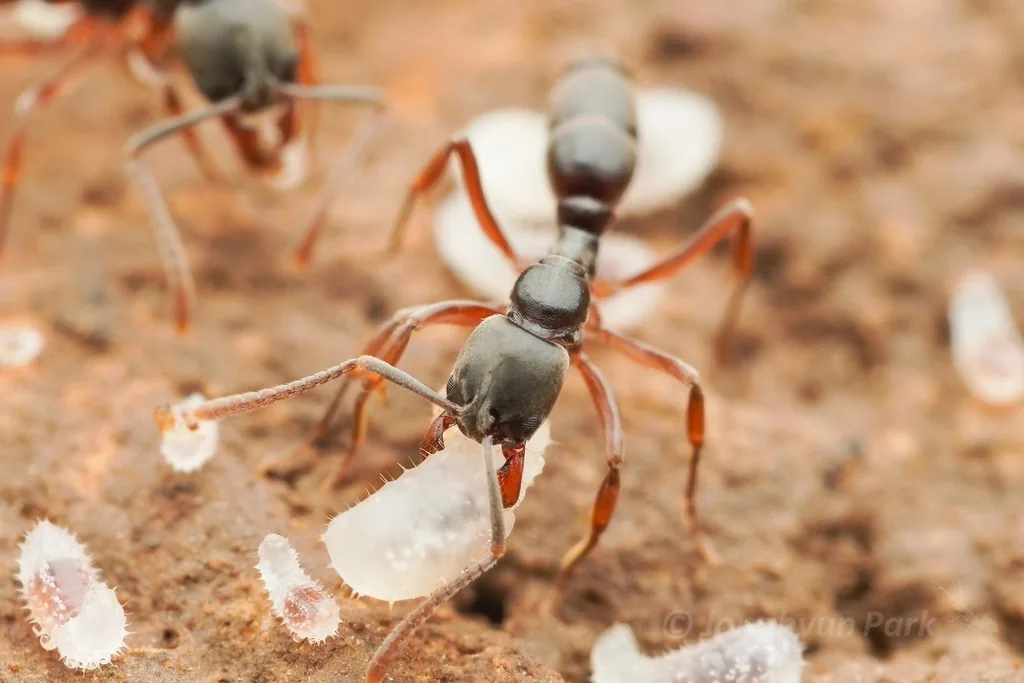
- Workers and queens look alike: long, slender and dark brown to black, 5.0 to 6.5 mm (about 1/5 inch), with lighter brown to orange-ish legs and mandibles.[1]
- It can't cling to smooth surfaces; trapped in a glass jar, it makes a few failed attempts to climb and then stays at the bottom.[1]
- Unlike many pest ants, it does not form foraging trails.[2]
- Winged swarmers look different from workers: Clemson measures the winged female at about 5.6 mm with a black body, and the smaller winged male at 3.0 mm and light brown.[2]
Look-alikes
| Look-alike | How to tell them apart |
|---|---|
| Red imported fire ant | Fire ants defend their nests aggressively, while needle ants try to flee and sting mainly when pressed; needle ant stings are often blamed on fire ants.[1][2] |
| Carpenter ants | Asian needle ant workers are smaller than carpenter ants.[1] |
| Argentine ant | Argentine ants are smaller sugar ants that form much larger colonies.[1] |
Where it lives
Native to Asia and in the United States since the early 1930s; documented in North Carolina, Alabama, Florida, Georgia, South Carolina, Tennessee, Virginia, Connecticut and New York, in settings from school cafeterias to lawns to forest logs. A 2023 study describes it spreading through urban and natural habitats across the eastern United States.[1][6]
Biology and life cycle
Prefers damp nest sites: rotting logs, leaf litter, under rocks and loose soil, plus mulch, landscape timbers, pavers and sprinkler systems.[1][2]
Colony size ranges from tens of ants to thousands, and a colony's territory may be several nests around the base of a single tree. Colonies often have more than one queen.[1][2]
It is a termite specialist that also scavenges other insects and small invertebrates and will take sugars and food scraps. A fun fact: in a 2023 field study, bait coated with termite skin chemicals drew these ants so well that ant numbers in the test plots fell 98% within 14 days.[1][6]
In upstate South Carolina, workers are active from March to late October; winged swarmers fly from late May to September, mostly in July and August.[2]
Damage and signs
- It increasingly invades homes and school cafeterias to take food, though its colonies are much smaller than odorous house ant or Argentine ant colonies.[1]
- In North Carolina forests where it was present, it outnumbered all native ant species combined, and native ant numbers and diversity were lower. NC State notes that this leaves jobs native ants do, such as spreading seeds and eating forest pests, undone.[5][1]
Health risk
The sting is painful. In a South Carolina survey of sting victims, 80% had local swelling under 5 cm, pain, redness and hives lasting 2 hours to 5 days, and 8% had larger swelling with symptoms lasting 3 to 14 days. Anaphylaxis from its sting has been documented in patients in Korea and Japan. Anyone with trouble breathing, throat or face swelling, or a history of severe sting reactions needs emergency care (call 911).[4][7][8][9]
Control
Prevention
Wear thick gloves when handling mulch or reaching into dark spots, since most stings happen when a hand presses on a nest.[1]
If an ant lands on you, flick it off rather than brushing it, because brushing often triggers a sting.[2]
Keep them out
Limit objects the ants nest under around the property, and keep door and window screens well fitted during swarming season.[2]
Pesticides
Ordinary ant baits often fail: Clemson says baiting may be unsuccessful because these ants don't follow foraging trails, though NC State notes that they do recruit to protein-based baits and those have worked inside buildings. Researchers are testing baits flavored with termite scents that the ants accept much more readily.[2][1][6]
Clemson recommends direct nest treatment, moving the logs, stones and other cover objects so the insecticide reaches the colony. There is still no formal management program for this ant.[2]
Common questions
- Is the Asian needle ant dangerous?
- Its sting is painful, and in a South Carolina survey most reactions lasted from 2 hours to 5 days, with some lasting up to 14 days. Severe allergic reactions (anaphylaxis) have been reported, so people allergic to insect stings should take special care and seek emergency help for any breathing trouble or swelling.[4][7][9]
- Why does it sting when I brush it off?
- Needle ants are not aggressive, but they sting when pressed against skin or trapped in clothing, so flicking them away is safer.[2]
- What should I do if an Asian needle ant stings me?
- Wash the area with soap and water and put ice wrapped in a cloth on it for 10 minutes, then off for 10 minutes; an antihistamine or anti-itch cream can help. Call 911 for signs of a severe allergic reaction, and use the person's epinephrine kit if they carry one.[9]
- How did it end up in the U.S.?
- It was first reported in the United States in the early 1930s but was recognized as a pest only around 2006. It has since spread through the eastern states.[1][6]
Sources
- NC State Extension, “Asian Needle Ant Around Landscape and Home (Entomology Insect Notes, reviewed June 2023).” content.ces.ncsu.edu/asian-needle-ant-around-landscape-and-home (accessed 2026-11-12)
- Clemson Cooperative Extension, Home & Garden Information Center, “Asian Needle Ant (HGIC 2470).” hgic.clemson.edu/factsheet/asian-needle-ant/ (accessed 2026-11-12)
- iNaturalist, “Brachyponera chinensis taxon page (order and family).” www.inaturalist.org/taxa/367034 (accessed 2026-11-12)
- Journal of Medical Entomology, via PubMed, “Emergence of the introduced ant Pachycondyla chinensis (Formicidae: Ponerinae) as a public health threat in the southeastern United States (Nelder et al. 2006).” pubmed.ncbi.nlm.nih.gov/17017251/ (accessed 2026-11-12). Cited from the PubMed abstract.
- PLoS One, via PubMed, “A new (old), invasive ant in the hardwood forests of eastern North America and its potentially widespread impacts (Guenard and Dunn 2010).” pubmed.ncbi.nlm.nih.gov/20657769/ (accessed 2026-11-12). Cited from the PubMed abstract.
- Pest Management Science, via PubMed, “Termite cuticular extracts improve acceptance of bait for controlling invasive Asian needle ants, Brachyponera chinensis (Buczkowski 2023).” pubmed.ncbi.nlm.nih.gov/37288874/ (accessed 2026-11-12). Cited from the PubMed abstract.
- Clinical and Experimental Allergy, via PubMed, “Characterization of the major allergens of Pachycondyla chinensis in ant sting anaphylaxis patients (2009).” pubmed.ncbi.nlm.nih.gov/19178543/ (accessed 2026-11-12). Cited from the PubMed abstract.
- Arerugi (Japanese Journal of Allergology), via PubMed, “A case of anaphylaxis due to stinging of a Brachyponera chinensis (2020).” pubmed.ncbi.nlm.nih.gov/32963192/ (accessed 2026-11-12). Cited from the PubMed abstract.
- MedlinePlus, U.S. National Library of Medicine, “Insect bites and stings (Medical Encyclopedia 000033).” medlineplus.gov/ency/article/000033.htm (accessed 2026-11-12)