On this page
How to identify it
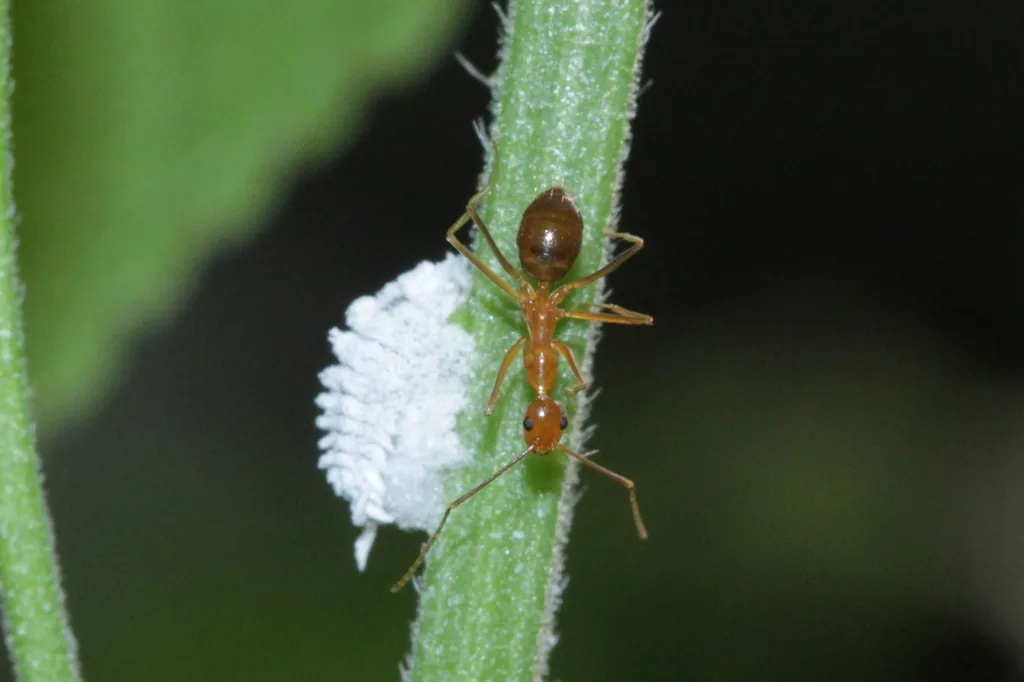
- Workers are large for an ant, about 5 mm, slender and yellowish to orange, with long legs, large eyes and very long antennae whose first segment is about twice as long as the head.[1][2]
- They run very fast in haphazard, changing directions with no obvious destination, which gives crazy ants their name.[2]
- They have a single waist segment, which separates them from long-legged Pheidole ants with a two-segmented waist.[1]
Look-alikes
| Look-alike | How to tell them apart |
|---|---|
| Carpenter ants | Also large, slim and fast, but usually seen in low to moderate numbers, often with striped gasters and in a range of worker sizes; yellow crazy ant workers are all one size with an unpatterned gaster.[2] |
| Longhorn crazy ant | Another fast crazy ant, but small (about 2.5 mm) and dark, with antennae only about one and a half times the head length.[1] |
Where it lives
Widespread across the tropics and especially dense in the Pacific, including Wake Atoll. In Hawaii it arrived in the 1940s, was found on Hawaii Island in 1954 and on Maui in 1973, and has since reached Molokai, Lanai and Kauai; it has not been reported on Kahoolawe.[1][2][3]
Biology and life cycle
Populations can explode to very high densities; on Christmas Island the ant caused what researchers call an ecological meltdown. MISC says explosions are typically followed by crashes within about a year.[1][2]
On Maui it's common throughout the lowlands and favors rocky places such as streambanks, rocky beaches, rock walls and broken concrete.[2]
Damage and signs
- Yellow crazy ants prey aggressively on native insects and other arthropods and are thought to have helped decimate native stream-side insects such as Hawaii's endemic damselflies.[2]
- They promote outbreaks of aphids, scale insects, mealybugs and related sap-sucking pests that often damage crops.[2]
- At times they are a significant nuisance in yards and sometimes inside homes.[2]
- USGS calls it especially harmful to ecosystems on Wake Atoll, including the federally protected seabirds that nest there, and found it on all three of the atoll's islands.[3]
Health risk
We found no CDC, MedlinePlus, state health department or peer-reviewed source on how yellow crazy ants affect people, so this page makes no health claim; the Maui Invasive Species Committee describes them as a nuisance in yards and sometimes inside homes.[2]
Control
Prevention
Strong quarantine measures are encouraged to keep the ant from reaching new places, because established populations are difficult to control.[1][2]
Pesticides
MISC says over-the-counter ant baits give inconsistent results against it; see where the sources disagree on what control can achieve.[2]
Where the sources disagree
What control can achieve: MISC says control is difficult and, since explosions usually crash within about a year, waiting them out can be an option; USGS says eradication from Wake Atoll looks technically feasible, based on methods developed on Johnston Atoll and elsewhere.[2][3]
Common questions
- What are the big, fast orange ants running all over my yard in Hawaii?
- Large, slender, yellowish to orange ants running fast and erratically in large numbers are likely yellow crazy ants, common in Hawaii's lowlands.[2][1]
- How do I tell yellow crazy ants from carpenter ants?
- Yellow crazy ants show up in large numbers, are all one size and usually have plain gasters; carpenter ants come in a range of sizes, often have striped gasters and are seen in smaller numbers.[2]
Sources
- USDA APHIS Identification Technology Program (idtools.org), “Anoplolepis gracilipes (PIAkey: Pacific Invasive Ant Key fact sheet).” www.idtools.org/id/ants/pia/Fact_Sheets/Anoplolepis_gracilipes.html (accessed 2026-11-13)
- Maui Invasive Species Committee, “Yellow Crazy Ant, Anoplolepis gracilipes (pest page).” mauiinvasive.org/pests/yellow-crazy-ant/ (accessed 2026-11-13)
- U.S. Geological Survey, Pacific Island Ecosystems Research Center, “Distribution of yellow crazy ants (Anoplolepis gracilipes) and notes on other ant species at Wake Atoll, 6-21 October, 2023 (HCSU-111; Plentovich, Peck, Sachs, 2024).” www.usgs.gov/publications/distribution-yellow-crazy-ants-anoplolepis-gracilipes-and-notes-other-ant-species-wake (accessed 2026-11-13)
- Global Biodiversity Information Facility (GBIF), “Anoplolepis gracilipes (Smith, 1857) (GBIF Backbone Taxonomy).” api.gbif.org/v1/species/1317433 (accessed 2026-11-13)
- iNaturalist, “Anoplolepis gracilipes taxon page (order and family).” www.inaturalist.org/taxa/123386 (accessed 2026-10-06)