On this page
How to identify it
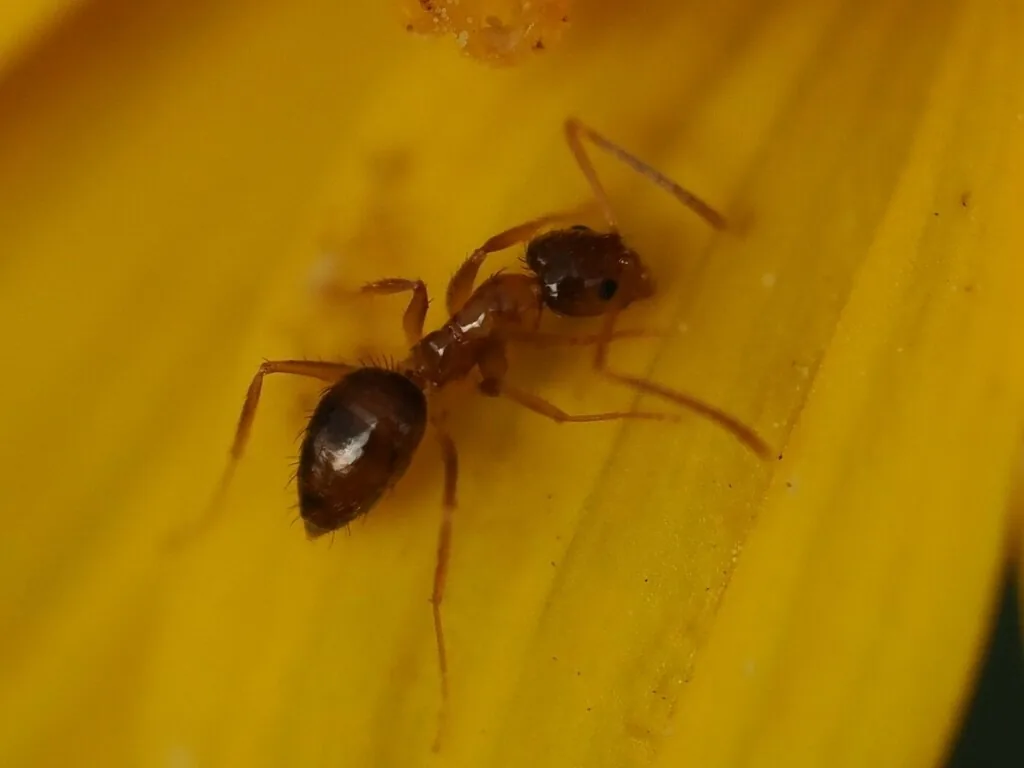
- Workers are all about the same size, about 1/8 inch long, and reddish brown. Up close they are very hairy, with long, coarse hairs and long legs and antennae. UF/IFAS gives workers as 2.0 to 2.4 mm long, males slightly larger (2.4 to 2.7 mm) and queens 4.0 mm or more, and describes the body as golden brown to reddish brown, smooth and glossy under dense hairs.[2][4][10][9]
- They run fast and erratically instead of following neat trails, which is where the name crazy ant comes from.[2][4]
- There is no stinger. In its place the tip of the abdomen has a small circle of hairs (the acidopore).[2][1]
- The sheer number is the best field clue: infested areas can hold hundreds of thousands to millions of uniformly sized ants. Confirming the species takes winged males under a microscope.[2][4][1]
- After feeding, the rear of the abdomen looks striped because the pale membranes between segments stretch. Antennae have 12 segments with no club, and workers lack the three small simple eyes (ocelli) that winged males and queens have on top of the head.[9][10]
Look-alikes
| Look-alike | How to tell them apart |
|---|---|
| Longhorn crazy ant (Paratrechina longicornis) | The longhorn crazy ant has much longer legs and antennae and a longer thorax, and it is often jet black rather than reddish brown.[2] |
| Caribbean crazy ant (Nylanderia pubens) | Workers of the two species lack distinctive differences and are often confused; only the males can be told apart. To add to the confusion, 'Caribbean crazy ant' and 'hairy crazy ant' have both been used as names for the tawny crazy ant itself. UF/IFAS says males are separated by the paramere, part of the male genitalia, which is sparsely haired and uneven in the tawny crazy ant but has a dense fringe of bristles in N. pubens.[1][2][4][9][10] |
| Fire ant | Tawny crazy ants build no mounds or beds and have no central nest openings; they nest under rocks, fallen limbs, leaf litter and firewood. In heavily infested parts of Texas they are even displacing red imported fire ants.[2][4] |
| Guatemalan crazy ant (Nylanderia guatemalensis) | UF/IFAS says it is notably smaller, with pale middle and hind coxae and shorter, stouter, darker hairs. In Florida it is common in Dade, Broward and Monroe counties and less common north to Hillsborough and Indian River counties.[9] |
| False honey ant (Prenolepis imparis) | It has a strongly pinched, hourglass-shaped thorax. UF/IFAS says it is found in north Florida, south into Orange County.[9] |
Where it lives
Established in Texas, Louisiana, Mississippi, Alabama, Florida and Georgia. In Mississippi it was found in Hancock County in 2009, spread to Harrison, Jackson and Pearl River counties, and in 2026 reached Wilkinson, Marion and Perry counties. It tolerates cold less well than the fire ant, so it is expected to stay further south. UF/IFAS's Featured Creatures article reports it from 27 counties in Florida and 27 in Texas, with a 2014 Florida map, and its fact sheet says it can be expected in any Florida county.[1][4][2][9][10]
Biology and life cycle
Nests have several queens and mix freely with each other. Genetic work found no aggression even between nests hundreds of kilometers apart, and concluded that the whole U.S. population forms a single supercolony spreading more than 2000 km. Sources disagree on queen numbers per nest: a 2016 review gives typically 0 to 5, while the 2018 genetic study found several, up to hundreds.[3][1][2]
No mating flights have been seen in the field. Colonies spread by budding at their edges at about 20 to 30 m per month in Texas neighborhoods, and much faster when people move infested yard debris, potted plants, compost, garbage or hay bales.[2][1]
They nest under or in almost anything that holds moisture: soil, leaf litter, rocks, stumps, fallen limbs, firewood and potted plants. Permanent nests may cover up to about one square meter, with brood kept as deep as 40 cm.[2][4][1]
They eat almost anything. Workers tend aphids, scale insects, whiteflies and mealybugs for honeydew and prey on insects and other small animals. UF/IFAS adds that they move aphids and scale insects from infested to uninfested plants, build carton shelters over scales on magnolia and aphids on southern red cedar, and are drawn to nectaries and overripe fruit. Given a choice they eat more food with a 1:2 protein-to-carbohydrate ratio.[2][1][9][10]
Few workers forage in winter. Numbers build from spring, climb sharply by July and August and stay high through October and November.[2]
UF/IFAS says new nests form by budding, when one or more queens leave to start a separate nest. Colonies keep permanent nests in protected spots such as rich leaf litter under trees, plus temporary nests under debris and in soil crevices when conditions favor growth; the temporary nests are thought to be used as the ants invade new areas.[10]
Populations can boom and then suddenly disappear; UF/IFAS describes this boom-or-bust pattern in South Florida and the West Indies. Infestations can cover golf courses or whole neighborhoods, and nesting areas are often hundreds of meters from where the ants forage.[9]
Damage and signs
- Masses of ants collect in electrical equipment, causing short circuits and clogging switches.[2][4][1]
- Huge numbers make yards hard to use, push into homes when outdoor populations are high, and can drive nesting songbirds and other wildlife out of an area.[2][4]
- By tending sap-feeding insects they can make those pests worse. In Colombia they were linked to grasslands drying out, and in the Caribbean and South America to higher losses in coconut and coffee.[2][1]
- UF/IFAS reports that it has killed honey bee larvae and used the hives as nests, damaged phone lines, air conditioning units and computers, and cut native ant abundance by 74% in a nature reserve in Colombia. In Texas it is displacing red imported fire ants where the two overlap.[9]
Health risk
Tawny crazy ants do not sting, and a 2016 scientific review says they pose no medical threat to people. In Colombia, huge infestations reportedly killed small livestock such as chickens by asphyxia.[1][2]
Control
Prevention
These ants favor wet conditions, so cut back irrigation, fix leaks and improve drainage. Inspect anything moved out of an infested area so you don't carry a colony to a new place.[2]
Keep them out
Seal potential entry points into the home as part of the plan. UF/IFAS says to cut back landscape plants so no branches touch the house and to seal all cracks and crevices around it.[1][10]
Sanitation
Remove fallen limbs, rocks, leaf litter and anything else sitting on the ground that you don't need, and manage food sources such as honeydew-producing insects on landscape plants. UF/IFAS adds: empty trash cans regularly, store them away from the house, and don't move infested plants, mulch or pots to uninfested areas.[2][1][10][9]
Pesticides
Most ant baits don't attract tawny crazy ants. An abamectin carpenter ant bait cut populations by more than half, but that was not enough and did not last. Contact sprays only make temporary buffer zones that are often breached within 2 to 3 months, and piles of dead ants must be swept away so treated surfaces keep working. UF/IFAS says methoprene granular bait, an insect growth regulator, can reduce foraging numbers, while products containing fipronil, chlorfenapyr, abamectin, acetamiprid or bifenthrin usually bring only temporary declines before the population resurges; no single method is enough, so an integrated plan is needed. Follow the label.[2][1][10]
Research is improving the bait options. In lab tests, baits with hydramethylnon or fipronil gave the highest kill, and the ants accepted sugar-based baits better. In a USDA field study, liquid baits with dinotefuran or disodium octaborate tetrahydrate shrank nests over 2 months.[5][6]
When to call a professional
Indoor treatment doesn't work because the nests are outdoors. A professional needs access to the whole infestation, or ants rebound from untreated areas within a month. Mississippi State says homeowners are unlikely to manage large populations alone, success means keeping ants out of the house rather than eliminating them, and follow-up treatments are often needed.[2][4]
UF/IFAS calls it an areawide problem: knocking ants down on one lot doesn't stop them reinvading from neighbors, so control works better as a community effort over large areas at the same time. Treatments work better early in spring, before ants spread out from overwintering sites and reach extreme numbers.[10]
Where it came from and when it arrived
The ant is native to South America (Brazil and Argentina). The Houston population was long unidentified until a 2012 study used body measurements, DNA and comparison with type specimens to name it Nylanderia fulva, and showed it had most likely invaded all of the Gulf Coast states. UF/IFAS says it was introduced from Brazil into Colombia in the 1930s and 1940s as a biological control agent against leaf-cutting ants and poisonous snakes, and that the large Florida infestations of the 1990s were first identified as the Caribbean crazy ant.[1][7][10]
Sources tell its U.S. history differently. Texas A&M and the 2016 review describe it as found near Houston in 2002. Mississippi State's ant taxonomist cites museum records going back to Illinois in 1931 and Florida and Texas in the late 1930s, with populations going largely unnoticed until they exploded in the early 2000s.[2][1][4]
Where the sources disagree
Worker size: Texas A&M and Mississippi State describe workers about 1/8 inch long; UF/IFAS gives 2.0 to 2.4 mm.[2][4][10]
Common questions
- Why don't regular ant baits kill tawny crazy ants?
- Tawny crazy ant workers aren't attracted to most bait products, and many baits that work against fire ants don't attract them. Even the best-accepted baits haven't given enough control on their own.[2][1]
- Is the tawny crazy ant the same as the Rasberry crazy ant?
- Yes. The Texas population was first called the Rasberry crazy ant after the pest management professional who found huge numbers of them; it was later identified as Nylanderia fulva and given the common name tawny crazy ant.[2][4][7]
- Why do crazy ants get into electrical boxes?
- Their foraging and nesting take them into electrical equipment, where masses of ants cause short circuits and clog switches.[1][2][4]
- Can I get rid of tawny crazy ants on just my property?
- Usually not for long. UF/IFAS says ants reinvade from neighboring lots, so control works better when a whole community treats large areas at the same time, combined with removing debris and sealing the house.[10]
Sources
- Insects, via PubMed Central, “A Review of the Tawny Crazy Ant, Nylanderia fulva, an Emergent Ant Invader in the Southern United States (Wang et al. 2016).” pmc.ncbi.nlm.nih.gov/articles/PMC5198225/ (accessed 2026-11-11)
- Texas A&M Center for Urban and Structural Entomology, “Tawny Crazy Ant (formerly Rasberry crazy ant).” urbanentomology.tamu.edu/urban-pests/ants/rasberry/ (accessed 2026-11-11)
- BMC Evolutionary Biology, via PubMed, “Supercolonial structure of invasive populations of the tawny crazy ant Nylanderia fulva in the US (Eyer et al. 2018).” pubmed.ncbi.nlm.nih.gov/30594137/ (accessed 2026-11-11)
- Mississippi State University Extension, “Tawny crazy ants spread to 7 Mississippi counties (October 2026).” extension.msstate.edu/news/feature-story/2026/tawny-crazy-ants-spread-7-mississippi-counties (accessed 2026-11-11)
- Insects, via PubMed, “Insecticides for Suppression of Nylanderia fulva (Calibeo, Oi, Oi and Mannion 2017).” pubmed.ncbi.nlm.nih.gov/28858251/ (accessed 2026-11-11)
- Journal of Economic Entomology, via PubMed, “Effect of fast and slow-acting bait toxicants on tawny crazy ant foraging and nesting in the field (Oi, Atchison and Read 2025, USDA ARS).” pubmed.ncbi.nlm.nih.gov/39707746/ (accessed 2026-11-11)
- PLoS One, via PubMed, “The importance of using multiple approaches for identifying emerging invasive species: the case of the Rasberry Crazy Ant in the United States (Gotzek et al. 2012).” pubmed.ncbi.nlm.nih.gov/23056657/ (accessed 2026-11-11)
- iNaturalist, “Nylanderia fulva taxon page (order and family).” www.inaturalist.org/taxa/69402 (accessed 2026-10-06)
- University of Florida IFAS Extension, EDIS (Featured Creatures), “Tawny Crazy Ant, Nylanderia fulva (Mayr), EENY610/IN1071 (Featured Creatures).” ask.ifas.ufl.edu/publication/IN1071 (accessed 2026-11-14)
- University of Florida IFAS Extension, EDIS, “Tawny Crazy Ant, SP486D/IN1076.” ask.ifas.ufl.edu/publication/IN1076 (accessed 2026-11-14)