On this page
How to identify it
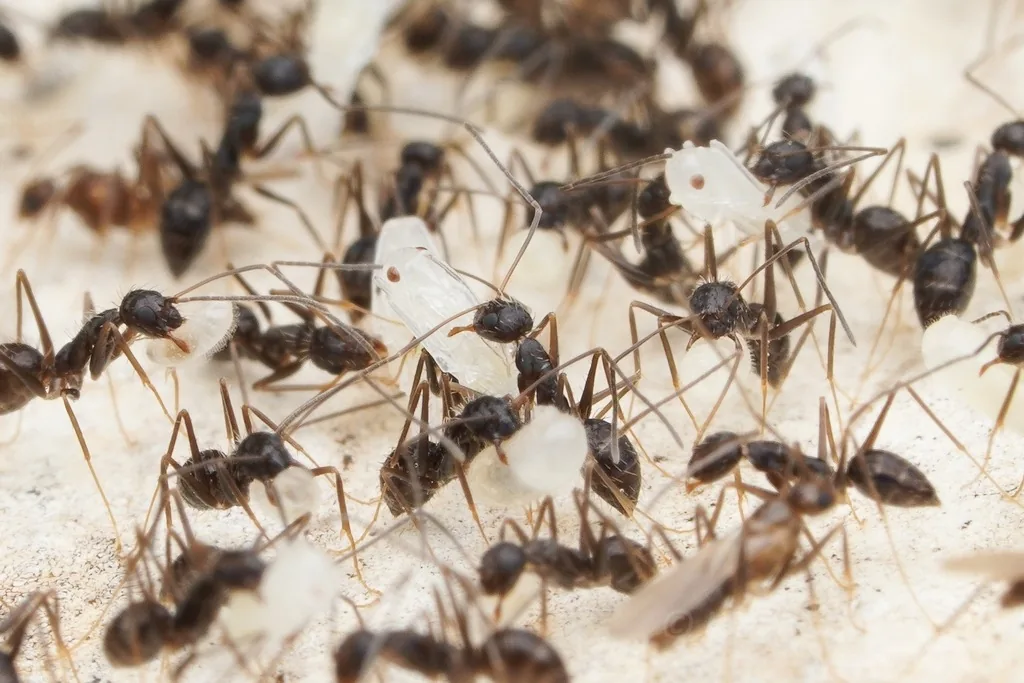
- Workers are all one size, about 1/8 inch long, and grayish black; Texas A&M says they are often jet black, but cautions that color is not a reliable ID feature. UF/IFAS gives workers as 2.3 to 3 mm (about 1/16 to 1/8 inch), dark brown to blackish, often with a faint bluish iridescence.[1][4][3]
- Legs and antennae are very long, and the thorax is noticeably elongated. UF/IFAS says the first antennal segment is so long that its tip passes the back of the head by at least half its length.[1][4][3]
- The body carries many long, coarse hairs. UF/IFAS describes them as scattered grayish or whitish hairs, easy to see with a hand lens.[1][3]
- Under magnification: 12-segmented antennae with no club, and a small circle of hairs at the tip of the abdomen. UF/IFAS adds a single node in the waist and no stinger; the ring of hairs surrounds an opening the ant uses to apply a formic acid secretion in defense and when catching prey.[1][3]
- The quickest field clue is movement: fast, with wide swings off the trail instead of a neat line.[2]
Look-alikes
| Look-alike | How to tell them apart |
|---|---|
| Tawny crazy ant | Usually reddish brown, with shorter legs, antennae and thorax. The longhorn crazy ant is often jet black, though color alone is unreliable.[4] |
Where it lives
An introduced ant spread around the world by commerce. In the U.S. it is established from South Carolina to Florida and west to Texas, where it is common in towns and cities, and it commonly occurs in California; farther inland and north it turns up sporadically and survives only indoors. UF/IFAS adds populations reported from Hawaii, Missouri, Virginia, New York and Massachusetts and from Quebec and Ontario, says it has been found as far north as Sweden and Estonia and as far south as New Zealand, and notes one ant researcher's view that it is the most broadly distributed of any ant species.[1][3]
Biology and life cycle
Colonies are small to moderate, with up to about 2,000 workers and as many as 40 queens. Mating flights have not been observed, and new colonies may form by budding.[1]
Its reproduction is unusual: queens and males are both produced as clones, forming two separate lineages, while workers are hybrids of the two. A worldwide genetic study found this double-clonal system in native and introduced populations alike and suggests it helped the ant spread.[5]
Outdoors they nest in rotten wood, fallen limbs, logs and stumps, trash, under stones, bricks and lumber, in potted-plant soil and around plant roots in mulched beds, where queens and brood hide in curled leaves. UF/IFAS adds that nests are often some distance from where the workers forage.[1][3]
Indoors they nest in wall voids and under floors, especially near hot-water pipes and heaters.[1]
Colonies are highly mobile, move when conditions turn bad, and tolerate both very dry and fairly moist sites, though they favor humid, wet conditions.[1]
They tend honeydew-producing insects. In one study, an invasive mealybug benefited from being tended by longhorn crazy ants.[1][6]
In warm regions colonies can raise winged queens and males at any time of year; in north Florida that is apparently limited to the warm, rainy months of May through September. On warm, humid evenings crowds of males gather at nest entrances, and males often turn up at lights, though they have never been seen flying.[3]
Workers are omnivores, eating live and dead insects, seeds, honeydew, fruit, plant juices and many household foods, and they carry large prey as a group. UF/IFAS says they seem to favor protein seasonally and in summer may refuse honey or sugar baits.[3]
Damage and signs
- Indoors they nest in wall voids and under floors, and in some cases they build up massive but localized numbers.[1][4]
- By tending mealybugs and other honeydew producers, they can help those plant pests. UF/IFAS adds that workers carry off small seeds, such as lettuce and tobacco, from seedbeds.[1][6][3]
- UF/IFAS records it on the top floors of New York apartment buildings, in Boston hotels and apartments and in San Francisco hotel kitchens; in 1977 it so overran temporary classrooms at a North Lauderdale, Florida, elementary school that table legs were set in pans of water to keep it off lunches.[3]
Health risk
None of the sources here reports stings or health problems from this ant.[1][4]
Control
Prevention
They favor humid, wet conditions, so cut back irrigation, fix leaks and improve drainage around the home.[1]
Inspect potted plants and anything else moved from an infested area so you don't carry the ants to a new site.[1]
Keep them out
Caulk openings in exterior walls and add weather-stripping to keep foragers out.[1]
Sanitation
Clear harborage near the house, such as fallen limbs, rocks, leaf litter and anything else sitting on the ground that doesn't need to be there, and manage aphids and other honeydew producers that feed them.[1]
Pesticides
Texas A&M reports granular baits with abamectin or hydramethylnon are attractive and effective; broadcast a granular bait through the infested area and place liquid sugar baits where ant traffic is heavy.[1]
Find nests by following workers carrying food home. UF/IFAS lists baits, dusts and spot treatments with residual sprays indoors, and baits, granules, dusts and sprays outdoors; read and follow the label.[3]
When to call a professional
Texas A&M recommends a perimeter barrier spray (naming fipronil), indoor crack-and-crevice treatment (naming chlorfenapyr), and treating as many nests as can be found with a labeled product. Professionals need access to the whole infestation, or ants rebound from untreated areas.[1]
Where sources disagree
Origin: Texas A&M calls it an introduced species thought to be of African or Oriental origin. A 2023 worldwide genetic study found the Indian subcontinent to be a hotspot of its genetic diversity and suggests it probably originates there. UF/IFAS notes it was long thought to be Asian or African and cites a 2008 review pointing to Southeast Asia or Melanesia.[1][5][3]
Colony size: Texas A&M calls colonies small to moderate, with as many as 2,000 workers, while UF/IFAS calls them moderate to very populous.[1][3]
Common questions
- Why are they called crazy ants?
- Because of how they move: in lab measurements longhorn crazy ants ran about three times faster than fire ants and, along with tawny crazy ants, swung farther off marked trails than the other pest ants tested.[2]
- What ant baits work on longhorn crazy ants?
- Texas A&M reports granular baits with abamectin or hydramethylnon are attractive and effective, along with liquid sugar baits set where traffic is heavy. Baits work best when they reach the whole infestation. UF/IFAS notes they may refuse honey or sugar baits in summer, when they seem to favor protein.[1][3]
- How is it different from the tawny crazy ant?
- The longhorn crazy ant has much longer legs, antennae and thorax and is often jet black; the tawny crazy ant is usually reddish brown.[4]
- Do longhorn crazy ants sting?
- No. UF/IFAS says they have no stinger.[3]
Sources
- Texas A&M Center for Urban and Structural Entomology, “Crazy Ant.” urbanentomology.tamu.edu/urban-pests/ants/crazy/ (accessed 2026-11-14)
- Insects, via PubMed, “Comparative quantification of trail-following behavior in pest ants (Vázquez et al. 2019).” pubmed.ncbi.nlm.nih.gov/31861668/ (accessed 2026-11-14)
- University of Florida/IFAS Extension (Featured Creatures), “Crazy Ant, Paratrechina longicornis (Latreille), EENY-142/IN299.” ask.ifas.ufl.edu/publication/IN299 (accessed 2026-11-14). Its defensive-bite line is not used (medical-source rule).
- Texas A&M Center for Urban and Structural Entomology, “Tawny Crazy Ant (formerly Rasberry crazy ant).” urbanentomology.tamu.edu/urban-pests/ants/rasberry/ (accessed 2026-11-14)
- Molecular Ecology, via PubMed, “Genetic analysis reveals the putative native range and widespread double-clonal reproduction in the invasive longhorn crazy ant (Tseng et al. 2023).” pubmed.ncbi.nlm.nih.gov/36527320/ (accessed 2026-11-14)
- Insects, via PubMed, “Interference competition for mutualism between ant species mediates ant-mealybug associations (Liu et al. 2020).” pubmed.ncbi.nlm.nih.gov/32024041/ (accessed 2026-11-14)
- iNaturalist, “Paratrechina longicornis taxon page (order and family).” www.inaturalist.org/taxa/69388 (accessed 2026-11-14)