The short answer
- What it is: the ant grips your skin with its jaws and stings, and a single fire ant can sting again and again. Burning pain comes first; a red bump follows, and a small white pustule usually appears a day or two later.[1][7][13]
- First aid: get the ants off fast, wash the area with soap and water, and use a cold compress or wrapped ice for pain and swelling. An over-the-counter antihistamine or anti-itch cream may help; follow the package directions.[1][2][4][5]
- Leave the pustules alone. Western Australia's health department says broken blisters or pustules can become infected. Over the next several days watch for increasing redness, swelling or pain, and see a doctor if a sting looks infected or pain does not go away.[4][2][5]
- Call 911 for trouble breathing, wheezing, swelling of the face, mouth or throat, chest pain, faintness or slurred speech after stings. Those are signs of a severe allergic reaction; see the insect sting allergy and anaphylaxis guide.[1][2][4]
- Highest-risk people: young children, and anyone who cannot move away or call for help. Peer-reviewed reports describe fire ants attacking bedridden or cognitively impaired residents inside nursing homes, some of whom died.[4][10][9]
Fire ants that sting people
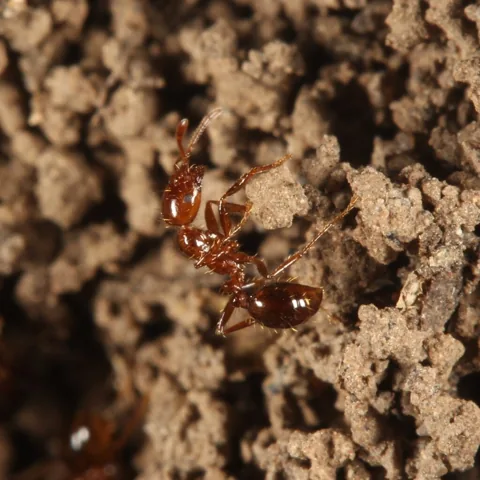 Red Imported Fire Ant
Solenopsis invicta
The red imported fire ant is an aggressive stinging ant that infests most of the southern United States and parts of California, building mounds in open, sunny areas such as lawns, parks and roadsides. USDA APHIS says imported fire ants came from South America, probably in soil on cargo ships, and now infest more than 367 million acres in Alabama, Arkansas, California, Florida, Georgia, Louisiana, Mississippi, North Carolina, Oklahoma, South Carolina, Tennessee, Texas, Virginia and Puerto Rico.
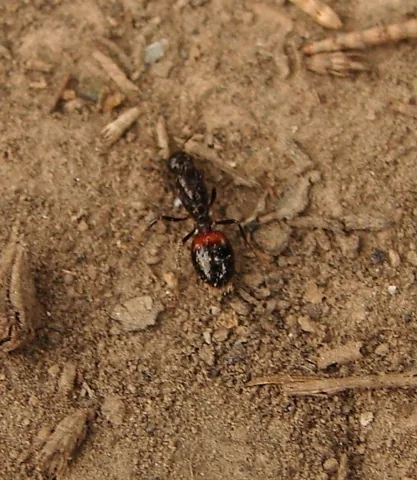 Black Imported Fire Ant
Solenopsis richteri
The black imported fire ant is a South American fire ant that reached Mobile, Alabama, decades before the red imported fire ant. Its range stays limited to northeastern Mississippi, northwestern Alabama and southern Tennessee.
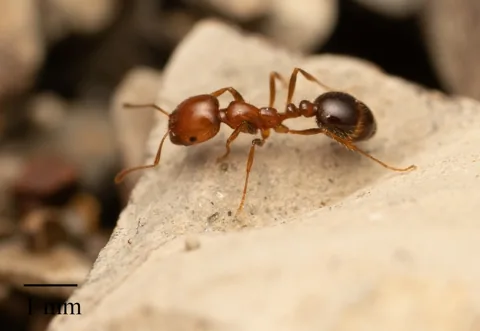 Southern Fire Ant
Solenopsis xyloni
The southern fire ant is a native fire ant of the Southwest. It nests in bare, sunny soil, swarms out to bite and sting when its nest is disturbed, and often wanders indoors for food in warm months.
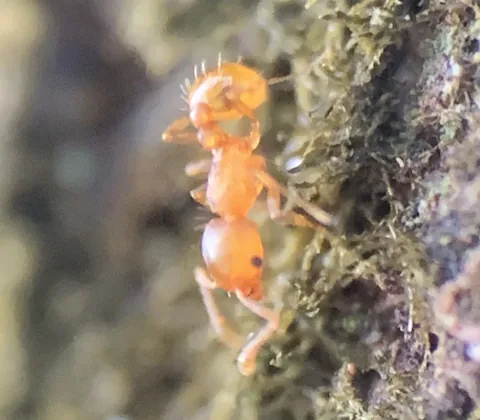 Little Fire Ant
Wasmannia auropunctata (listed on iNaturalist as Allomerus auropunctatus)
The little fire ant is an invasive ant from the American tropics whose sting, the Hawaii Department of Agriculture (HDOA) notes, is out of proportion to its tiny size. It was first found in Hawaii in 1999 and has spread there in plants, logs and green waste.
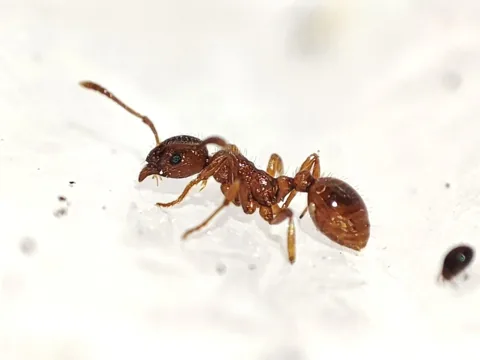 European Fire Ant (European Red Ant)
Myrmica rubra
The European fire ant, also called the European red ant, is a very small red ant that aggressively defends its territory and readily stings people, pets and livestock. It is only distantly related to the true fire ants of the southern United States.
What a fire ant sting is
Fire ants bite and sting. MedlinePlus notes that fire ant bites usually hurt rather than itch, and NIOSH says the stings inject venom that causes a burning sensation. The Merck Veterinary Manual describes the sequence: the ant latches on with its mandibles, stings with a stinger that is not barbed, and pivots in a circle, stinging again until its venom is used up.[3][1][13]
Because the stinger is not barbed, there is nothing to pull out. UC IPM says a single red imported fire ant can bite and sting repeatedly, and that the ants quickly climb onto and sting anything touching their mound or food source.[7][13]
They attack in numbers. USDA APHIS says hundreds of fire ants may swarm and run up vertical surfaces to sting when a nest is disturbed, and Western Australia's health department says fire ants usually sting all at once.[6][4]
The venom is mostly alkaloids called solenopsins. The Merck Veterinary Manual says these have cell-damaging effects, which is why a sting site behaves differently from a bee or wasp sting.[13]
The normal reaction: burning, a bump, then a white pustule
Pain first. Western Australia's health department describes severe burning or fiery pain, swelling, redness and blistering, with the burning or itching lasting up to an hour.[4]
Then the pustule. NIOSH says red bumps at the sting sites can develop into white, fluid-filled pustules within a day or two; Western Australia's health department says they can appear within a couple of hours or up to a day or two later. A 2024 review of the medical literature says the most frequent reaction is a sterile 1-2 mm pseudo pustule, meaning it is not caused by germs.[1][4][12]
Healing takes time. Western Australia's health department says fire ant stings can take up to 10 days to heal.[4]
Some people get a large local reaction, with swelling well beyond the sting sites. The 2024 review lists large local reactions as the next most common outcome after the pustule. Big swelling on its own is not anaphylaxis; the allergy guide explains how to tell the difference.[12]
Don't pop the pustules: infection signs
Leave pustules and blisters intact. Western Australia's health department says that if the blisters or pustules break, there is a risk they can get infected. A peer-reviewed review of imported fire ant stings lists secondary infections among the medical consequences.[4][11]
Keep the area clean: wash it carefully with soap and water. NIOSH also advises against scratching, which it says may increase swelling, itching and the risk of infection.[4][2][1]
Signs of infection: MedlinePlus and Washington State's health department say to watch over the next several days for increasing redness, swelling or pain.[2][5]
See a doctor if pain persists or a sting looks infected. Western Australia's health department says infected stings may need antibiotics, which only a clinician can decide.[4]
First aid for fire ant stings
Get the ants off and move away from the mound. Sources differ on how: NIOSH says to rub the ants off briskly because they hold on with their jaws, while Western Australia's health department says to pick them off by hand, warning that brushing makes them more aggressive and that ants sprayed with water may latch on.[1][4]
Wash the sting sites with soap and water.[2][4][5]
Cool it. MedlinePlus says to place ice wrapped in a washcloth on the sting for 10 minutes, then off for 10 minutes, and repeat. Western Australia's health department recommends a cold compress for swelling and pain.[2][4]
For itching, NIOSH, MedlinePlus and Washington State's health department say an over-the-counter antihistamine or anti-itch cream may help. NIOSH notes these can cause drowsiness; follow the package directions.[1][2][5]
Watch the person for an allergic reaction afterward. NIOSH says to have someone stay with a person who has been stung.[1]
Normal reaction vs. allergic reaction
A painful bump and a pustule at each sting are the normal reaction. An allergic reaction involves the whole body. Western Australia's health department lists rapid flushing, hives all over, swelling of the face, eyes or throat, chest pain, nausea, severe sweating, breathing difficulty and faintness.[4][12]
NIOSH says to get a stung worker to an emergency medical facility immediately for severe chest pain, nausea, severe sweating, loss of breath, serious swelling or slurred speech. MedlinePlus says to call 911 for trouble breathing, swelling of the face or mouth, throat tightness, weakness or turning blue.[1][2]
Fire ant stings can cause anaphylaxis. Western Australia's health department says this is rare but can be fatal, and a peer-reviewed review lists hypersensitivity reactions among fire ant sting consequences. Emergency steps, epinephrine and allergy testing are covered in the insect sting allergy and anaphylaxis guide, not repeated here.[4][11][12]
Anyone who has had a severe reaction to stings should carry their emergency medicine and wear a medical ID, according to NIOSH and Washington State's health department.[1][5]
Babies, older adults and bedridden people
Young children are stung more often. Western Australia's health department says young children and pets are more likely to be stung because they are less aware of fire ant nests. Check play areas and keep toddlers off mounds.[4]
Fire ants can attack people indoors. A 1999 report in the Annals of Internal Medicine counted 10 reported indoor fire ant attacks on people since 1989, including two Mississippi nursing home residents who died after the stings; six of the 10 people had pre-existing neurologic impairment.[9]
A 2004 review in the American Journal of Medicine found that the presence of fire ants around immobile, often cognitively impaired patients seems to be the main risk factor for massive attacks. Ants were usually noticed in the facility days before the attacks. One patient had anaphylaxis and four died within a week.[10]
What that means at home: if you care for someone who is bedridden or cannot move away or call for help, treat fire ants indoors as urgent. The 1999 authors wrote that ants inside an occupied building mean an active colony is close by, and that efforts to eradicate them should start immediately, especially when immobile people are present.[9][10]
Dogs, cats and fire ant stings
The Merck Veterinary Manual says animals that are badly hurt are usually those that could not move away from the colony and received many stings.[13]
Merck says the first sign is a wheal and flare reaction that typically resolves within an hour. The pustule people get rarely develops in dogs; a red, itchy bump is more common and usually resolves within 24 hours. Dead fire ants may be found still attached to the skin and coat.[13]
Merck says anaphylaxis from fire ant stings is not reported in companion animals, and that in most cases ant envenomation resolves with no treatment. Animals with many stings and a more severe reaction may need supportive care from a veterinarian.[13]
Pets can also carry fire ants indoors on their fur, Western Australia's health department notes, so check a dog that has been near a mound before it comes inside.[4]
Where fire ants sting people in the US
Red and black imported fire ants are South American species introduced into the US in the early 20th century, according to the Merck Veterinary Manual. USDA APHIS says imported fire ants infest more than 367 million acres in Alabama, Arkansas, California, Florida, Georgia, Louisiana, Mississippi, North Carolina, Oklahoma, South Carolina, Tennessee, Texas, Virginia and Puerto Rico, and runs quarantines on moving soil, hay and plants out of infested areas.[13][6]
Sources describe the edges differently. NIOSH says fire ants are mostly found in the Southeastern US, with limited distribution in New Mexico, Arizona and California. A 1999 peer-reviewed report noted colonies found in Arizona, California, New Mexico and Virginia, while APHIS's current list includes California and Virginia but not Arizona or New Mexico.[1][9][6]
Other fire ants sting too. Washington State's health department says European fire ants, first identified in Maine in 1908, now occur in the Seattle area, and their stings can leave a welt or a fluid-filled pustule within a day or two. Hawaii's Invasive Species Council says little fire ants often fall on people from trees and sting the neck, arms and torso, leaving welts that can last for weeks.[5][8]
Avoiding stings around mounds
Look before you stand, sit or work. NIOSH says not to disturb or stand on or near ant mounds, and to look over an area before starting work because fire ants may be on trees or in water.[1]
Know the mound. USDA APHIS says mounds are hard and can get quite large, up to 18-24 inches high. UC IPM says undisturbed mounds are often dome-shaped, but mowed mounds in irrigated turf can look flat, like gopher mounds, and some colonies nest under sidewalks, in walls, logs and utility boxes with no mound at all.[6][7]
Be careful lifting things off the ground. NIOSH says items lying on the ground may be covered in ants.[1]
Dress for it. Western Australia's health department advises gloves for gardening and thick socks and boots when working or walking outdoors, and watching for nests when you mow.[4]
To get rid of the colonies themselves, UC IPM recommends fire ant baits, which foraging ants carry back to the nest; the yard guide linked below walks through it.[7]
Common questions
- Why do fire ant stings turn into white bumps?
- NIOSH says the red bumps at sting sites can develop into white, fluid-filled pustules within a day or two. A 2024 medical review says this is the most frequent reaction and that the pustule is sterile, so it is not a sign of infection by itself.[1][12]
- Should I pop a fire ant pustule?
- No. Western Australia's health department says broken blisters or pustules can become infected. Keep the area clean and watch for increasing redness, swelling or pain.[4][2]
- Do fire ants bite or sting?
- Both. NIOSH says fire ants bite and sting; the Merck Veterinary Manual says the ant grips with its jaws and stings repeatedly while pivoting.[1][13]
- How long do fire ant stings last?
- The burning or itching can last up to an hour, and the stings can take up to 10 days to heal, according to Western Australia's health department.[4]
- When is a fire ant sting an emergency?
- Call 911 for trouble breathing, swelling of the face, mouth or throat, chest pain, faintness or slurred speech. NIOSH and MedlinePlus list these as signs that need emergency care.[1][2]
- Can fire ants hurt someone who is bedridden?
- Yes. Peer-reviewed reports describe fire ants attacking immobile, often cognitively impaired residents inside nursing homes, and some of those residents died. Ants indoors near someone who cannot move away need prompt action.[9][10]
- Is my dog in danger from fire ant stings?
- Usually not seriously. The Merck Veterinary Manual says most cases resolve without treatment and anaphylaxis from fire ant stings is not reported in companion animals, but animals that cannot get away and take many stings can be badly affected and may need a veterinarian.[13]
- Which states have imported fire ants?
- USDA APHIS lists Alabama, Arkansas, California, Florida, Georgia, Louisiana, Mississippi, North Carolina, Oklahoma, South Carolina, Tennessee, Texas, Virginia and Puerto Rico. NIOSH adds limited distribution in New Mexico and Arizona.[6][1]
Photo credits
- Red Imported Fire Ant: (c) Natasha Taylor, some rights reserved (CC BY) — via iNaturalist, CC BY 4.0
- Black Imported Fire Ant: (c) Nicolas Olejnik, some rights reserved (CC BY) — via iNaturalist, CC BY 4.0
- Southern Fire Ant: Jesse Rorabaugh, public domain (CC0), via iNaturalist
- Little Fire Ant: natalie, public domain (CC0), via iNaturalist
- European Fire Ant (European Red Ant): (c) Igor Balashov, some rights reserved (CC BY) — via iNaturalist, CC BY 4.0
Sources
- CDC National Institute for Occupational Safety and Health (NIOSH), “Insects and Scorpions at Work.” www.cdc.gov/niosh/outdoor-workers/about/insects-and-scorpions.html (accessed 2026-11-15)
- MedlinePlus, U.S. National Library of Medicine, “Insect bites and stings (Medical Encyclopedia).” medlineplus.gov/ency/article/000033.htm (accessed 2026-11-15)
- MedlinePlus, U.S. National Library of Medicine, “Insect Bites and Stings.” medlineplus.gov/insectbitesandstings.html (accessed 2026-11-15)
- Department of Health, Western Australia (HealthyWA), “First aid for fire ant stings.” www.healthywa.wa.gov.au/Articles/F_I/First-aid-for-fire-ant-stings (accessed 2026-11-15)
- Washington State Department of Health, “European Fire Ants (Myrmica rubra).” doh.wa.gov/community-and-environment/pests/european-fire-ants (accessed 2026-11-15)
- USDA Animal and Plant Health Inspection Service, “Imported Fire Ants.” www.aphis.usda.gov/plant-pests-diseases/ifa (accessed 2026-11-15)
- University of California Statewide IPM Program, “Pest Notes: Red Imported Fire Ant.” ipm.ucanr.edu/PMG/PESTNOTES/pn7487.html (accessed 2026-11-15)
- Hawaii Invasive Species Council (Hawaii DLNR), “Little Fire Ant (LFA).” dlnr.hawaii.gov/hisc/info/invasive-species-profiles/little-fire-ant/ (accessed 2026-11-15)
- Annals of Internal Medicine (PubMed 10498558), “deShazo RD, Williams DF, Moak ES. Fire ant attacks on residents in health care facilities: a report of two cases. Ann Intern Med 1999;131(6):424-9.” pubmed.ncbi.nlm.nih.gov/10498558/ (accessed 2026-11-15)
- American Journal of Medicine (PubMed 15178500), “deShazo RD, Kemp SF, deShazo MD, Goddard J. Fire ant attacks on patients in nursing homes: an increasing problem. Am J Med 2004;116(12):843-6.” pubmed.ncbi.nlm.nih.gov/15178500/ (accessed 2026-11-15)
- Journal of Allergy and Clinical Immunology (PubMed 10756216), “Kemp SF et al. Expanding habitat of the imported fire ant (Solenopsis invicta): a public health concern. J Allergy Clin Immunol 2000;105(4):683-91.” pubmed.ncbi.nlm.nih.gov/10756216/ (accessed 2026-11-15)
- Tropical Medicine and Infectious Disease (PubMed 38668530), “Lopez DJ et al. The Human Health Impacts of the Red Imported Fire Ant in the Western Pacific Region Context: A Narrative Review. Trop Med Infect Dis 2024;9(4):69.” pubmed.ncbi.nlm.nih.gov/38668530/ (accessed 2026-11-15)
- Merck Veterinary Manual, “Wasp, Bee, and Ant Stings to Animals.” www.merckvetmanual.com/toxicology/venomous-arthropods/hymenoptera (accessed 2026-11-15)