On this page
How to identify it
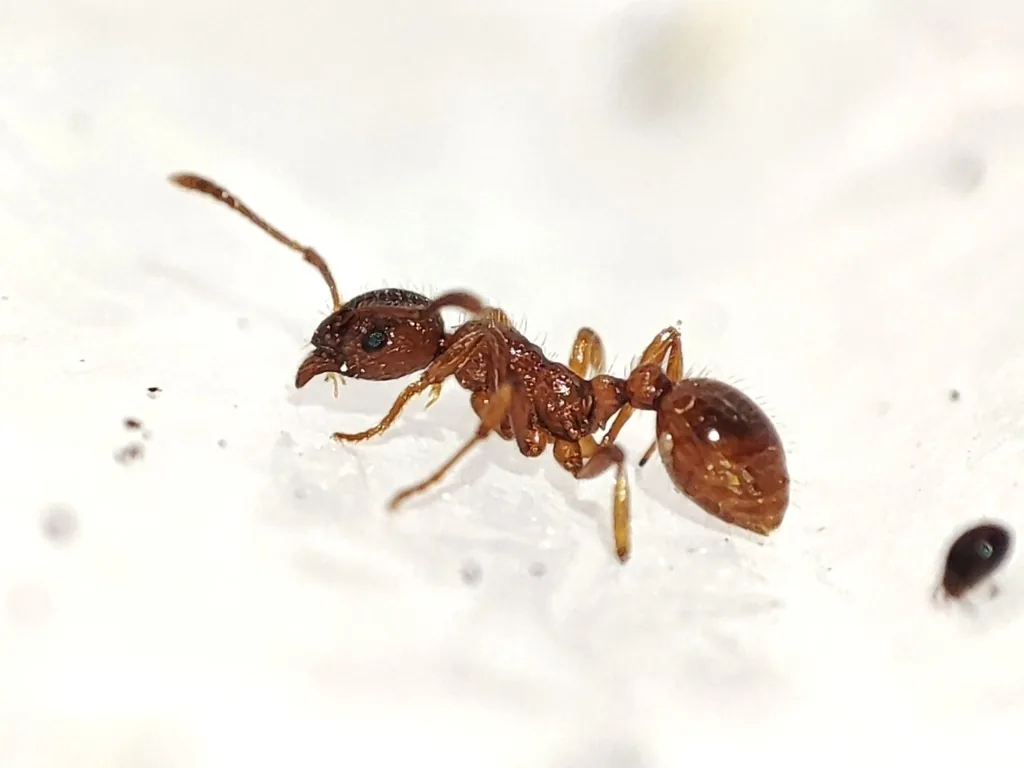
- Workers are about 3/16 inch long and red; queens are a little larger.[1][2]
- Washington State University (WSU) describes workers as reddish-brown and about 1/5 inch long, with color varying between individuals and colonies; the City of North Vancouver gives 4 to 5 mm, with larger queens.[4][5]
- The waist has two segments, while most native ants have only one.[1][2][4][5]
- Two backward-pointing spines sit on the middle body section, visible only with a magnifying glass.[1][2][4][5]
- WSU adds that the body is covered in fine hairs, the head and thorax are ridged and dull, and the abdomen is shiny.[4]
- Nests are found under rocks, wood and debris rather than in large soil mounds, often 10 to 12 nests in a 10-by-10-foot area.[1][4]
Look-alikes
| Look-alike | How to tell them apart |
|---|---|
| Pavement ant | Shares some of the same features, so have ants identified by Extension before treating; many native red ants also look similar.[1][2] |
| Red imported fire ant | The true fire ants are Solenopsis species of the southern U.S. and Latin America, only distantly related to the European fire ant.[1][4] |
| Native Myrmica ants | Native Myrmica species look very much alike, WSU says, but occur in low numbers and aren't aggressive. North Vancouver notes that other red, stinging ants live there too, so have an expert confirm the ID.[4][5] |
Where it lives
Native to cold regions of Europe and Asia, it is established in many coastal Maine communities, confirmed in Cumberland, Hancock, Kennebec, Knox, Penobscot, Sagadahoc, Waldo, Washington and York counties.[1]
Biology and life cycle
Colonies range from a few hundred to ten thousand workers and usually have several egg-laying queens.[1][4][5]
In Maine they live in lawns, old fields, shrubby areas and deciduous woods, in soil, rotting logs, grass clumps and leaf litter; they don't nest in houses.[1]
They spread when people move infested potted plants, mulch, compost, wood chips or soil, and locally when a group of workers carries a queen off to start a nearby nest.[1][2][4][5]
Mating flights by winged queens don't appear to be a common way they spread in their invaded range.[1]
A University of Maine survey from 2001 to 2004 found it a pest in several parts of the northeastern US, especially coastal Maine, where nests reach densities seldom seen in its native range.[6]
A 2012 study counted it in over 40 Maine communities and in parts of Vermont, New Hampshire, Massachusetts, New York, the Canadian Maritimes and Ontario. WSU says it has also been found in Washington State and British Columbia, where North Vancouver dates the first record to 2010.[9][4][5]
It reached New England in the early 20th century. Unlike some invasive ants that form one vast, tolerant supercolony, field tests on Mount Desert Island found that colonies only about 10 meters apart fought each other.[7]
Like many ants it tends aphids for honeydew. On meadowsweet in Maine, aphids were more plentiful when European fire ants tended them than when native ants did.[9][4]
Damage and signs
- Where nests are established, homeowners report being unable to use yards and gardens because of repeated stings.[1][5][6]
- They may displace native ants and other insects that didn't evolve alongside them.[1][2][8]
- In field tests at baits on Mount Desert Island, it found food faster than native ants and drove them off, a likely reason native ants disappear where it settles in.[8]
Health risk
These ants sting readily, and because nests are so dense, people keep running into them. For most insect stings home care is enough, but a person allergic to the venom can go into anaphylaxis, a severe, potentially life-threatening reaction that needs emergency care right away.[6][10][11]
Control
Prevention
Inspect plants, wood chips, compost, logs and soil before bringing them home, and don't share or move materials that might carry these ants.[2][4][5]
Sanitation
Remove stones, boards, leaves, logs and debris that offer nest sites, and reduce irrigation and shade, since these ants need moist habitat.[2][4]
WSU says these habitat changes won't eliminate colonies but can help keep numbers low, and that controlling aphids and scales makes a yard less attractive to the ants.[4]
Traps and physical control
When working near nests, North Vancouver says to wear gloves and closed-toe shoes or boots, tuck pants into socks and close other gaps in clothing so no skin is exposed.[5]
Pesticides
UMaine found baits the most effective treatment; in its trials, broadcast baits with indoxacarb, hydramethylnon or spinosad worked best, and liquid imidacloprid baits did best in bait stations.[2]
Bait in Maine between June 1 and September 1 when it is above 60°F, not right before or after rain or watering, and follow the label.[2][4]
Others are more cautious. WSU says results with food-based baits have been inconsistent and that repeated applications may make colonies move. North Vancouver says insecticide is the only effective control in British Columbia: digging to expose nests for direct treatment of small to medium infestations, and sugar-solution boric acid baits that may lower numbers for a time but won't eliminate nests.[4][5]
When to call a professional
Send suspected specimens to the UMaine Extension Diagnostic and Research Laboratory for identification before treating.[1][2][4]
Common questions
- Is the European fire ant a real fire ant?
- No. It is a Myrmica ant only distantly related to the true fire ants of the South, though its sting is painful.[1][4]
- Do boiling water or boric acid work on European fire ants?
- Not in UMaine field tests, where boiling water, plain cornmeal grits and both homemade and commercial boric acid products failed. North Vancouver does list a boric acid sugar bait, but only to reduce numbers temporarily, not to eliminate nests.[2][5]
- Can European fire ants be eliminated?
- Established infestations may not be eliminated, but baiting can reduce them, and neighbors can work together on colonies that cross property lines.[2]
- What should I do if European fire ants sting me?
- Brush the ants off, wash the area with soap and water, and put a cloth-wrapped ice pack on it in 10-minute rounds. Call 911 for wheezing or trouble breathing, swelling anywhere on the face or in the mouth, or difficulty swallowing.[11]
Sources
- University of Maine Cooperative Extension, “Bulletin #2550, European Fire Ant: A New Invasive Insect in Maine (reviewed 2025).” extension.umaine.edu/publications/2550e/ (accessed 2026-10-06)
- University of Maine Cooperative Extension, “Bulletin #2551, European Fire Ant: Management for Homeowners: Least Toxic Management Strategies.” extension.umaine.edu/publications/2551e/ (accessed 2026-10-06)
- iNaturalist, “Myrmica rubra taxon page (order and family).” www.inaturalist.org/taxa/1404712 (accessed 2026-11-11)
- Washington State University Pestsense, “European fire ant.” pestsense.cahnrs.wsu.edu/fact-sheet/european-fire-ant/ (accessed 2026-11-11)
- City of North Vancouver, British Columbia, “Tackling European Fire Ants (Myrmica rubra), fact sheet.” www.cnv.org/-/media/City-of-North-Vancouver/Documents/Environment/european-fire-ants-fact-sheet.pdf (accessed 2026-11-11)
- Journal of Economic Entomology, via PubMed, “Groden E, Drummond FA, Garnas J, Franceour A (2005), Distribution of an invasive ant, Myrmica rubra, in Maine, Journal of Economic Entomology 98(6).” pubmed.ncbi.nlm.nih.gov/16539093/ (accessed 2026-11-11). Cited from the PubMed abstract.
- Environmental Entomology, via PubMed, “Garnas JR, Drummond FA, Groden E (2007), Intercolony aggression within and among local populations of the invasive ant, Myrmica rubra, in coastal Maine, Environmental Entomology 36(1):105.” pubmed.ncbi.nlm.nih.gov/17349123/ (accessed 2026-11-11). Cited from the PubMed abstract.
- Environmental Entomology, via PubMed, “Garnas J, Groden E, Drummond FA (2014), Mechanisms of competitive displacement of native ant fauna by invading Myrmica rubra populations, Environmental Entomology.” pubmed.ncbi.nlm.nih.gov/25268214/ (accessed 2026-11-11). Cited from the PubMed abstract.
- Environmental Entomology, via PubMed, “McPhee K, Garnas J, Drummond F, Groden E (2012), Homopterans and an invasive red ant, Myrmica rubra (L.), in Maine, Environmental Entomology.” pubmed.ncbi.nlm.nih.gov/22525060/ (accessed 2026-11-11). Cited from the PubMed abstract.
- Centers for Disease Control and Prevention, NIOSH, “Insects and Scorpions at Work.” www.cdc.gov/niosh/outdoor-workers/about/insects-and-scorpions.html (accessed 2026-11-11)
- MedlinePlus, U.S. National Library of Medicine, “Insect bites and stings (Medical Encyclopedia 000033).” medlineplus.gov/ency/article/000033.htm (accessed 2026-11-11)