The short answer
- Usually fine: pain and a swollen spot that appear within minutes of the sting. Merck says local reactions settle quickly unless a severe reaction develops. Put a cold pack on the area and watch your pet closely.[1][6]
- Look for a stinger: if you see one in the skin, scrape it out sideways with a flat, rigid object such as a clean credit card. Merck says not to squeeze it with tweezers, which can push more venom into the wound.[6][7]
- Go to the vet now if there is major swelling of the head or neck that could block breathing, a stinger on the tongue or roof of the mouth, or many stings at once. These are the situations Merck says need emergency care.[6][7][1]
- Also go now for vomiting, diarrhea, drooling, pale gums, cold legs, weakness, collapse or trouble breathing after a sting. Merck lists these as signs of anaphylactic shock, which can start within seconds to minutes.[3][4]
- Hives and a puffy face alone are the mildest allergic reaction and usually pass, but call your vet, because a reaction can get worse and only the vet can decide whether your pet needs treatment.[3][5]
If someone may be poisoned
- Emergency vet now: swelling of the face, head or neck that could affect breathing, a stinger in the mouth or on the tongue, or many stings at once (Merck Veterinary Manual).[6][7][1]
- Emergency vet now: vomiting, diarrhea, drooling, pale gums, cold limbs, a fast heartbeat with a weak pulse, trouble breathing, weakness, seizures or collapse after a sting. Merck calls anaphylaxis an extreme emergency.[3][4]
Insects that sting pets
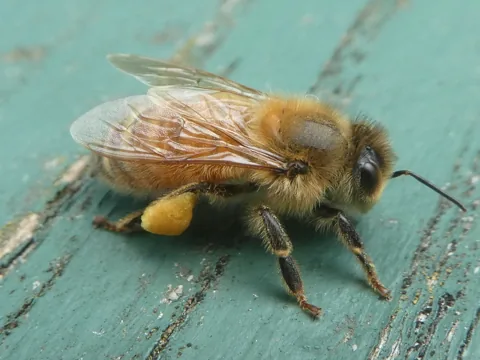 Western Honey Bee
Apis mellifera
Honey bees are important pollinators, but a colony that moves into a wall void or attic can become a stinging hazard. A swarm is temporary and usually best left alone, while an established colony in a building should be removed along with its comb.
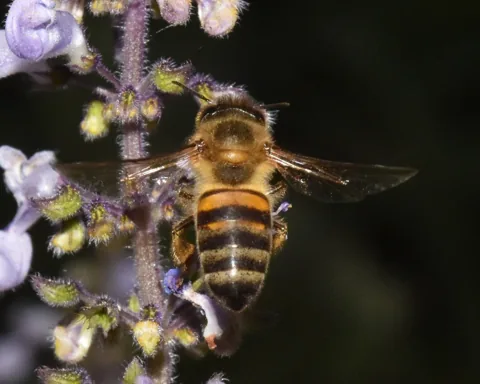 Africanized Honey Bee
Apis mellifera scutellata and its hybrids with European honey bees (Apis mellifera)
Africanized honey bees descend from African honey bees taken to Brazil in the 1950s that got into the wild and bred with European honey bees. They look like ordinary honey bees and carry the same venom, but colonies respond faster, in greater numbers and over a wider area when their nest is disturbed. UF/IFAS's Featured Creatures profile says the African subspecies was imported into Brazil in the late 1950s for a breeding program to make it gentler, which ended when the bees swarmed accidentally out of quarantine.
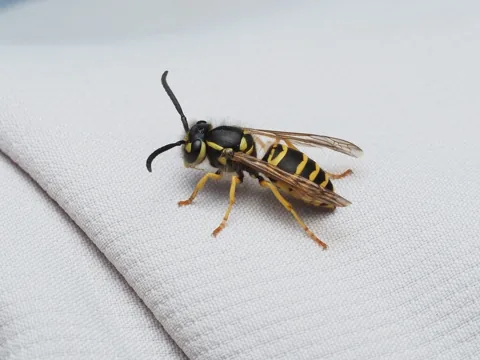 Eastern Yellowjacket
Vespula maculifrons
The eastern yellowjacket is a native, ground-nesting yellowjacket common across the eastern US in lawns, woodlands, pastures and parks; it defends its nest aggressively and can sting repeatedly.
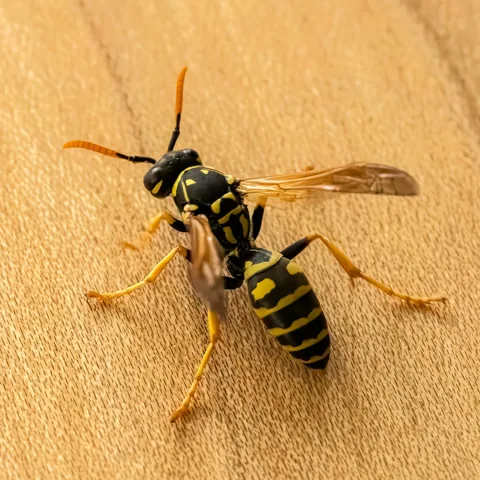 European Paper Wasp
Polistes dominula
Paper wasps hang open, umbrella-shaped paper nests under eaves and in sheltered spots; they are much less defensive than yellowjackets and rarely sting unless a nest is disturbed.
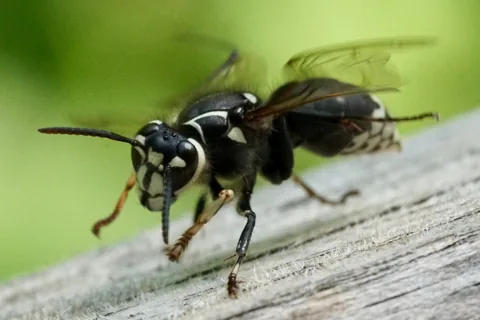 Bald-faced Hornet
Dolichovespula maculata
The bald-faced hornet is a large black-and-white aerial yellowjacket that builds gray, football-shaped paper nests in trees, shrubs and on buildings and defends them aggressively.
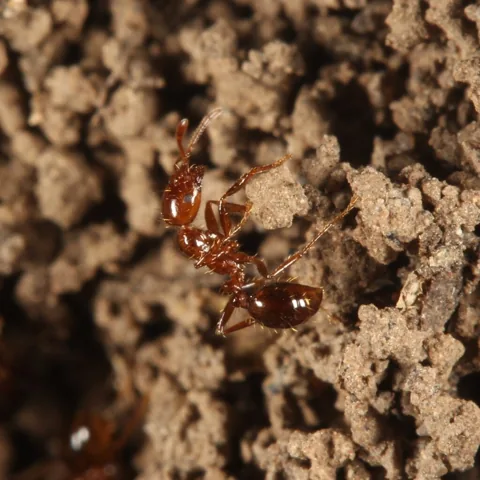 Red Imported Fire Ant
Solenopsis invicta
The red imported fire ant is an aggressive stinging ant that infests most of the southern United States and parts of California, building mounds in open, sunny areas such as lawns, parks and roadsides. USDA APHIS says imported fire ants came from South America, probably in soil on cargo ships, and now infest more than 367 million acres in Alabama, Arkansas, California, Florida, Georgia, Louisiana, Mississippi, North Carolina, Oklahoma, South Carolina, Tennessee, Texas, Virginia and Puerto Rico.
Normal sting swelling vs an allergic reaction
A normal reaction is local. Merck says the venom causes pain and swelling at the sting site within minutes, the area can turn red and puffy, and these local reactions resolve quickly unless a more severe reaction occurs.[1]
Stings are easy to miss in fur. Merck notes that a bite or sting may be too small to see until the pet reacts, so a pet pawing at its face, licking one spot or suddenly limping after playing outside may have been stung.[7]
Hives are the mildest allergic reaction. Merck describes small bumps on the skin, often with the hair standing up over them, that generally appear within 20 minutes. Insect bites and stings are among the most common causes of hives in dogs.[3][4][5]
Facial swelling is common with allergic reactions. Merck says it shows most on the lips, muzzle and around the eyes, and can be so severe the pet cannot open its eyes. Hives and swelling are usually not life threatening and often go away on their own, but swelling of the airway is dangerous, so call your vet.[3][4][5]
Venom from both bees and wasps contains proteins that can trigger allergic reactions, and Merck says bee venom is a well recognized cause of anaphylaxis.[1][2]
Signs of anaphylaxis in dogs and cats
Anaphylactic shock is rare but life threatening, Merck says, and an insect sting is one of its triggers. Signs usually begin within seconds to minutes.[3][4]
Dogs often show stomach signs first. Merck explains that in dogs the main organ hit by anaphylaxis is the liver rather than the lungs, so the major signs are sudden diarrhea, heavy drooling and vomiting, followed by shock, seizures, coma and death. The gums may be pale, the legs cold, the heart rate very fast and the pulse weak.[3][2]
Cats show severe breathing trouble along with sudden diarrhea, vomiting, drooling, excitement and incoordination, then shock, seizures and coma. Merck adds that the gums are very pale, the limbs feel cold, and there may be facial swelling and itching around the head.[4]
If you think your pet is having an anaphylactic reaction, Merck says to get emergency veterinary help immediately; treatment is given by the veterinarian.[3][4]
Stings in the mouth or throat
Merck says stings in dogs and cats are most common on the face and in the mouth, because pets snap at or mouth flying insects.[1][7]
A stinger on the tongue or the roof of the mouth is a reason to get emergency veterinary care, according to Merck, as is major swelling around the head or neck that could block breathing. Merck's summer safety advice gives the same two warnings.[6][7]
Many stings at once: swarms, ground nests and fire ant mounds
Multiple stings from bees or wasps can cause severe local and body-wide reactions. Merck lists collapse, seizures or depression, bloody vomiting and diarrhea, high body temperature, destruction of red blood cells and platelets, and kidney and liver failure.[1]
Massive stinging, as with Africanized honey bees, can also cause facial paralysis, wobbliness, seizures and blood in the urine, Merck says. These pets need aggressive veterinary care and monitoring even if they look all right at first.[1]
Honey bees have a barbed stinger that tears out of the bee, so each bee stings once; wasps, yellowjackets and hornets have smooth stingers and can sting again and again. Merck says wasps, hornets and yellowjackets are more aggressive than bees.[1]
Africanized honey bees, which have reached the southern US, defend their hive by stinging repeatedly, can produce hundreds or thousands of stings, and may chase a target for up to a kilometer from the hive, according to Merck. Their hives are often in the open, where pets stumble on them.[1]
Fire ants sting repeatedly while pivoting, and badly hurt animals are usually those that could not get away from the mound. Merck says most ant stings resolve without treatment and anaphylaxis from fire ant stings is not reported in companion animals, but many stings can cause a body-wide reaction that needs a vet. The fire ant stings guide covers this in more detail.[1]
First aid at home and removing a stinger
Apply a cold pack to the sting to reduce swelling and itching, Merck advises.[6][7]
Look for a stinger. Only honey bees usually leave one; Merck says if you find it, scrape it out with a flat object such as a credit card cleaned with alcohol rather than squeezing it with tweezers, because squeezing can release more venom into the wound.[6][7][1]
A honey bee stinger left in the skin can occasionally cause an abscess, Merck notes, so call your vet if the spot becomes painful, hot or starts to drain.[1]
Ask your veterinarian before giving any medicine. Merck describes sting treatment as a veterinary decision that depends on how severe the reaction is, from pain relief and a cool compress to emergency care for anaphylaxis.[1][3]
Keep watching your pet after the sting. Merck says hives and swelling generally develop within 20 minutes and anaphylaxis within seconds to minutes, so a pet that was fine right after the sting can still react.[3][4]
Reducing sting risk in the yard
Keep food, including pet food, covered or indoors. UC IPM says yellowjackets scavenge on human food and garbage, and recommends keeping garbage in sealed cans that are emptied regularly.[8][10]
Watch for ground nests. Missouri's Department of Conservation says a large yellowjacket nest may show only as a hole in the ground with wasps flying in and out; keep pets away and do not mow over it.[9][10]
Late summer is peak season. The Missouri Department of Conservation says that is when yellowjacket nests are largest and the wasps visit soda cans and garbage most and may be more irritable.[9]
Cover sweet drinks outdoors and clean up spilled food around trash cans, Ohio State Extension advises.[10][8]
Not every nest needs to go. Penn State Extension says ground nests can be ignored unless they are near a building entrance, in a lawn that is mowed or where people are likely to run into them; those are also the spots a dog is likely to find.[11]
Common questions
- How long does swelling from a bee sting last in a dog?
- Merck says local reactions usually resolve quickly, and hives often disappear as fast as they came, usually within a few hours. Swelling that keeps growing, spreads to the throat or comes with any change in breathing or behavior needs a vet.[1][5][3]
- My dog ate a bee. What should I do?
- Check the mouth from a safe distance and watch for swelling. Merck says a stinger on the tongue or roof of the mouth, or major swelling of the head or neck, needs emergency veterinary care.[6][7]
- Can cats have an allergic reaction to a bee sting?
- Yes. Merck lists insect stings among the triggers of anaphylaxis in cats, which mainly causes severe breathing trouble along with vomiting, diarrhea, drooling and collapse.[4]
- Are wasp stings worse than bee stings for dogs?
- Either can cause a serious reaction. Merck says wasps, hornets and yellowjackets are more aggressive and can sting repeatedly, while honey bees sting once but leave a stinger behind.[1]
- Should I give my dog an antihistamine for a sting?
- Call your veterinarian first. Merck describes sting treatment as a veterinary decision based on how severe the reaction is, and anaphylaxis needs emergency care, not home medicine.[1][3]
Photo credits
- Western Honey Bee: (c) Doug Miller, some rights reserved (CC BY) — via iNaturalist, CC BY 4.0
- Africanized Honey Bee: (c) Sunčana Bradley, some rights reserved (CC BY) — via iNaturalist, CC BY 4.0
- Eastern Yellowjacket: Brighton Lee, public domain (CC0), via iNaturalist
- European Paper Wasp: (c) Andrew McKinlay, some rights reserved (CC BY) — via iNaturalist, CC BY 4.0
- Bald-faced Hornet: (c) Amy Schnebelin, some rights reserved (CC BY) — via iNaturalist, CC BY 4.0
- Red Imported Fire Ant: (c) Natasha Taylor, some rights reserved (CC BY) — via iNaturalist, CC BY 4.0
Sources
- Merck Veterinary Manual, “Wasp, Bee, and Ant Stings to Animals.” www.merckvetmanual.com/toxicology/bites-and-stings-from-spiders-scorpions-and-insects/wasp-bee-and-ant-stings-to-animals (accessed 2026-11-15)
- Merck Veterinary Manual, “Hypersensitivity Diseases in Animals.” www.merckvetmanual.com/immune-system/immunologic-diseases/hypersensitivity-diseases-in-animals (accessed 2026-11-15)
- Merck Veterinary Manual, “Disorders Involving Anaphylactic Reactions in Dogs (Dog Owners).” www.merckvetmanual.com/dog-owners/immune-disorders-of-dogs/disorders-involving-anaphylactic-reactions-type-i-reactions-atopy-in-dogs (accessed 2026-11-15)
- Merck Veterinary Manual, “Disorders Involving Anaphylactic Reactions in Cats (Cat Owners).” www.merckvetmanual.com/cat-owners/immune-disorders-of-cats/disorders-involving-anaphylactic-reactions-type-i-reactions-atopy-in-cats (accessed 2026-11-15)
- Merck Veterinary Manual, “Hives and Rashes (Urticaria) in Dogs (Dog Owners).” www.merckvetmanual.com/dog-owners/skin-disorders-of-dogs/hives-and-rashes-urticaria-in-dogs (accessed 2026-11-15)
- Merck Veterinary Manual, “Minor Injuries and Accidents (Special Pet Topics).” www.merckvetmanual.com/special-pet-topics/emergencies/minor-injuries-and-accidents (accessed 2026-11-15)
- Merck Veterinary Manual, “Protecting Pets During Hot Summer Months.” www.merckvetmanual.com/news/editorial/2025/05/28/17/27/protecting-pets-during-hot-summer-months (accessed 2026-11-15)
- University of California Statewide IPM Program, “Yellowjackets and Other Social Wasps.” ipm.ucanr.edu/home-and-landscape/yellowjackets-and-other-social-wasps/ (accessed 2026-11-15)
- Missouri Department of Conservation, “Yellowjackets (Vespula Wasps).” mdc.mo.gov/discover-nature/field-guide/yellowjackets-vespula-wasps (accessed 2026-11-15)
- Ohio State University Extension, “Yellowjackets (HYG-2075).” ohioline.osu.edu/factsheet/hyg-2075 (accessed 2026-11-15)
- Penn State Extension, “Eastern Yellowjacket.” extension.psu.edu/eastern-yellowjacket (accessed 2026-11-15)