The short answer
- Normal reaction: pain, redness, swelling, itching or burning right at the sting. MedlinePlus says most stings can be treated at home, and people who are not allergic usually get better within 1 week.[2][3]
- Large local reaction: swelling around the sting that spreads wider than about 10 cm and lasts longer than 24 hours. It looks alarming but stays next to the sting; allergy researchers say it is managed differently from a whole-body reaction.[13][14][12]
- Anaphylaxis: symptoms away from the sting, often within minutes, such as trouble breathing or wheezing, swelling of the face, lips, tongue or throat, hives over the body, dizziness or fainting, vomiting or chest tightness. Call 911.[4][2][8]
- If the person has a prescribed epinephrine auto-injector or epinephrine nasal spray, help them use it right away. MedlinePlus says to use it immediately if available, and FDA calls epinephrine the only life-saving treatment for anaphylaxis.[4][6]
- After any whole-body reaction to a sting, MedlinePlus says your provider should refer you to an allergist for testing and therapy; allergy specialists say venom immunotherapy prevents future reactions in most patients who need it.[2][9][15]
Stinging insects behind most reactions
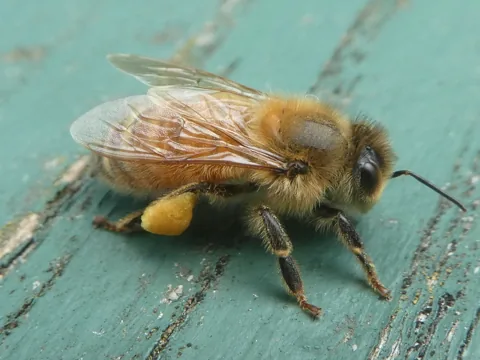 Western Honey Bee
Apis mellifera
Honey bees are important pollinators, but a colony that moves into a wall void or attic can become a stinging hazard. A swarm is temporary and usually best left alone, while an established colony in a building should be removed along with its comb.
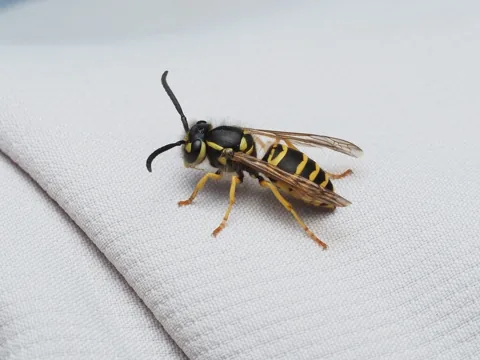 Eastern Yellowjacket
Vespula maculifrons
The eastern yellowjacket is a native, ground-nesting yellowjacket common across the eastern US in lawns, woodlands, pastures and parks; it defends its nest aggressively and can sting repeatedly.
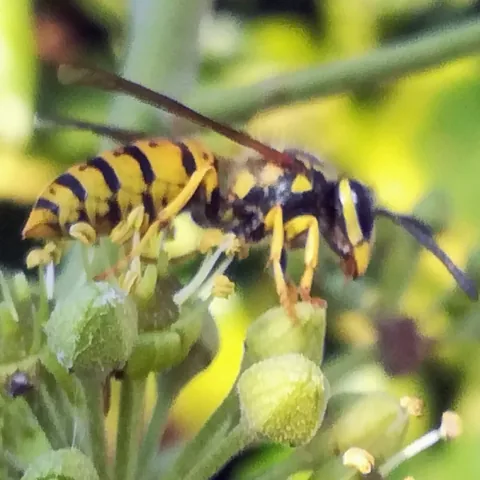 German Yellowjacket
Vespula germanica
The German yellowjacket is an invasive wasp from Eurasia that has spread across the northern US, displaces native yellowjackets and often nests in buildings.
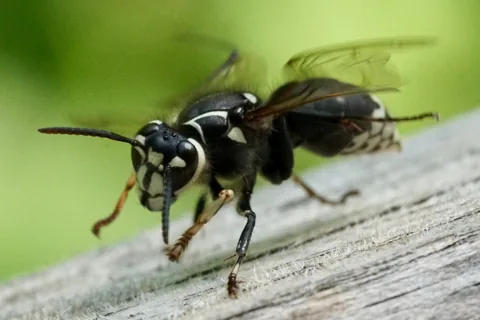 Bald-faced Hornet
Dolichovespula maculata
The bald-faced hornet is a large black-and-white aerial yellowjacket that builds gray, football-shaped paper nests in trees, shrubs and on buildings and defends them aggressively.
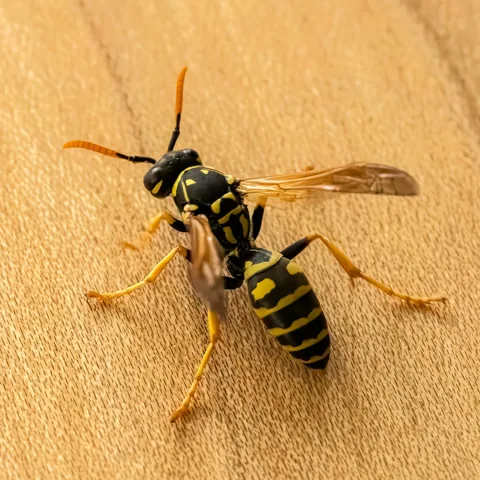 European Paper Wasp
Polistes dominula
Paper wasps hang open, umbrella-shaped paper nests under eaves and in sheltered spots; they are much less defensive than yellowjackets and rarely sting unless a nest is disturbed.
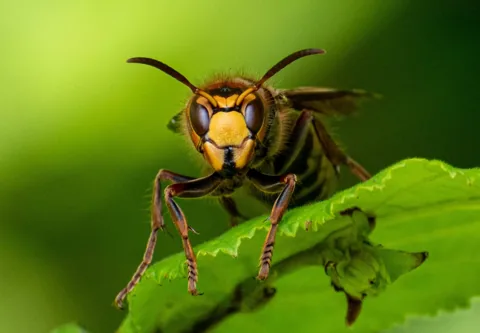 European Hornet
Vespa crabro
The European hornet is a large wasp introduced from Europe and first reported in the United States in 1840. It is now widespread in the East and is the only true hornet (genus Vespa) established in North America.
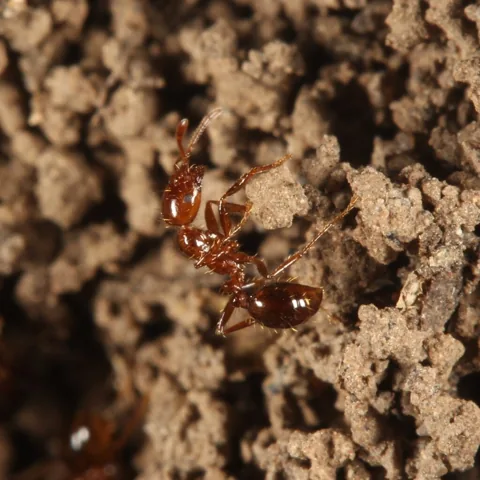 Red Imported Fire Ant
Solenopsis invicta
The red imported fire ant is an aggressive stinging ant that infests most of the southern United States and parts of California, building mounds in open, sunny areas such as lawns, parks and roadsides. USDA APHIS says imported fire ants came from South America, probably in soil on cargo ships, and now infest more than 367 million acres in Alabama, Arkansas, California, Florida, Georgia, Louisiana, Mississippi, North Carolina, Oklahoma, South Carolina, Tennessee, Texas, Virginia and Puerto Rico.
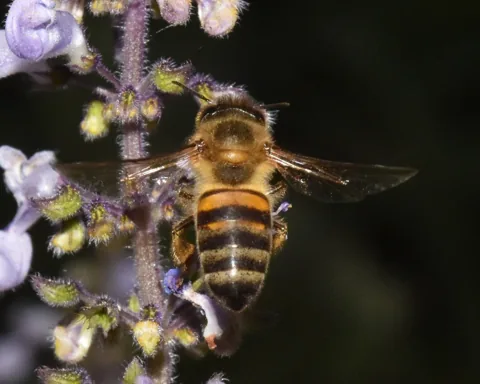 Africanized Honey Bee
Apis mellifera scutellata and its hybrids with European honey bees (Apis mellifera)
Africanized honey bees descend from African honey bees taken to Brazil in the 1950s that got into the wild and bred with European honey bees. They look like ordinary honey bees and carry the same venom, but colonies respond faster, in greater numbers and over a wider area when their nest is disturbed. UF/IFAS's Featured Creatures profile says the African subspecies was imported into Brazil in the late 1950s for a breeding program to make it gentler, which ended when the bees swarmed accidentally out of quarantine.
Normal sting, large local reaction or anaphylaxis?
Venom from bees, yellowjackets, hornets, wasps and stinging ants can cause three kinds of reaction, and only one is usually an emergency. A 2026 allergy review by McMurray, Bingemann and Golden groups venom allergy into large local reactions and systemic (whole-body) reactions, including anaphylaxis.[9][15]
- Normal local reaction. MedlinePlus lists pain, redness, swelling, itching, burning, numbness and tingling where you were stung. Bee, wasp and hornet stings and fire ant stings usually hurt more than they itch.[2][5]
- Fire ant stings look different. NIOSH and the Washington State Department of Health say they burn, and the red bumps can turn into white, fluid-filled pustules within a day or two. That pustule is the normal fire ant reaction, not by itself a sign of allergy.[1][8]
- Large local reaction. Allergy researchers usually define it as swelling more than 10 cm across that lasts longer than 24 hours, sometimes with redness, itching and blisters. A hand sting can swell the whole forearm, for example, but breathing and the rest of the body are fine.[13][14]
- Anaphylaxis. MedlinePlus says symptoms develop quickly, often within seconds or minutes, and can include hives and itching, swelling of the face, eyes or tongue, trouble breathing, wheezing or coughing, trouble swallowing, chest tightness, a racing heart, dizziness, nausea, vomiting or belly pain, and loss of consciousness. The Alabama Department of Public Health says symptoms may appear within a few minutes or a few hours.[4][7]
- Venom vs. allergy. MedlinePlus notes that throat, lip and tongue swelling, hives, a severe drop in blood pressure, collapse and trouble breathing after a bee, wasp, hornet or yellowjacket sting come from an allergic reaction, not from the venom itself.[3]
Emergency signs: call 911
MedlinePlus and the Washington State Department of Health give the same list. Call 911 or your local emergency number if someone who was stung has any of these:[2][8]
- Trouble breathing, wheezing or shortness of breath.[2][8]
- Swelling anywhere on the face or in the mouth.[2][8]
- Throat tightness or difficulty swallowing. MedlinePlus says a very hoarse or whispered voice, or rough sounds when breathing in, is a warning sign of dangerous throat swelling.[2][8][4]
- Feeling weak, faint or dizzy, or turning blue.[2][8]
- A sting inside the mouth or throat, or a sting on someone known to be allergic: MedlinePlus says to call poison control (1-800-222-1222) or an emergency room even before symptoms start.[3]
- For a worker stung by fire ants, NIOSH says to go to an emergency medical facility immediately for severe chest pain, nausea, severe sweating or loss of breath.[1]
What to do while help is on the way
These steps come from MedlinePlus first-aid guidance for anaphylaxis and stings. They are for an emergency already in progress; they do not replace calling 911.[4][2]
- Check the person's airway and breathing. If needed, begin rescue breathing and CPR.[4][2]
- If they carry emergency allergy medicine, help them use it. MedlinePlus says an epinephrine injector or intranasal epinephrine should be used immediately if it is available, and that there is no contraindication to using epinephrine in a severe allergic reaction. Follow the directions on the device and the person's own prescription; this page gives no doses.[4]
- If it was a bee sting and the stinger is still in, scrape it off with something firm, such as a fingernail or a plastic card.[4][2]
- Keep them calm, remove rings and anything tight, and stay with them until help arrives.[2][4]
- To help prevent shock, MedlinePlus says to have the person lie flat with the feet raised about 12 inches (30 centimeters) and cover them with a coat or blanket, unless a head, neck, back or leg injury is suspected. Don't put a pillow under the head of someone who is having trouble breathing.[4]
- Don't give anything by mouth if they are having trouble breathing, don't use a tourniquet, and don't give stimulants, aspirin or other pain medicine unless a provider prescribed it.[4][2]
- Go to the emergency room even if symptoms ease. The Alabama Department of Public Health says people who have a severe allergic reaction should also go to the emergency room, and MedlinePlus warns not to assume that allergy shots the person has already had will give complete protection.[7][4]
Epinephrine: auto-injectors and nasal spray
Epinephrine is the emergency medicine for anaphylaxis. FDA says it is the only life-saving treatment for anaphylaxis, and in 2024 FDA approved neffy, the first epinephrine nasal spray, as an option to injection for some patients.[6]
It is a prescription. MedlinePlus says sting kits containing epinephrine require a prescription, and that people with an allergy to bee, wasp, yellowjacket or similar stings should always carry one and know how to use it. A 2026 review says patients with sting anaphylaxis should be prescribed epinephrine.[3][9]
Carry it and say so. NIOSH says workers with a history of severe allergic reactions to stings should carry an EpiPen and wear a medical ID bracelet or necklace; the Washington State Department of Health gives the same advice for anyone with a known sting allergy.[1][8]
Some states train the public to use it. The Alabama Department of Public Health offers training on using an epinephrine auto-injector or nasal spray under a state law that lets members of the public keep epinephrine for someone having a severe allergic reaction.[7]
A large local reaction alone usually does not call for it. Carlson and Golden write that people with large local reactions are not at enough risk to warrant prescribing auto-injectable epinephrine; whether you need one is your provider's decision.[12]
Removing a stinger and caring for an ordinary sting
For an ordinary sting with no allergy signs, CDC's NIOSH and MedlinePlus give these steps. A stinger left in the skin is most likely from a bee; MedlinePlus says to remove it if it is still present.[1][2][3]
- Get the stinger out quickly. MedlinePlus says to scrape the back of a credit card or other straight edge across it; NIOSH says to wipe gauze or scrape a fingernail over the area.[2][1]
- Don't squeeze it. NIOSH says never to squeeze the stinger or use tweezers, and MedlinePlus says tweezers may squeeze the venom sac and release more venom. MedlinePlus's bee sting article allows pulling it out if you avoid pinching the sac at the end; the two agencies agree the sac must not be squeezed.[1][2][3]
- Wash the area with soap and water.[2][1]
- Cool it. MedlinePlus says to put ice wrapped in a cloth on the sting for 10 minutes, then off for 10 minutes, and repeat, using shorter times for someone with poor circulation.[2][3]
- For itching, MedlinePlus and the Washington State Department of Health say an antihistamine or anti-itch cream can help if needed; NIOSH notes some antihistamines cause drowsiness and to follow the package directions.[2][8][1]
- Don't scratch. NIOSH says scratching can increase swelling, itching and the risk of infection. Watch the sting over the next several days for increasing redness, swelling or pain, which can mean infection.[1][2]
- Fire ants: NIOSH says to rub the ants off briskly, since they hold on with their jaws while they sting.[1]
If you get big swelling from stings
A large local reaction is uncomfortable but is not the same as anaphylaxis. Carlson and Golden say these reactions have an immune basis but should be managed differently from whole-body reactions, and that antibiotics are generally not needed because the swelling is inflammation, not infection.[12]
Researchers disagree a little on how often a big local reaction is followed by a whole-body reaction on a later sting. Carlson and Golden say people with large local reactions are not at enough risk to need an epinephrine prescription, while an Italian study that followed people after a first large local reaction found that some had a systemic reaction when stung again. That is why any reaction away from the sting site, or worsening reactions, should be raised with a provider.[10][13]
MedlinePlus says the chances of future whole-body reactions rise when local reactions become more and more severe.[3]
Carlson and Golden say venom immunotherapy can be considered when large local reactions are frequent and cause significant problems, so referral to an allergist is reasonable if they keep disrupting your life.[12]
Who should see an allergist
MedlinePlus says anyone who had a severe, bodywide reaction to a sting should be referred to an allergist for skin testing and therapy. Allergists test with skin tests and blood tests for venom-specific antibodies, and a 2025 review says a baseline blood tryptase test is now routine to look for mast cell disorders that raise the risk.[2][9][10]
- You had anaphylaxis or any whole-body reaction after a sting. A 2026 review says patients with sting anaphylaxis should be prescribed epinephrine and venom immunotherapy.[9][2]
- Your local reactions are getting worse with each sting, or large local reactions are frequent and disruptive.[3][12]
- Hives or skin symptoms only. US and European guidelines agree that children and adults whose whole-body reaction was limited to the skin do not require venom immunotherapy; an allergist can tell you where you fall.[11][10]
Venom immunotherapy (allergy shots for stings)
Venom immunotherapy (VIT) is allergy treatment with insect venom, prescribed and given under an allergist's care. Reviews in primary care and allergy journals describe it as highly effective at reducing systemic reactions and anaphylaxis.[15][9]
Golden's 2025 review says VIT is aimed at high-risk patients, can be started on faster schedules safely, and that recurring reactions during treatment are rare. How long you stay on it depends on your own risk factors, which the allergist decides.[10][9]
Common heart and blood pressure medicines are not automatically a barrier. The 2019 and 2025 Golden reviews say the risk from beta blockers and ACE inhibitors during VIT is relatively low and they are not contraindicated; never stop a prescribed medicine without your doctor.[11][10]
Shots do not replace the auto-injector. MedlinePlus warns not to assume allergy shots already received give complete protection during a reaction.[4]
NIOSH advice for outdoor workers
CDC's National Institute for Occupational Safety and Health (NIOSH) says stinging insects, including bees, wasps, hornets and fire ants, are a hazard for outdoor workers. Bees, wasps and hornets are found throughout the United States and are most abundant in warmer months; fire ants are mostly in the Southeast, with limited range in New Mexico, Arizona and California.[1]
- Expect nests in trees, under roof eaves and on equipment such as ladders, and look over the area before you start work, since fire ants can be on trees or even in water.[1]
- Wear light-colored, smooth-finished clothing that covers as much of the body as possible. Skip perfumed soaps, shampoos, deodorants and cologne; bathe daily and wear clean clothes, since NIOSH says sweat may anger bees.[1]
- Keep work areas clean; NIOSH says social wasps thrive where people throw out food.[1]
- If a single insect is flying around, stay calm and still, because swatting may cause it to sting.[1]
- If several insects attack, run. Go indoors or to shade, not into water, since some insects hover above water. NIOSH says stinging bees release a chemical that may attract other bees.[1]
- If a bee gets in your vehicle, stop slowly and open all the windows.[1]
- Have someone stay with a stung worker to watch for an allergic reaction, and workers with a history of severe reactions should carry their epinephrine and a medical ID.[1]
Cutting sting risk around the house
MedlinePlus's basic advice is not to bother insects and to be careful when eating outside, because food attracts them. Its bee sting article adds: don't put your hands or feet into nests, hives or their usual hiding places, and avoid bright clothing and perfumes where these insects gather.[5][3]
- Cover food and drinks outdoors and keep trash closed; NIOSH says social wasps thrive where people throw out food. The yellowjacket picnic guide covers which traps help.[1][5]
- Find nests before you mow, trim hedges or clean gutters, and leave ground nests and eave nests alone until you decide how to handle them. The wasp nest removal guide explains when a pro is the safer choice.[1][3]
- Don't disturb or stand on fire ant mounds, and be careful lifting things off the ground where fire ants live, since NIOSH says they may be covered in ants. The fire ant yard guide covers baits and mound treatments.[1]
- Anyone with a known sting allergy should carry their epinephrine kit outdoors and know how to use it, as MedlinePlus advises.[3][5]
Common questions
- How do I know if a bee sting is an allergic reaction?
- Look beyond the sting. Pain, redness and swelling at the sting are normal. Hives elsewhere on the body, swelling of the face, lips or tongue, trouble breathing or swallowing, dizziness or vomiting point to an allergic reaction, and breathing or throat symptoms mean call 911.[2][4][3]
- How soon does anaphylaxis start after a sting?
- MedlinePlus says symptoms develop quickly, often within seconds or minutes. The Alabama Department of Public Health says they may appear within a few minutes or a few hours, so keep watching a stung person for a while.[4][7]
- My whole arm swelled up after a wasp sting. Is that anaphylaxis?
- Not by itself. Swelling that spreads wider than about 10 cm around the sting and lasts more than a day is a large local reaction. It becomes an emergency only if symptoms appear away from the sting, such as breathing trouble, face swelling or dizziness.[13][14][2]
- Should I go to the ER if I used my EpiPen?
- Yes. Call 911 for anaphylaxis even if you have used epinephrine. The Alabama Department of Public Health says people who have a severe allergic reaction should also go to the emergency room.[4][7]
- Can you suddenly become allergic to bee stings?
- A person can react more strongly to later stings. MedlinePlus says the chance of future whole-body reactions increases when local reactions become more and more severe, so tell your provider if your sting reactions are getting bigger.[3]
- Do fire ant stings cause anaphylaxis?
- They can. The Washington State Department of Health says a fire ant sting can cause allergic reactions, including severe anaphylaxis, and a 2026 allergy review lists stinging ants with bees and wasps as causes of venom anaphylaxis. The usual result is a burning sting and a pustule.[8][9][1]
- Can allergy shots stop sting allergy?
- Venom immunotherapy, given by an allergist, is highly effective at reducing future whole-body reactions in people who need it. You still carry epinephrine during treatment.[15][9][4]
Photo credits
- Western Honey Bee: (c) Doug Miller, some rights reserved (CC BY) — via iNaturalist, CC BY 4.0
- Eastern Yellowjacket: Brighton Lee, public domain (CC0), via iNaturalist
- German Yellowjacket: (c) Gianni Del Bufalo bygdb, some rights reserved (CC BY) — via iNaturalist, CC BY 4.0
- Bald-faced Hornet: (c) Amy Schnebelin, some rights reserved (CC BY) — via iNaturalist, CC BY 4.0
- European Paper Wasp: (c) Andrew McKinlay, some rights reserved (CC BY) — via iNaturalist, CC BY 4.0
- European Hornet: (c) Михаил Малышев, some rights reserved (CC BY) — via iNaturalist, CC BY 4.0
- Red Imported Fire Ant: (c) Natasha Taylor, some rights reserved (CC BY) — via iNaturalist, CC BY 4.0
- Africanized Honey Bee: (c) Sunčana Bradley, some rights reserved (CC BY) — via iNaturalist, CC BY 4.0
Sources
- CDC National Institute for Occupational Safety and Health (NIOSH), “Insects and Scorpions at Work.” www.cdc.gov/niosh/outdoor-workers/about/insects-and-scorpions.html (accessed 2026-11-15)
- MedlinePlus, U.S. National Library of Medicine, “Insect bites and stings (Medical Encyclopedia).” medlineplus.gov/ency/article/000033.htm (accessed 2026-11-15)
- MedlinePlus, U.S. National Library of Medicine, “Bee, wasp, hornet, or yellow jacket sting (Medical Encyclopedia).” medlineplus.gov/ency/article/002847.htm (accessed 2026-11-15)
- MedlinePlus, U.S. National Library of Medicine, “Anaphylaxis (Medical Encyclopedia).” medlineplus.gov/ency/article/000844.htm (accessed 2026-11-15)
- MedlinePlus, U.S. National Library of Medicine, “Insect Bites and Stings (health topic).” medlineplus.gov/insectbitesandstings.html (accessed 2026-11-15)
- U.S. Food and Drug Administration, “FDA Approves First Nasal Spray for Treatment of Anaphylaxis (2024).” www.fda.gov/news-events/press-announcements/fda-approves-first-nasal-spray-treatment-anaphylaxis (accessed 2026-11-15)
- Alabama Department of Public Health, “Anaphylaxis.” www.alabamapublichealth.gov/nursing/anaphylaxis.html (accessed 2026-11-15)
- Washington State Department of Health, “European Fire Ants (Myrmica rubra).” doh.wa.gov/community-and-environment/pests/european-fire-ants (accessed 2026-11-15)
- Immunology and Allergy Clinics of North America (PubMed 41932750), “McMurray JC, Bingemann TA, Golden DBK. Venom Anaphylaxis. Immunol Allergy Clin North Am 2026;46(2):325-345.” pubmed.ncbi.nlm.nih.gov/41932750/ (accessed 2026-11-15)
- Allergy and Asthma Proceedings (PubMed 40958191), “Golden DBK. Update in stinging insect hypersensitivity. Allergy Asthma Proc 2025;46(5):382-387.” pubmed.ncbi.nlm.nih.gov/40958191/ (accessed 2026-11-15)
- Current Opinion in Allergy and Clinical Immunology (PubMed 31335358), “Golden DBK. Insect sting allergy: new guidelines from the European and USA consensus groups. Curr Opin Allergy Clin Immunol 2019;19(5):456-461.” pubmed.ncbi.nlm.nih.gov/31335358/ (accessed 2026-11-15)
- Current Opinion in Allergy and Clinical Immunology (PubMed 27285489), “Carlson J, Golden DB. Large local reactions to insect envenomation. Curr Opin Allergy Clin Immunol 2016;16(4):366-369.” pubmed.ncbi.nlm.nih.gov/27285489/ (accessed 2026-11-15)
- Allergy (PubMed 31074868), “Bilo MB et al. Large local reactions to Hymenoptera stings: Outcome of re-stings in real life. Allergy 2019;74(10):1969-1976.” pubmed.ncbi.nlm.nih.gov/31074868/ (accessed 2026-11-15)
- JACEP Open (PubMed 40012656), “Denkler KA, Hudson RF. Injection of Lidocaine With Epinephrine for Bee Sting Large Local Reactions. J Am Coll Emerg Physicians Open 2025;6(1):100009.” pubmed.ncbi.nlm.nih.gov/40012656/ (accessed 2026-11-15)
- Primary Care: Clinics in Office Practice (PubMed 27545732), “Lee H, Halverson S, Mackey R. Insect Allergy. Prim Care 2016;43(3):417-431.” pubmed.ncbi.nlm.nih.gov/27545732/ (accessed 2026-11-15)