The short answer
- Which scorpion matters: of the 30 scorpion species in Arizona, the Arizona Poison and Drug Information Center regards only one, the bark scorpion (Centruroides sculpturatus), as life-threatening. The Merck Veterinary Manual places it in Arizona, western New Mexico, southern Utah and Nevada, and occasionally along the Colorado River in California.[3][8]
- What a typical sting feels like: immediate pain with little swelling, often with numbness and tingling that can travel across the body. The spot may be very sensitive to touch, pressure, heat and cold.[3][2]
- Danger signs: trouble breathing, drooling, a thick tongue or slurred speech, roving or wild eye movements, jerky body movements, muscle twitches and convulsions. Call 911 for these.[2][1][3]
- Young children are at highest risk. MedlinePlus says children 6 and younger are more likely to be harmed by venomous scorpions, and the Arizona poison center says small children are at the highest risk of severe reactions.[1][3]
- For any sting, call Poison Help at 1-800-222-1222. It is free, confidential and open around the clock, and the specialist will tell you whether the person can stay home or needs a hospital.[1][3]
Scorpions in the U.S.
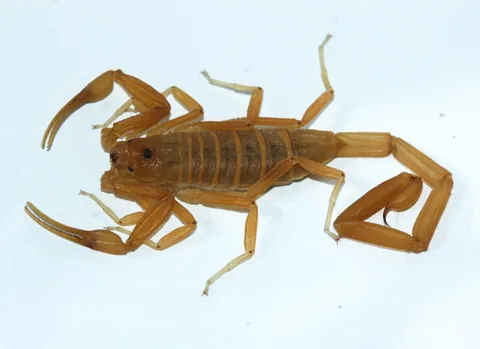 Arizona Bark Scorpion
Centruroides sculpturatus
The Arizona bark scorpion is a slender, climbing scorpion of the desert Southwest that often lives in and around homes. It is the only scorpion in the United States whose sting is considered a hazard to human health.
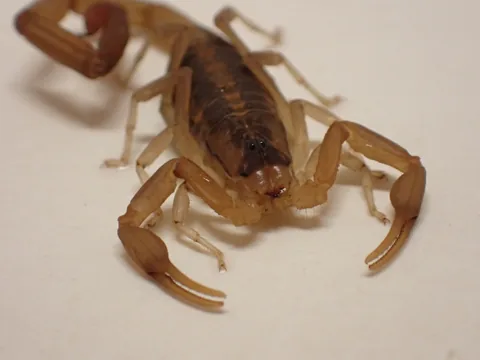 Scorpions
Order Scorpiones (shown: striped bark scorpion, Centruroides vittatus)
Scorpions are arachnids, relatives of spiders, ticks and mites, that hide by day and hunt insects at night. They live across the southern United States, and most U.S. stings are reported from Arizona, Texas and Nevada.
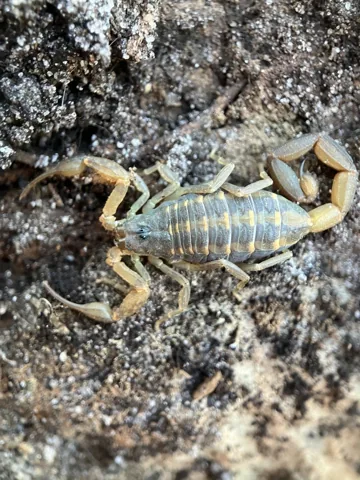 Hentz Striped Scorpion
Centruroides hentzi
The Hentz striped scorpion occurs statewide in Florida and often enters houses there. Researchers who analyzed its venom describe it as a Centruroides species that poses no serious threat to people, though a sting still hurts.
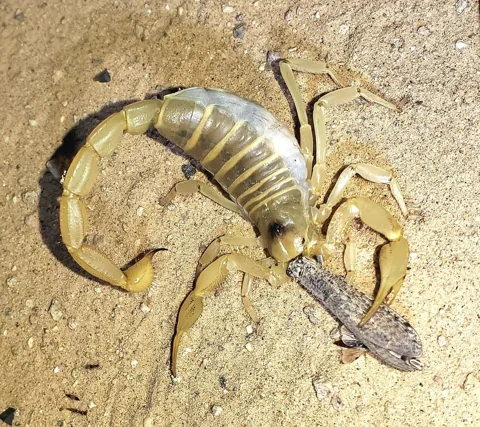 Giant Desert Hairy Scorpion
Hadrurus arizonensis
The giant desert hairy scorpion, also called the Arizona giant hairy scorpion, is the largest scorpion in the United States. Despite its size its venom is mild: in Arizona only the much smaller bark scorpion is regarded as life-threatening. Extension entomologists call it harmless and even beneficial, so the best plan is to seal it out of the house and move any that get in.
Which U.S. scorpions are dangerous
MedlinePlus says more than 40 scorpion species live in the United States and that the venomous ones live mainly in the southwestern deserts. The Arizona poison center regards only the bark scorpion as life-threatening.[1][3]
The bark scorpion is small and slender. The Arizona poison center says it reaches only about an inch and a half, has thinner tail segments and pincers than less toxic species, and is the best climber of the group. Our Arizona bark scorpion profile and the bark vs striped scorpion comparison cover identification in detail.[3]
Stings happen well beyond Arizona. A study of the National Poison Data System counted 185,402 scorpion exposures reported to U.S. poison centers from 2005 to 2015. Arizona, Texas and Nevada reported the most, and six other southern states each reported more than 100 cases a year, mostly in warm months and evening hours.[5]
The effects differed by region in that study. Outside Arizona, stings mostly caused pain with local redness and swelling. In Arizona and Nevada, where the bark scorpion lives, severe whole-body symptoms were more common.[5]
Symptoms: mild stings and severe ones
In mild cases, MedlinePlus says the only symptom may be tingling or burning where the scorpion stung. NIOSH describes stinging or burning at the site with very little swelling and a positive tap test: extreme pain when the spot is tapped with a finger.[1][2]
Bark scorpion venom acts on nerves and muscles. A 2009 clinical trial describes its effect as a dramatic neuromotor syndrome. The signs NIOSH and MedlinePlus list for a serious sting include:[2][1][7]
- Eyes: roving or random eye movements, and double vision.[2][1]
- Mouth and throat: drooling, a tongue that feels thick, slurred speech, and spasm of the voice box.[2][1]
- Muscles and movement: twitching, muscle spasms, random movements of the head and neck, a staggering walk, restlessness and convulsions.[2][1]
- Breathing and heart: trouble breathing, fast breathing, and a heart rate that is too fast, too slow or irregular.[2][1]
- Other signs: sweating, belly pain and cramps, nausea and vomiting, and loss of bladder or bowel control.[2][1]
Stings in young children versus adults
Healthy adults: the Arizona poison center says most stings in healthy young adults can be managed at home with basic first aid and follow-up. NIOSH says symptoms usually subside within 48 hours, while warning that a bark scorpion sting can be life-threatening.[3][2]
Small children: the Arizona poison center says they are at the highest risk of severe reactions and can show jerky body and wild eye movements. MedlinePlus says death from scorpion stings rarely occurs in people older than 6.[3][1]
The national poison center study found that children under 10 in Arizona and Nevada had the most whole-body effects, hospital stays and intensive care admissions. A clinical trial published in 2009 described the bark scorpion syndrome in children as a dramatic neuromotor syndrome with breathing trouble that often needs intensive supportive care.[5][7]
Watch the first hours closely. MedlinePlus says that if symptoms quickly get worse in the first 2 to 4 hours after the sting, a poor outcome is more likely, and that symptoms may last several days or longer.[1]
When to call Poison Help or 911
Call Poison Help at 1-800-222-1222 after any scorpion sting. MedlinePlus says the line reaches your local poison center from anywhere in the U.S., is free and confidential, and does not need to be an emergency. The Arizona poison center says its experts will decide whether you need to go to the hospital.[1][3]
Call 911 right away for trouble breathing, drooling, convulsions, roving eyes or uncontrolled movements, or a sting in a small child who is showing any of these signs. MedlinePlus tells anyone who is stung, or with someone who is stung, to call 911 or the poison center.[1][2][3]
Before you call, MedlinePlus suggests having ready the person's age, weight and condition, the type of scorpion if known, the time of the sting and where on the body it happened.[1]
A sting can also set off a venom allergy. NIOSH says people allergic to venom may have anaphylaxis, which needs immediate emergency care. Our insect sting allergy page covers anaphylaxis.[2]
First aid for a scorpion sting
These steps come from MedlinePlus, NIOSH and the Arizona poison center. They do not replace the call to Poison Help.[1][2][3]
- Wash the sting with soap and water.[1][3]
- Cool it. MedlinePlus says to put ice wrapped in a clean cloth on the site for 10 minutes, then off for 10 minutes, and repeat, using shorter times for anyone with poor circulation. NIOSH says not to submerge the area in ice water.[1][2]
- Keep the stung limb still and in a comfortable position, and stay calm.[1][3][2]
- Loosen clothing and take off rings and other tight jewelry.[1]
- Over-the-counter pain medicine may help minor discomfort, per the Arizona poison center. NIOSH says not to take sedatives.[3][2]
- Identify the scorpion if it is safe. NIOSH says to capture it if you can do so safely; MedlinePlus suggests a photo and warns not to risk another sting. If you go to the hospital, MedlinePlus says to bring it in a tightly closed container.[2][1]
At the hospital, and the scorpion antivenom
MedlinePlus says hospital staff will monitor temperature, pulse, breathing and blood pressure, and that a person may get blood and urine tests, a chest x-ray, an ECG, IV fluids and, in severe cases, breathing support.[1]
An antivenom exists. FDA has licensed Anascorp, Centruroides (Scorpion) Immune F(ab')2 (Equine) Injection, for the treatment of clinical signs of scorpion envenomation. The Merck Veterinary Manual describes it as an equine-derived antivenom approved for people in the US and used for severe whole-body signs, especially in children and older adults.[4][8]
In a randomized trial of 15 critically ill children published in 2009, symptoms cleared within 4 hours in all eight who got the antivenom compared with one of seven who got a placebo.[7]
An Arizona poison center study of stings from 2017 to 2019 says the antivenom is available at selected health care facilities in the state. Of the 145 patients who received it, 76 were children younger than 5, and the authors saw rapid resolution of symptoms without immediate or delayed allergic reactions. A doctor decides whether a patient needs it.[6]
Outdoor workers and scorpions
NIOSH says scorpions usually hide during the day under rocks, wood or anything else lying on the ground, some burrow, and they come out at night. NIOSH says scorpions are found in the Southern and Southwestern United States; most live in dry desert areas, though some species live in grasslands, forests and caves.[2]
NIOSH tells employers to train workers about the risk, how to avoid stings and what to do after one. Its protections for workers:[2]
- Wear long sleeves, long pants and leather gloves.[2]
- Shake out clothing and shoes before putting them on.[2]
- Don't put hands or feet into hiding places such as under rocks, logs and floors or in crevices, which MedlinePlus names as the places scorpions spend the day.[1][2]
- If a worker is stung, contact a health care provider or poison control center and follow the first aid steps above.[2]
Scorpion stings in dogs and cats
The Merck Veterinary Manual says U.S. scorpions are unlikely to cause envenomation in companion animals, though a sting can be very painful. The Arizona bark scorpion can cause more extensive whole-body effects in some animals.[8]
In most dogs stung by a bark scorpion, Merck says the effects stay local: pain shown by pawing, limping or crying out, plus swelling, redness and itching. The skin at the site can slough off.[8]
Whole-body signs are not common, but Merck says to watch for them. The most common are a fast heart rate and high blood pressure; agitation, twitching and drooling can also occur, and fluid can build up in the lungs. An allergic reaction with swollen eyelids or tongue and vomiting is rare but possible.[8]
Merck says stung animals should be monitored for those signs, and that treatment is washing the site, cold compresses and supportive care with pain relief, and that the human antivenom is rarely used in animals.[8]
Common questions
- Are scorpion stings dangerous?
- Most U.S. stings cause pain, burning and tingling that pass. The Arizona bark scorpion is the exception: its sting can cause roving eyes, drooling, twitching and breathing trouble, especially in children 6 and younger.[3][1][2]
- Should I go to the ER for a scorpion sting?
- Call Poison Help at 1-800-222-1222 first; the Arizona poison center says its experts will tell you whether hospital care is needed. Go or call 911 right away for trouble breathing, drooling, convulsions or abnormal eye movements.[3][1]
- What is the tap test?
- NIOSH describes it as extreme pain when the sting site is tapped with a finger, a sign it lists among scorpion sting symptoms.[2]
- How long does a scorpion sting hurt?
- NIOSH says symptoms usually subside within 48 hours. MedlinePlus says symptoms after a serious sting may last several days or longer.[2][1]
- Can a scorpion sting kill you?
- It is rare. MedlinePlus says death from scorpion stings rarely occurs in people older than 6, and that rapidly worsening symptoms in the first 2 to 4 hours point to a worse outcome.[1]
- Is there an antivenom for scorpion stings?
- Yes. FDA has licensed Anascorp for the clinical signs of scorpion envenomation, and a 2021 study says it is available at selected health care facilities in Arizona. A doctor decides whether it is needed.[4][6]
- Should I put ice on a scorpion sting?
- Yes, wrapped in a cloth, on and off in 10-minute spells, per MedlinePlus. NIOSH says not to submerge the area in ice water.[1][2]
- My dog was stung by a scorpion. What should I do?
- Watch it closely. The Merck Veterinary Manual says most U.S. stings cause local pain and swelling in pets, but a bark scorpion sting can occasionally cause a fast heart rate, agitation, twitching or drooling.[8]
Photo credits
- Arizona Bark Scorpion: (c) Andrew Meeds, some rights reserved (CC BY) — via iNaturalist, CC BY 4.0
- Scorpions: (c) dhasdf, some rights reserved (CC BY) — via iNaturalist, CC BY 4.0
- Hentz Striped Scorpion: mikoikoi, public domain (CC0), via iNaturalist
- Giant Desert Hairy Scorpion: (c) Bob Miller, some rights reserved (CC BY) — via iNaturalist, CC BY 4.0
Sources
- MedlinePlus, U.S. National Library of Medicine, “Scorpions (Medical Encyclopedia).” medlineplus.gov/ency/article/002850.htm (accessed 2026-11-15)
- National Institute for Occupational Safety and Health (CDC), “Insects and Scorpions at Work.” www.cdc.gov/niosh/outdoor-workers/about/insects-and-scorpions.html (accessed 2026-11-15)
- Arizona Poison and Drug Information Center, University of Arizona, “Scorpions.” azpoison.com/venom/scorpions (accessed 2026-11-15)
- U.S. Food and Drug Administration, “Anascorp.” www.fda.gov/vaccines-blood-biologics/approved-blood-products/anascorp (accessed 2026-11-15)
- Journal of Medical Toxicology (PubMed 27921219), “Kang AM, Brooks DE. Nationwide Scorpion Exposures Reported to US Poison Control Centers from 2005 to 2015. J Med Toxicol 2017;13(2):158-165.” pubmed.ncbi.nlm.nih.gov/27921219/ (accessed 2026-11-15)
- American Journal of Medicine (PubMed 33631163), “Klotz SA et al. Scorpion Stings and Antivenom Use in Arizona. Am J Med 2021;134(8):1034-1038.” pubmed.ncbi.nlm.nih.gov/33631163/ (accessed 2026-11-15)
- New England Journal of Medicine (PubMed 19439743), “Boyer LV et al. Antivenom for critically ill children with neurotoxicity from scorpion stings. N Engl J Med 2009;360(20):2090-8.” pubmed.ncbi.nlm.nih.gov/19439743/ (accessed 2026-11-15)
- Merck Veterinary Manual, “Spider and Scorpion Bites and Stings to Animals.” www.merckvetmanual.com/toxicology/bites-and-stings-from-spiders-scorpions-and-insects/spider-and-scorpion-bites-and-stings-to-animals (accessed 2026-11-15)