On this page
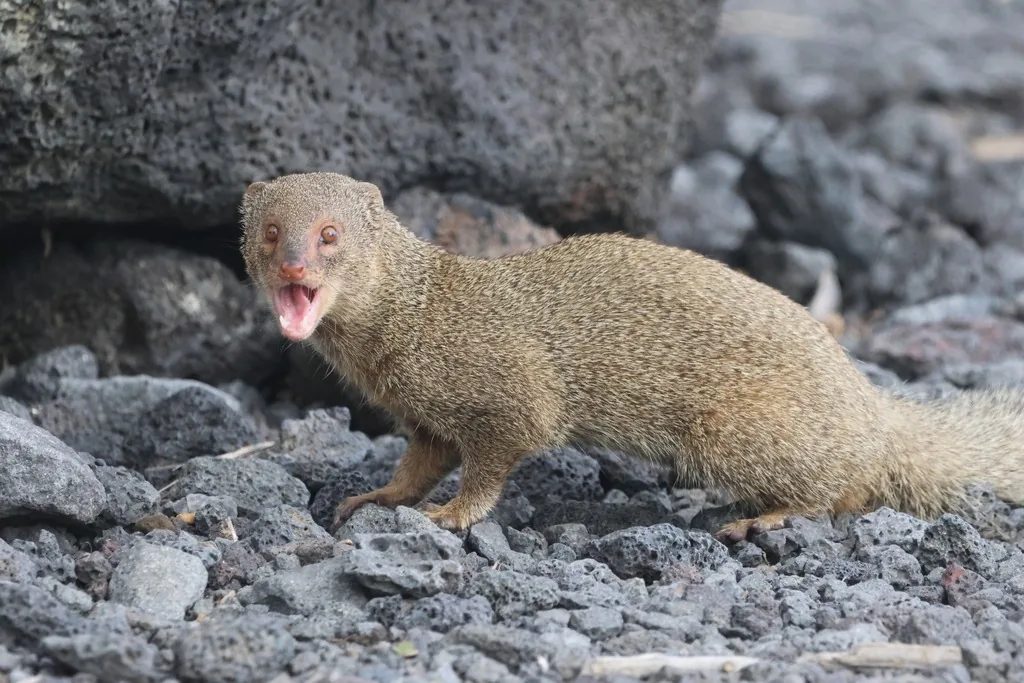
How to identify it
Look-alikes
| Look-alike | How to tell them apart |
|---|---|
| Feral cats | The Kauai Invasive Species Committee says cats are often mistaken for mongooses. Cats usually come out around dusk and are active at night, while mongooses are active by day; a running mongoose holds its tail parallel to the ground, while a cat's tail often curves upward.[2] |
| Rats | Rats can be mistaken for mongooses too, but rats have a hairless tail and are usually much smaller.[2] |
Where it lives
Widespread on Hawaii Island, Oahu, Maui and Molokai, with no known established populations on Lanai or Kauai; on Kauai, single animals arriving with cargo have been trapped near Nawiliwili Harbor and Lihue Airport in 2012, 2016, 2021 and 2023. Outside Hawaii it was also introduced to several Caribbean islands, including Jamaica and Puerto Rico, to control rats in sugarcane.[1][5][2][6][3]
Biology and life cycle
Females can breed from about 10 months of age and have two or three litters of about three pups a year.[2]
They live in wet and dry places alike, including gardens, grasslands and forests.[1]
Fun fact: island life has changed its body in little more than a century. A 2020 study compared mongooses in their sparsely populated native range with dense introduced populations on four tropical islands: males on the islands had smaller scent-marking pads and larger testes, a fast evolutionary shift the authors link to how often mongooses meet each other there.[7]
Damage and signs
- Mongooses eat birds, small mammals, reptiles, insects, fruits and plants; the eggs and hatchlings of ground-nesting seabirds and waterbirds such as the nene, and of endangered sea turtles, are especially at risk.[1][2]
- They kill birds, including 8 federally listed endangered Hawaiian species such as the Hawaiian crow, Hawaiian petrel and nene.[1]
Health risk
Wild mongooses can carry disease. In Puerto Rico the Department of Health calls the mongoose the island's main rabies reservoir, and USDA scientists report it accounts for over 70% of reported animal rabies cases there; in a 2014-21 survey 17.0% of mongooses tested carried antibodies showing exposure to rabies. A 2015 human rabies death in Puerto Rico followed a mongoose bite for which the man never sought care. Hawaii is the only rabies-free state, but a 1970s survey on Oahu found leptospirosis bacteria in 23.0 percent of mongooses tested.[3][8][9][4][10]
Control
Prevention
On Kauai and Lanai, report any mongoose sighting right away to the state pest hotline, 808-643-7378 (643-PEST), or at 643pest.org; on the islands where mongooses are established, routine sightings don't need to be reported.[1][5]
If a mongoose bites you: Puerto Rico's Department of Health says to wash the wound right away with plenty of soap and water and get medical care, and adds that rabies in people can be prevented if treatment starts soon after exposure, before symptoms. Where rabies is present it advises avoiding all contact with mongooses, keeping pets' rabies shots up to date and taking a bitten pet to a veterinarian at once.[3]
When to call a professional
On Kauai, rapid-response teams from the invasive species committee and the Department of Health catch arriving mongooses with live traps; 43 traps were set around Nawiliwili Harbor for the 2023 capture.[5][2]
Common questions
- Should I report a mongoose in Hawaii?
- Yes on Kauai or Lanai, where they aren't established: call 643-PEST. On Hawaii Island, Oahu, Maui and Molokai, sightings don't need to be reported.[1]
- Why are there mongooses in Hawaii?
- The sugar industry brought them in 1883 to control rats in cane fields, but mongooses are active by day while rats are mostly active at night, so they had little effect on the rats.[2][1]
- Can a mongoose give you rabies?
- In Puerto Rico, yes: the Department of Health calls the mongoose the island's main rabies reservoir and vector, and a man died of rabies in 2015 after a mongoose bite he never had treated. Hawaii is rabies-free, so Hawaii's mongooses are not a rabies source.[3][9][4]
- Is a mongoose a cat or a rat?
- Neither. People often mistake cats and rats for mongooses, but mongooses are active by day and run with the tail held level, while rats have a hairless tail and are usually much smaller.[2]
Sources
- Hawaii Invasive Species Council (Hawaii Department of Land and Natural Resources), “Mongoose (Urva auropunctata) (species page).” dlnr.hawaii.gov/hisc/mongoose-urva-auropunctata/ (accessed 2026-11-12)
- Kauai Invasive Species Committee, “Mongoose (pest page).” www.kauaiisc.org/pests/mongoose/ (accessed 2026-11-12)
- Puerto Rico Department of Health, “Rabies (Rabia): rabies alert and Health Department recommendations.” oeca.salud.pr.gov/en/rabie/ (accessed 2026-11-12)
- Hawaii Department of Agriculture, “Quarantine FAQs (Animal Industry Division).” dab.hawaii.gov/ai/?p=59 (accessed 2026-11-12)
- Hawaii Department of Agriculture, “Mongoose Captured on Kauai (news release, May 2023).” dab.hawaii.gov/blog/main/nr23-08nawiliwilimongoose/ (accessed 2026-11-12)
- J Wildl Dis 2015;51(4):896-900, via PubMed, “Exposure to Rabies in Small Indian Mongooses (Herpestes auropunctatus) from Two Regions in Puerto Rico.” pubmed.ncbi.nlm.nih.gov/26251987/ (accessed 2026-11-12)
- Evolution 2020, via PubMed, “Rapid evolution by sexual selection in a wild, invasive mammal.” pubmed.ncbi.nlm.nih.gov/31989582/ (accessed 2026-11-12)
- J Wildl Dis 2023;59(4):577-589, via PubMed, “Rabies virus serosurvey of the small Indian mongoose (Urva auropunctata) across multiple habitats in Puerto Rico, 2014-21.” pubmed.ncbi.nlm.nih.gov/37486871/ (accessed 2026-11-12)
- MMWR Morb Mortal Wkly Rep 2017;65(52):1474-1476, via PubMed, “Human Rabies - Puerto Rico, 2015.” pubmed.ncbi.nlm.nih.gov/28056006/ (accessed 2026-11-12)
- Public Health Rep 1976, via PubMed, “Prevalence of rodent and mongoose leptospirosis on the Island of Oahu.” pubmed.ncbi.nlm.nih.gov/822470/ (accessed 2026-11-12)
- iNaturalist, “Urva auropunctata taxon page (order and family).” www.inaturalist.org/taxa/925979 (accessed 2026-10-06)