On this page
How to identify it
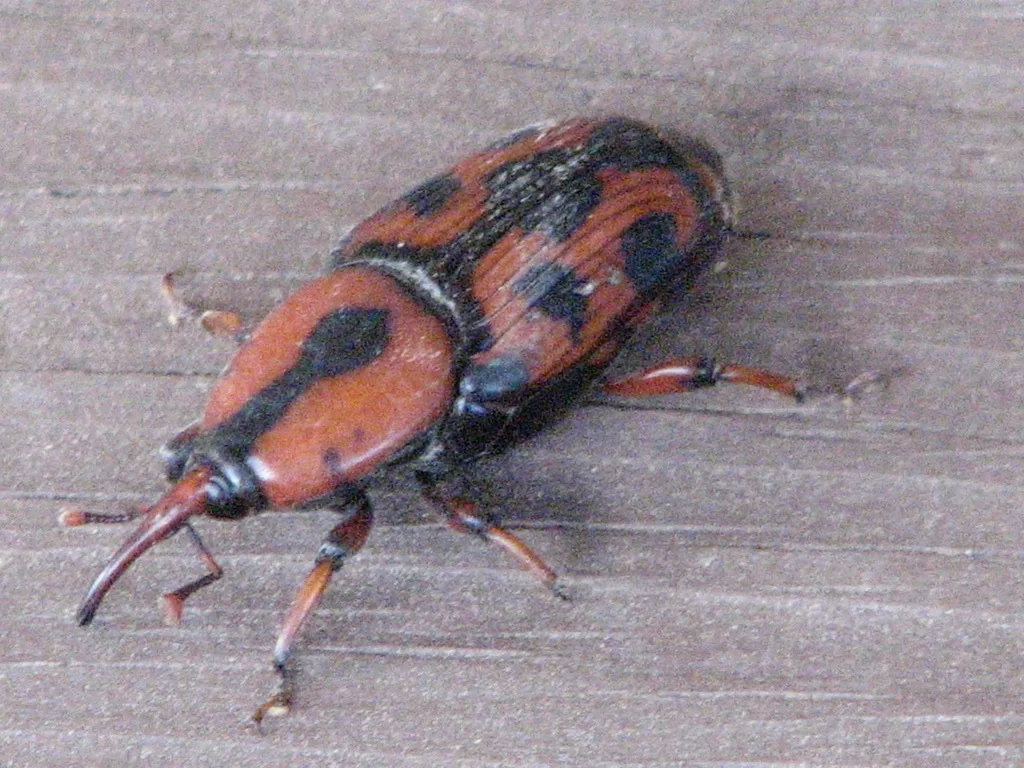
- Adults are large weevils, 2.7 to 3.3 cm (a little over 1 inch) long, with a long snout. They range from dull to shiny and from reddish brown to black, or a pattern of both. UF/IFAS gives 1.9 to 3.0 cm from the snout tip to the end of the abdomen, with colors from solid black to almost entirely red with a variable black pattern. Males' snouts are covered with tiny bumps; females' are smooth and shiny.[1][6]
- Larvae live inside the palm and spin a cocoon of plant fibers in which they pupate. UF/IFAS describes the grubs as legless and creamy to yellowish, with a hard dark brown head and large jaws; mature grubs can weigh close to six grams.[1][6]
- Florida's Division of Plant Industry tells it from the red palm weevil and the South American palm weevil by the pronotum, the shield behind the head: evenly curved at the rear and abruptly narrowed at the front. It is red, red and black, or black.[2]
- Symptoms in the palm commonly start as a general, often irreversible decline of the younger leaves. In upright-leaved palms such as Canary Island date palm, older leaves droop early on and soon collapse. Eventually rot and feeding weaken the crown until the top falls over, a condition called 'popped neck.'[6]
Look-alikes
| Look-alike | How to tell them apart |
|---|---|
| South American palm weevil | A related palm weevil, Rhynchophorus palmarum. It carries the nematode that causes red ring disease of palms; the palmetto weevil has not been proven to carry that nematode.[1] |
Where it lives
Native to the Southeast. CDFA gives its range as South Carolina south through Florida, including the Keys, and west to Texas, plus Andros Island in the Bahamas, possibly as an introduction; Florida's Division of Plant Industry lists Florida, Georgia, South Carolina, Louisiana and Texas and says it occurs throughout Florida. GBIF holds 693 U.S. records since 1990, most from Florida (571), then Georgia, South Carolina and Texas, with a few from Alabama, Mississippi, Louisiana and North Carolina. CDFA says it is not known in California. UF/IFAS gives coastal South Carolina through the Florida Keys and west into coastal Texas, plus all of Florida, and notes a 2008 report from the Bahamas; fossils suggest it was in Florida about 1 million years ago.[1][2][3][6]
Biology and life cycle
Females lay eggs in the bases of leaf stalks or in wounds on the palm, and the larvae tunnel and feed inside. Adults fly. In the lab a female lays an average of 207 eggs, which hatch in about three days. UF/IFAS says the grubs feed mostly in the soft tissue around the palm's growing point, and the whole cycle from egg to adult takes about 84 days. Adults can live several weeks to several months if they have moisture, up to 26 weeks in captivity.[1][6]
For the giant palm weevils as a group, Florida's Division of Plant Industry gives a total life cycle of 45 to 180 days; larvae feed inside the palm and then pupate in a cell built from palm fibers.[2]
UF/IFAS says adults fly and can be found all year in Florida, but are most noticeable in late spring and early summer and least in the cool, dry winter. Between flights they hide among the leaf bases of healthy palms.[6]
Odors from stressed, wounded or dying palms draw the weevils in. Feeding males then release an aggregation pheromone, cruentol, and the pheromone and the palm odors together attract many more weevils than either alone; mating and egg laying follow.[6]
UF/IFAS suspects the silky cane weevil, introduced to Dade County in the early 1980s, stresses palms through its own feeding at small wounds such as pruning cuts and so sets them up for palmetto weevil attack.[6]
Damage and signs
- Larval feeding can weaken the palm so much that the crown falls over.[1]
- In native cabbage palmettos CDFA says it apparently attacks only stressed trees, but introduced palms such as Canary Island date palm can be attacked and killed while they still look healthy, sometimes in large numbers: 97% of the Canary Island date palms in one Florida nursery were killed. Florida's Division of Plant Industry adds that it can be a severe pest of sabal palms in landscapes, especially newly planted trees under stress. UF/IFAS adds that palms in undisturbed places are rarely infested, and lightning-struck palms have been seen with infestations afterward.[1][2][6]
- Besides Phoenix and Sabal palms, CDFA lists Caryota, Cocos (coconut), Latania, Pritchardia, Roystonea (royal palms), Thrinax and Washingtonia palms as hosts. Florida's Division of Plant Industry also lists Bismarck palm (Bismarckia nobilis), saw palmetto (Serenoa repens) and date palm (Phoenix dactylifera).[1][2]
Health risk
It is a borer of palms. CDFA and Florida's Division of Plant Industry describe it only as a pest of palms; neither mentions bites, stings or any effect on people or pets.[1][2]
Control
Prevention
Stress is the main warning sign in native palms: CDFA says cabbage palmettos are apparently attacked only when stressed, and Florida's Division of Plant Industry points to newly planted, stressed sabal palms in landscapes. Introduced palms such as Canary Island date palm can be attacked while they look healthy.[1][2]
For nursery and landscape palms, UF/IFAS advises growing them with proper fertilization and irrigation, taking extra care with Canary Island date palms, which aren't adapted to south Florida's climate, and avoiding wounds such as pruning cuts.[6]
Sanitation
Because larvae feed out of sight, CDFA notes the damage is often not apparent until the palm's death is inevitable. CDFA adds that the weevil could be moved with whole palms or cut fronds; one was intercepted at a California border station on palm fronds from Florida in 2011.[1]
UF/IFAS says there is little if any chance of saving an infested palm. The best course is to cut it down and destroy it before adults emerge, which also protects nearby palms.[6]
Pesticides
Preventive insecticide treatment of newly transplanted palms is an option, but UF/IFAS says costs climb quickly unless only a few trees are protected; curative and preventive systemic neonicotinoid treatments are possible but take vigilance and persistence. Follow the label.[6]
Why California rates it a top-priority pest
The California Department of Food and Agriculture gives it an A rating: it is not known to be established in California but was intercepted at a border station on palm fronds from Florida in 2011. CDFA notes that because larvae feed inside the palm the damage often isn't apparent until the tree can't be saved, and that it could threaten both ornamental palms and date palms if it became established.[1]
Regulatory status
CDFA's pest rating profile gives the palmetto weevil an A rating for California and says it is not known to be under official control anywhere.[1]
UF/IFAS reports that in January 2010 the federal government prohibited importing live palms of 17 genera into the United States, because palm weevils are suspected of spreading with imported palms.[6]
Where the sources disagree
Family: CDFA and GBIF place it in the family Dryophthoridae; Florida's 2010 pest alert uses the broader weevil family Curculionidae.[1][4][2]
Range: CDFA gives South Carolina to Florida and west to Texas; Florida's Division of Plant Industry also lists Georgia and Louisiana, and GBIF holds records from Alabama, Mississippi and North Carolina as well.[1][2][3]
Size: CDFA gives adults of this species as 2.7 to 3.3 cm long; Florida's alert gives the giant palm weevils as a group as about 1 to 1.8 inches (25 to 45 mm).[1][2]
Healthy palms: CDFA says it apparently attacks only stressed cabbage palmettos; Florida's Division of Plant Industry says it mostly attacks wounded or dying palms but can be a severe pest of sabal palms in landscapes.[1][2]
Hosts: CDFA counts eight palm genera; Florida's list adds Bismarck palm and saw palmetto.[1][2]
Size of this species: CDFA gives 2.7 to 3.3 cm; UF/IFAS gives 1.9 to 3.0 cm from snout tip to abdomen tip and stresses that size varies a lot.[1][6]
Life cycle: Florida's alert gives 45 to 180 days for giant palm weevils as a group; UF/IFAS gives about 84 days from egg to adult for the palmetto weevil.[2][6]
Common questions
- Why is my palm's center collapsing?
- Palmetto weevil larvae feeding inside the palm are one cause; their feeding can make the crown fall over. CDFA singles out stressed cabbage palmettos and introduced palms such as Canary Island date palm.[1]
- Can an infested palm be saved?
- Rarely. The feeding is hidden inside the palm and usually isn't noticed until the tree's death is inevitable.[1]
- Can a palm with palmetto weevils be saved?
- Rarely. UF/IFAS says infestations are hard to detect early and there is little if any chance of saving an infested palm, so remove and destroy it before adults emerge.[6]
- Why did the top of my palm fall over?
- A palm whose crown has toppled may have 'popped neck', where palmetto weevil grubs and rot have destroyed the crown. If the palm is pulled apart, grubs, cocoons and adults may be found inside.[6]
Sources
- California Department of Food and Agriculture (Pest Ratings), “California Pest Rating: Palmetto Weevil | Rhynchophorus cruentatus (Fabricius).” blogs.cdfa.ca.gov/Section3162/?p=5576 (accessed 2026-11-13)
- Florida Department of Agriculture and Consumer Services, Division of Plant Industry, “Pest Alert: Giant Palm Weevils of the Genus Rhynchophorus (Coleoptera: Curculionidae) and Their Threat to Florida Palms (DACS-P-01719, Michael C. Thomas, 2010).” ccmedia.fdacs.gov/content/download/66344/file/pest_alert_-_giant_palm_weevils_of_the_genus_rhynchophorus.pdf (accessed 2026-11-13)
- Global Biodiversity Information Facility (GBIF), “Rhynchophorus cruentatus: U.S. occurrence records since 1990 by state (GBIF occurrence search).” api.gbif.org/v1/occurrence/search?taxonKey=5008533&country=US&hasGeospatialIssue=false&occurrenceStatus=PRESENT&year=1990%2C2026&facet=stateProvince&facetLimit=400&limit=0 (accessed 2026-11-13). State counts are records reported, not abundance. 693 records on 2026-11-13.
- Global Biodiversity Information Facility (GBIF), “Rhynchophorus cruentatus (J.C.Fabricius, 1775) (GBIF Backbone Taxonomy).” api.gbif.org/v1/species/5008533 (accessed 2026-11-13)
- iNaturalist, “Rhynchophorus cruentatus taxon page (order and family).” www.inaturalist.org/taxa/130352 (accessed 2026-10-06)
- University of Florida IFAS Extension, EDIS (Featured Creatures), “Palmetto Weevil, Rhynchophorus cruentatus Fabricius, EENY013/IN139 (Featured Creatures).” ask.ifas.ufl.edu/publication/IN139 (accessed 2026-11-14)