On this page
How to identify it
- Adults are small dark gray flies with yellow markings, about the size of an eye gnat. NC State gives a length of 3/32 inch; UC IPM describes Liriomyza leafminer adults as about 1/12 inch long, mostly black and yellow, with clear wings.[1][2]
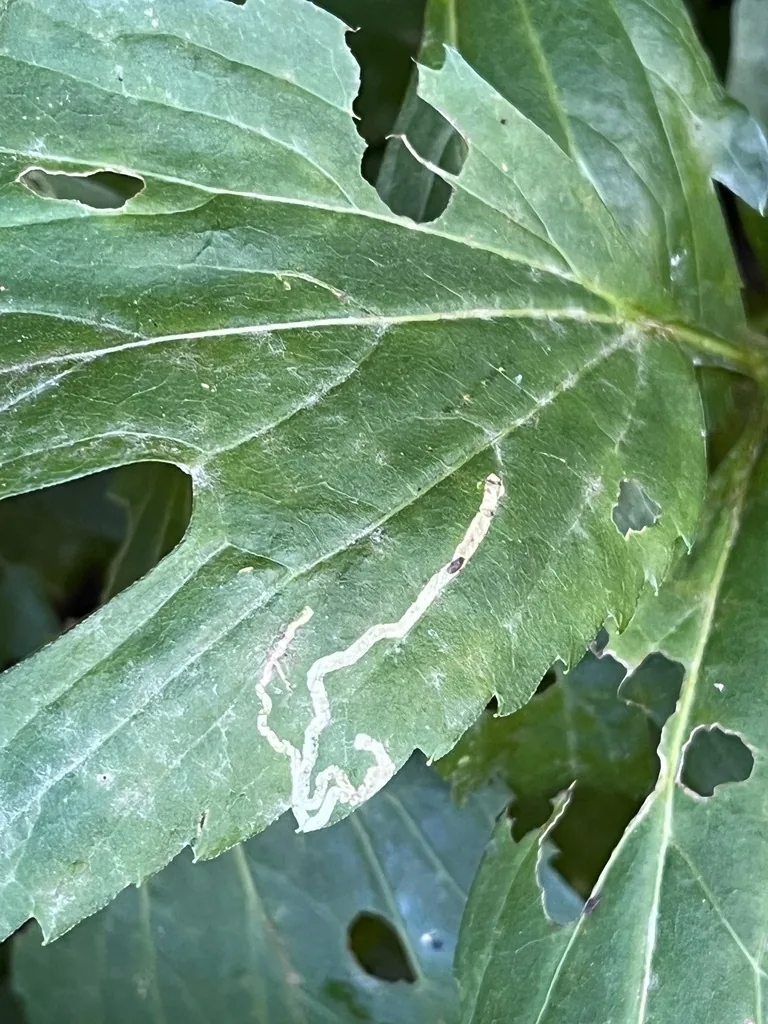
- Each white to yellow maggot feeds inside the leaf and shows through the surface in its own winding (serpentine) mine, which it widens and lengthens as it grows. In this species the mines are easy to see from the top of the leaf.[1][2]
- Females puncture the leaf surface, and both sexes drink the sap that pools in the holes. The punctures turn into small, round, pale spots that show clearly when a leaf is held against the light.[1][2][3]
Look-alikes
| Look-alike | How to tell them apart |
|---|---|
| Vegetable leafminer | A close relative in the same genus that also makes winding mines in bean, pea, pepper, potato, tomato, squash and other vegetables. Liriomyza species are hard to tell apart by eye; UC IPM suggests collecting a few and taking them to the county agriculture office or Cooperative Extension for identification.[4][2] |
| Spinach and beet leafminers | A larger, hairy gray or brownish fly, about 1/4 inch long. Its whitish, carrot-shaped maggots make blotch mines that start long and narrow and become an irregular patch, not a thin winding trail.[4] |
Where it lives
Native to the Americas, it has spread around the world over the past 50 years. In the US it is an outdoor vegetable and flower pest in warm weather, with three or four generations a year in North Carolina, and UC IPM covers it among the leafminers of greenhouse and nursery flower crops in California.[5][1][2]
Biology and life cycle
Heat sets the pace. NC State says a complete generation takes about two weeks in hot weather, with at least three or four generations a year outdoors in North Carolina. UC IPM gives about a month at common greenhouse temperatures, 14 days at 95°F and 64 days at 59°F.[1][2]
Females can live three to four weeks and may lay 200 to 400 eggs over their lifetime, inserting each tiny white egg into the leaf.[1]
In a lab study the fly completed development on bean, chrysanthemum, potato, bell pepper and tomato, doing best on bean and bell pepper. Some fertilizer treatments slowed its development and reduced survival, adult life span and egg-laying.[6]
Damage and signs
- Hosts include aster, baby's breath, chrysanthemum, dahlia, daisy, marigold, petunia, sunflower and zinnia, and vegetables such as bean, cantaloupe, carrot, celery, cucumber, eggplant, lettuce, onion, pea, pepper, potato and tomato. Weeds such as nightshade and Bidens are also hosts.[1][6]
- The mines make foliage unsightly and, when abundant, unmarketable. Heavy mining rarely if ever kills a plant but can slow growth and make infested leaves drop early.[2]
- In vegetable gardens, leafminer feeding has little effect on plant growth but can spoil crops grown for their edible leaves.[4]
Health risk
It feeds inside plant leaves; none of the sources describes any harm to people or pets.[1][2]
Control
Prevention
Check transplants before planting and discard plants or leaves that already have mines.[2]
Sanitation
Pull broadleaf weeds that host leafminers, such as lambsquarters and nightshade, and pick off and destroy mined leaves while the damage is still light.[4][1][2]
Traps and physical control
Fine-mesh row cover keeps the flies off young plants, but only in beds that haven't had leafminers for at least a year; pupae that overwintered in the soil can emerge under the cover. Tilling after harvest destroys pupae.[4]
Biological control
Tiny parasitic wasps generally keep Liriomyza leafminers low outdoors. On chrysanthemums and other flowers, NC State suggests ignoring the mines and letting the parasites do the work.[1][2]
Pesticides
Broad-spectrum sprays such as pyrethroids kill the parasites and only encourage this leafminer; UC IPM says outbreaks commonly follow persistent insecticides applied for other pests, and resistance is widespread in Liriomyza. If a product must be used, NC State names a systemic such as imidacloprid. Follow the label.[1][2]
One species or two?
A 2025 genome-wide study found that leafminers from pepper and tomatillo form a separate group with no gene flow to the rest of Liriomyza trifolii, strong evidence of a previously unrecognized species. The authors say having two species under one name matters for management.[5]
Where sources disagree
Where it pupates: UC IPM says mature Liriomyza larvae commonly leave the mine and pupate in topsoil or growing media, only uncommonly on leaves; NC State describes the new fly emerging from the pupal skin and through the upper leaf surface.[2][1]
Pupa color: NC State calls the seed-like pupa light brown; UC IPM says Liriomyza pupae are orange or yellow.[1][2]
Common questions
- What makes the white squiggly lines in my leaves?
- Often the maggots of a leafminer fly, such as the American serpentine leafminer, feeding between the upper and lower leaf surfaces. The trail gets wider as the maggot grows.[1][4][2]
- Should I spray?
- Usually not. Parasitic wasps tend to keep it in check, pyrethroid sprays kill those wasps and encourage the leafminer, and many Liriomyza populations resist insecticides.[1][2]
- Do I need to do anything about mines on my vegetables?
- Often not: leafminer feeding has little effect on plant growth, and natural enemies usually keep vegetable leafminers in check. On leafy greens, where the leaves are the harvest, remove mined leaves while the damage is small.[4]
Sources
- NC State Extension, “American Serpentine Leafminer (PDIC Factsheet).” content.ces.ncsu.edu/american-serpentine-leafminer (accessed 2026-11-11)
- University of California Statewide IPM Program, “Leafminers (Floriculture and Ornamental Nurseries Pest Management Guidelines).” ipm.ucanr.edu/agriculture/floriculture-and-ornamental-nurseries/leafminers/ (accessed 2026-11-11)
- University of California Statewide IPM Program, “Leafminers (Lettuce Pest Management Guidelines).” ipm.ucanr.edu/agriculture/lettuce/leafminers/ (accessed 2026-11-11)
- University of Minnesota Extension, “Leafminers in home gardens.” extension.umn.edu/yard-and-garden-insects/leafminers (accessed 2026-11-11)
- Evolutionary Applications, via PubMed, “Population Phylogenomics and Genetic Structure of the Polyphagous Leafminer, Liriomyza trifolii (Xuan et al. 2025).” pubmed.ncbi.nlm.nih.gov/40642030/ (accessed 2026-11-11)
- Neotropical Entomology, via PubMed, “Host Plants and Fertilization Mediated Life History of American Serpentine Leaf Miner, Liriomyza trifolii (Dehghan et al. 2024).” pubmed.ncbi.nlm.nih.gov/39026134/ (accessed 2026-11-11)
- iNaturalist, “Liriomyza trifolii taxon page (order and family).” www.inaturalist.org/taxa/243751 (accessed 2026-11-11)