On this page
How to identify it
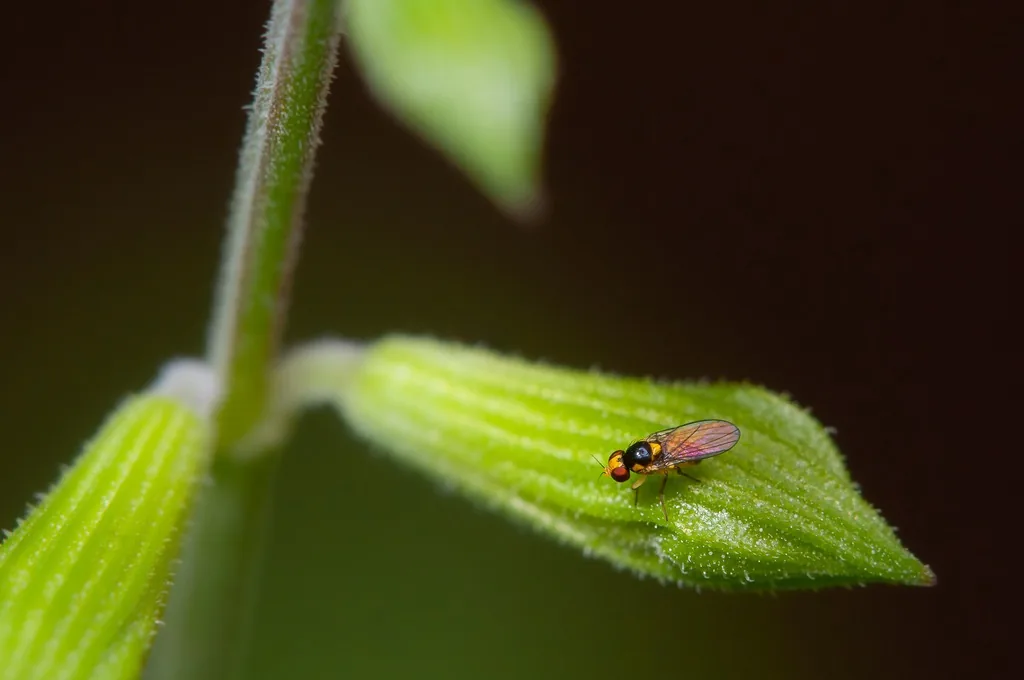
- Adults are small black and yellow flies, about 0.06 inch (1.5 mm) long, with a bright yellow triangle on the back between the wing bases. Wisconsin describes the adult as a shiny yellow-brown fly with black markings. UF/IFAS gives a wing length of 1.25 to 1.7 mm, about 1.3 mm in males and 1.5 mm in females, and says females are larger, with an elongated abdomen.[3][2][5][7]
- Its back is shiny black, and behind the eyes it is mostly black, with about a quarter to a third of the rear rim of the eye bordered in black. The American serpentine leafminer has a dull gray back and mostly yellow behind the eyes. UF/IFAS uses the same two features: the shiny black back and the black rear margin of the eyes, against the serpentine leafminer's grayish back and yellow eye margins.[3][2][7]
- Larvae are yellowish maggots, about 2 mm long when they leave the leaf to pupate. Pupae are brown and look like tiny grains of rice. UF/IFAS says larvae reach about 2.25 mm, starting nearly colorless and turning greenish, then yellowish, with black mouthparts visible at every stage; the reddish brown puparium is about 1.5 mm long.[3][2][7]
Look-alikes
| Look-alike | How to tell them apart |
|---|---|
| American serpentine leafminer | Nearly identical mines, maggots and pupae. The adult's back looks silvery gray from overlapping bristles, the area behind the eyes is mostly yellow, and it is much more resistant to insecticides. UF/IFAS says the American serpentine leafminer, which seems more resistant to insecticides, has displaced it in importance in most of the U.S.[2][3][7] |
| Pea leafminer | Liriomyza huidobrensis is bigger, with a wing length of 1.7 to 2.25 mm, and has dark rather than yellow thighs.[7] |
Where it lives
Native to the Americas and now also in Africa, Asia and Oceania, carried mainly on traded vegetables and plants. It is common throughout California. Wisconsin Extension covers it as more of a greenhouse problem there, especially on tomato and cucumber transplants. UF/IFAS says it is common in the southern United States from Florida to California and Hawaii and in most of Central and South America, and now also in many areas of Asia and the Middle East. It is sometimes reported in colder areas on transported plants but can't survive cold areas except in greenhouses.[4][2][5][7]
Biology and life cycle
Females puncture leaves to lay eggs and to feed. Most punctures are feeding sites where adults drink the sap that oozes out; only a few hold an egg.[3][1]
Larvae feed between the upper and lower leaf surfaces, then drop to the soil to pupate. The EFSA Panel on Plant Health describes three larval stages in the leaf and a short fourth stage in the soil just before pupation.[2][4]
In warm weather the life cycle takes only about 2 weeks, with seven to ten generations a year on California tomatoes, and development continues year-round as the population moves from crop to crop.[2][1]
Eggs are white, about 0.23 mm long, inserted just under the leaf surface, and hatch in about 3 days. Females can lay 600 to 700 eggs over their life, though 200 to 300 may be more typical, starting at 30 to 40 a day.[7]
At 77°F to 86°F the egg and larval stages together take about 7 to 9 days and the pupa another 7 to 9; at 86°F it goes from egg to adult in about 15 days, while at 59°F development stretches to about 25 days.[7]
The mature larva cuts a semicircular slit, almost always in the upper leaf surface, drops out and burrows only a few centimeters into the soil to pupate. Adults emerge about nine days later, mostly in the early morning, and live about a month.[7]
Flies are uncommon in the cool months but often reach damaging numbers by midsummer; in warm climates they breed continuously, with many overlapping generations.[7]
Damage and signs
- It feeds on many crops and weeds. UC IPM lists hosts such as cucurbits, tomatoes, peas, beans and cole crops, plus flowers like aster, dahlia, marigold and petunia. UF/IFAS says it favors the squash, bean and nightshade families and records nearly 40 hosts from 10 plant families in Florida, including bean, eggplant, pepper, potato, squash, tomato and watermelon; in Hawaii it damages scallion foliage.[1][2][4][7]
- Adult feeding punctures turn white and stipple the leaves, but the larval mines, which widen as the larva grows, are the most obvious damage. UF/IFAS says the mine widens from about 0.25 mm to about 1.5 mm as the larva grows, and the larva and its droppings are often visible inside.[1][3][7]
- Heavily mined leaves dry up and drop early. On tomatoes and melons that can reduce yield and fruit size and expose fruit to sunburn.[2][3]
- Greenhouse-grown tomato and cucumber transplants are susceptible, and leafminers build to damaging levels sooner when an infestation starts on transplants.[5][2]
- In California squash trials that UF/IFAS cites, effective insecticides raised yields 30% to 60%, though many of the insecticides tested didn't work.[7]
Health risk
It is a plant pest: the maggots feed inside leaves, and the adult flies feed on plant juices from the punctures females make in leaves.[3][1][7]
Control
Prevention
Check transplants for mines before planting, especially greenhouse-grown tomatoes and cucumbers, and destroy infested ones.[5][2]
In gardens, keep plants well watered, clip off older mined leaves and protect seedlings with protective cloth. Most plants older than seedlings are not seriously hurt.[1]
Row covers over cantaloupe prevented damage in a study UF/IFAS cites. Resistant cultivars, nitrogen levels and reflective mulches give modest or inconsistent results.[7]
Traps and physical control
Yellow sticky traps catch adults and quickly show when flies move in from nearby fields.[7]
Biological control
Parasitic wasps, especially Diglyphus and Chrysocharis species, often keep leafminers below damaging levels when left undisturbed. UF/IFAS says parasitism tends to rise with leafminer density, and that weeds supply parasitoids as well as flies.[1][3][2][7]
Pesticides
Broad-spectrum sprays backfire: organophosphates, carbamates and pyrethroids kill the parasites, and leafminer outbreaks often follow. UC IPM says Liriomyza leafminers resist all three groups and that insecticides are not very effective in gardens. UF/IFAS agrees that many insecticides no longer work, says susceptibility varies from place to place and year to year, and notes outbreaks sometimes follow sprays aimed at other insects.[2][3][1][7]
Where sources disagree
Generations: UC IPM's tomato guidelines give seven to ten a year in California, and its garden page five to ten.[2][1]
Adult color: UC IPM describes a shiny black back with a yellow triangle, while Wisconsin calls the adult a shiny yellow-brown fly with black markings.[2][5]
Common questions
- Why are there white tunnels in my tomato leaves?
- Often the maggots of vegetable leafminer or American serpentine leafminer. Their maggots and pupae are too similar to tell apart in the field.[1][2][5]
- Should I spray for leafminers on tomatoes?
- Usually not in a garden. Spraying broad-spectrum insecticides kills the parasitic wasps that control leafminers and can set off an outbreak.[1][2]
Sources
- UC Statewide IPM Program, “Vegetable Leafminers (Home and Landscape).” ipm.ucanr.edu/home-and-landscape/vegetable-leafminers/ (accessed 2026-11-11)
- UC Statewide IPM Program, “Leafminers, Tomato: Pest Management Guidelines.” ipm.ucanr.edu/agriculture/tomato/leafminers/ (accessed 2026-11-11)
- UC Statewide IPM Program, “Leafminers, Cucurbits: Pest Management Guidelines.” ipm.ucanr.edu/agriculture/cucurbits/leafminers/ (accessed 2026-11-11)
- EFSA Journal, via PubMed, “EFSA Panel on Plant Health (2020), Pest categorisation of Liriomyza sativae.” pubmed.ncbi.nlm.nih.gov/32874253/ (accessed 2026-11-11)
- University of Wisconsin-Madison Extension, “Vegetable Leafminers (A3754-E).” hort.extension.wisc.edu/files/2014/11/A3754-E.pdf (accessed 2026-11-11)
- iNaturalist, “Liriomyza sativae taxon page (order and family).” www.inaturalist.org/taxa/243752 (accessed 2026-10-06)
- University of Florida IFAS Extension, EDIS, “Vegetable Leafminer, Liriomyza sativae Blanchard, EENY255/IN507 (Featured Creatures).” ask.ifas.ufl.edu/publication/IN507 (accessed 2026-11-14)