On this page
How to identify it
- Larvae are tiny, flat caterpillars that taper toward the rear like a rattlesnake's rattle, about 1/4 inch long when grown.[2]
- Each blotch mine holds a single larva. Ohio State says the mines show on the upper surface but not from below; hold a leaf up to the light to see the caterpillar inside.[1][2][3]
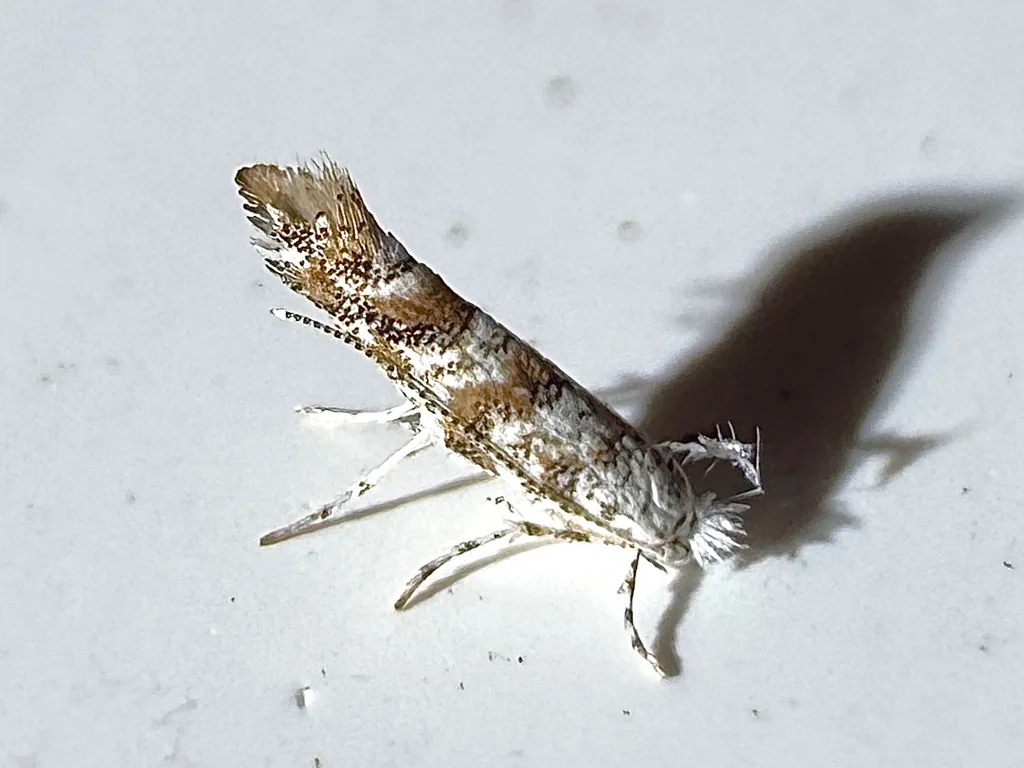
- Adults are tiny, pale silvery moths with bronze blotches on the wings.[2]
Look-alikes
| Look-alike | How to tell them apart |
|---|---|
| Gregarious oak leafminer | Cameraria cincinnatiella, a white oak species that packs up to 12 larvae into one mine.[1] |
Where it lives
Native to North America and widely distributed, Ohio State says. NC State reports it in North Carolina, where it is usually more common on oaks in natural areas than in yards, and Ohio State has found it in southwest Ohio.[3][2]
Biology and life cycle
It spends the winter in fallen oak leaves, but sources differ on the stage: NC State and Ohio State say as larvae, which pupate in spring, while UMass says as pupae. Moths emerge in spring and glue eggs one at a time to the upper surface of new leaves.[1][2][3]
NC State reports two or more generations a year in North Carolina. Ohio State says the number in Ohio is unclear but likely two, and UMass gives 2 to 5 for the genus, depending on climate.[2][3][1]
Mature larvae spin a flimsy white cocoon inside the mine and pupate there.[2]
Damage and signs
- It mainly attacks oaks in the white oak group. NC State says it prefers white oak and sometimes attacks bur, black and red oaks; Ohio State names white, swamp white and bur oak, with fewer on red oaks. UMass lists black, post, red, scrub and white oaks as hosts for these leafminers.[2][3][1]
- Mines turn brown, and heavy infestations cause browning and early leaf drop by late summer.[1][2]
- UMass says that in rare heavy years 80 to 100 percent of foliage can be killed, though there's usually little damage. Ohio State says it has periodic outbreaks in the southern part of its range but has never seen serious damage in Ohio.[1][3][2]
Health risk
It feeds inside oak leaves. UMass, NC State and Ohio State Extension describe leaf damage only and don't mention any risk to people or pets.[1][2][3]
Control
Sanitation
Rake up and destroy fallen oak leaves in fall, where the insects spend the winter. NC State says it has to cover all oaks in the immediate area, and UMass says it works best where yard oaks are away from forest oaks.[1][2][3]
Biological control
Parasitoid wasps and predators kill many leafminers every year; NC State puts it at 21 to 25 percent, and UMass lists at least 14 parasitoid species.[1][2]
Pesticides
NC State does not recommend chemical treatment, and UMass notes sprays are often unnecessary.[1][2]
Common questions
- What are the brown blotches inside my oak leaves?
- Often mines of the solitary oak leafminer; a leaf held up to the light shows the caterpillar inside.[1][2]
- Will oak leafminers hurt my tree?
- Rarely; the damage is mostly cosmetic. Ohio State calls it more of an oddity than a serious pest in Ohio.[2][3][1]
Sources
- UMass Extension Landscape, Nursery and Urban Forestry Program (Landscape Insect & Mite Guide), “Cameraria spp. (Oak Blotch Leafminer).” www.umass.edu/agriculture-food-environment/landscape/publications-resources/insect-mite-guide/cameraria-spp (accessed 2026-11-13)
- NC State Extension, “Solitary Oak Leafminer (PDIC Factsheet).” content.ces.ncsu.edu/solitary-oak-leafminer (accessed 2026-11-13)
- Ohio State University Extension, “Solitary Oak Leafminer: An Oddity or a Serious Pest? (Joe Boggs, BYGL, July 18, 2026).” bygl.osu.edu/node/2673 (accessed 2026-11-13)
- Global Biodiversity Information Facility (GBIF), “Cameraria hamadryadella (Clemens, 1859) (GBIF Backbone Taxonomy).” api.gbif.org/v1/species/5104706 (accessed 2026-11-13)
- iNaturalist, “Cameraria hamadryadella taxon page (order and family).” www.inaturalist.org/taxa/215951 (accessed 2026-10-06)