On this page
How to identify it
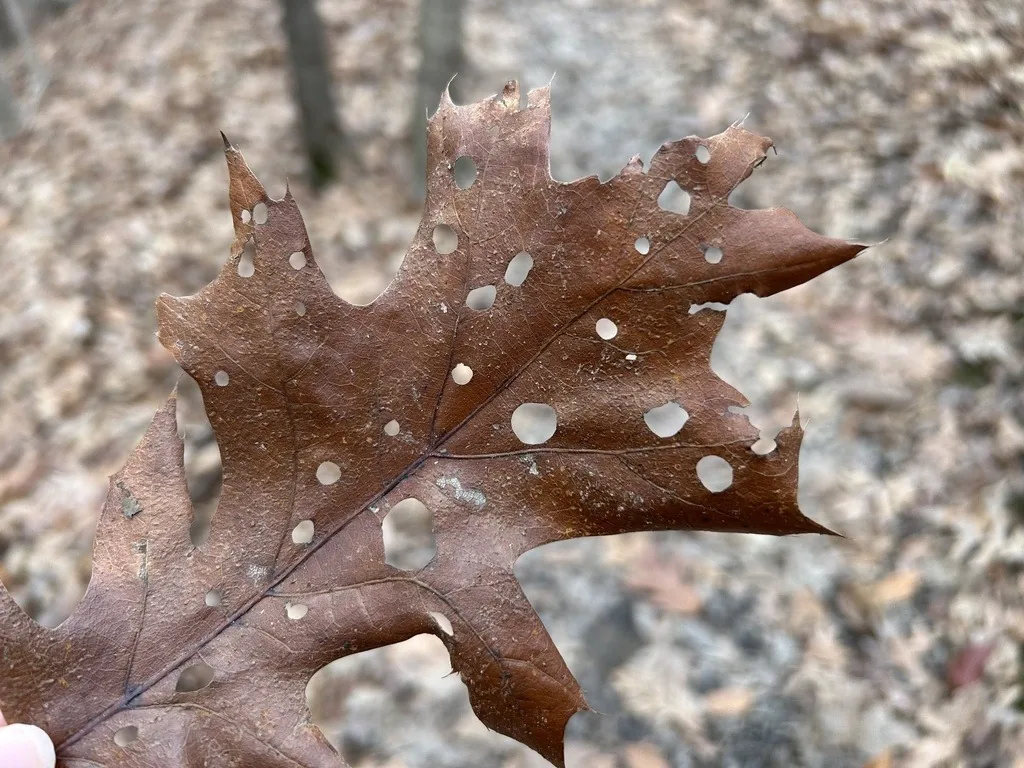
- Round holes, often matching on both halves of a new leaf, are the first sign. UMass says each hole starts as a puncture under 1 mm and ends about six times larger; NC State says holes reach up to 3/8 inch. A small dead disc of tissue often stays stuck in the hole.[1][2]
- Active blotch mines are light green to tan and darken after the maggots leave; the dead tissue then drops out and leaves ragged holes.[1][2]
- The adult flies are about 3 mm long and rarely noticed.[2][1]
Look-alikes
| Look-alike | How to tell them apart |
|---|---|
| Spongy moth and winter moth caterpillars | Caterpillar chewing on young oak leaves can look similar. UMass says the leftover disc of tissue in each hole and the blotch mines point to the leafminer.[2] |
Where it lives
It is native and reported from Maine to Georgia, probably across the eastern half of the United States. The 2019 outbreak was seen in Massachusetts, coastal Rhode Island, southern New Hampshire, eastern New York and eastern Pennsylvania, and USDA researchers studied damage in the mid-Atlantic in 2019 and 2020.[2][4][5][3]
Biology and life cycle
Females are active from bud break until leaves are about 5 cm long, piercing buds and young leaves with the egg-laying tube to feed on sap and lay the odd egg. The 2025 study tied the shotholes to these punctures.[2][1][3]
There is one generation a year. Maggots leave the leaves to pupate in the soil, where they stay through summer and winter. Timing varies by region: NC State says by the end of May in North Carolina, and UMass gives early to mid-May in Ohio but mines appearing in the second week of June in Maine.[1][2]
Outbreaks tend to last a couple of years and then collapse. The 2025 study suggests damage only becomes obvious when adult emergence lines up with bud break, and that trap catches could warn of an outbreak coming.[2][3][5]
Damage and signs
- Hosts include black, bur, post, red, scrub, turkey and white oaks and Chinese chestnut. In the 2025 study, chestnut oak was the least damaged, while northern red and scarlet oaks were highly susceptible, with deformed leaves and bigger holes.[1][3][5]
- Sources weigh the damage differently. NC State calls the holes and mines cosmetic, and UMass says it is usually not significant. USDA ARS says heavy outbreaks can cause leaf drop that harms tree health.[1][2][5]
- In the 2019 outbreak, oak anthracnose made things worse in some trees. UMass says the fungus appeared to use the leafminer's wounds, and the white oak group is especially susceptible to the disease, mainly after long wet spells early in the season.[4][2]
- Early leaf loss is usually survivable: UMass says most healthy trees have the reserves to grow a second flush of leaves and suffer only minor growth losses.[4]
Health risk
It feeds inside oak leaves. NC State, UMass and USDA ARS describe tree damage only and don't mention any risk to people or pets.[1][2][5]
Control
Biological control
NC State says numerous parasites attack it and the next year's infestation may not be noticeable. UMass says its natural enemies aren't well understood.[1][2]
Pesticides
Spraying isn't recommended. By the time holes show, the maggots have usually left, so NC State says pesticides are probably best avoided; UMass knows of no cultural controls.[1][2]
Common questions
- Why do my new oak leaves have round holes in them?
- Probably oak shothole leafminer. Females puncture the buds in spring, and the punctures widen into holes as the leaves grow.[1][2]
- Should I spray for oak shothole leafminer?
- No. By the time you see damage the maggots are gone, and spraying won't make the leaves look better.[1][2]
- Will it happen again next year?
- Maybe not. Outbreaks usually last a couple of years and then fade.[1][2]
- Which oaks are hit hardest?
- In a 2019 to 2020 mid-Atlantic study, northern red and scarlet oaks suffered most and chestnut oak least.[3][5]
Sources
- NC State Extension, “Oak Shothole Leafminer (PDIC Factsheet).” content.ces.ncsu.edu/oak-shothole-leafminer (accessed 2026-11-13)
- UMass Extension Landscape, Nursery and Urban Forestry Program (Landscape Insect & Mite Guide), “Japanagromyza viridula (Oak Shothole Leafminer).” www.umass.edu/agriculture-food-environment/landscape/publications-resources/insect-mite-guide/japanagromyza-viridula-formerly-agromyza-viridula (accessed 2026-11-13)
- J Econ Entomol 2025;118(2):770-779, via PubMed, “Anatomy of a forest pest outbreak: the oak shothole leafminer, damage, and host susceptibilities (Quesada et al., 2025).” pubmed.ncbi.nlm.nih.gov/40079523/ (accessed 2026-11-13)
- UMass Amherst Center for Agriculture, Food, and the Environment, “Leaf Damage to Oaks Caused by the Oak Shothole Leafminer and Oak Anthracnose (Pest Alert, June 13, 2019).” ag.umass.edu/landscape/news/leaf-damage-to-oaks-caused-by-oak-shothole-leafminer-oak-anthracnose (accessed 2026-11-13)
- USDA Agricultural Research Service, “Anatomy of a forest pest outbreak: the oak shothole leafminer, damage, and host susceptibilities (publication record and interpretive summary).” www.ars.usda.gov/research/publications/publication/?seqNo115=420496 (accessed 2026-11-13)
- Global Biodiversity Information Facility (GBIF), “Japanagromyza viridula (Coquillett, 1902) (GBIF Backbone Taxonomy).” api.gbif.org/v1/species/1552795 (accessed 2026-11-13)
- iNaturalist, “Japanagromyza viridula taxon page (order and family).” www.inaturalist.org/taxa/501206 (accessed 2026-10-06)