On this page
How to identify it
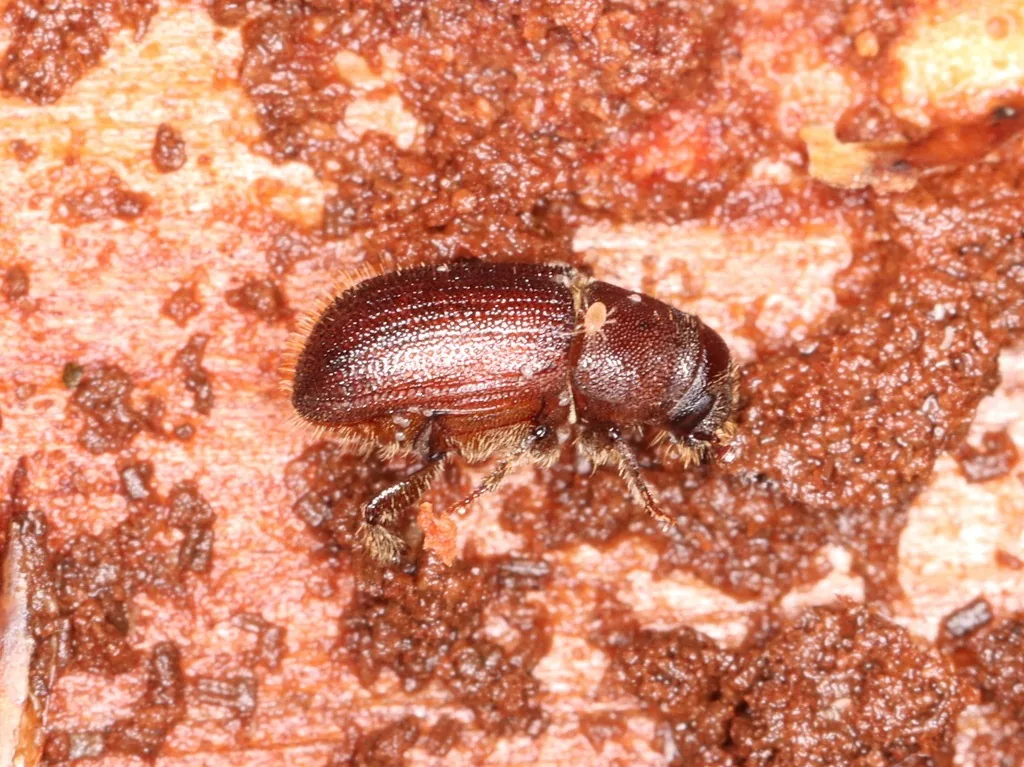
- Adults are reddish brown, about 1/4 to 3/8 inch long, with a rounded rear end; the Forest Service calls it the largest bark beetle in North America, and UC IPM says it's larger than engraver beetles.[1][2][3]
- Attacks show as pitch tubes up to about 2 inches across, pinkish brown, reddish or white, low on the trunk; see where the sources disagree on height.[1][2][3]
- Larvae are cream-colored grubs with a reddish-brown head and feed side by side in a broad gallery packed with frass.[2][1]
Look-alikes
| Look-alike | How to tell them apart |
|---|---|
| Engraver beetles | Engravers usually attack near the top of large pines, have a spiny rear end and push out dry boring dust.[1] |
| Black turpentine beetle | The USDA Forest Service says the red turpentine beetle is absent from the southeastern U.S., from South Carolina to Texas, where the black turpentine beetle occurs instead.[2] |
Where it lives
Native from the Northwest Territories south to Honduras, but absent from the Southeast, the Forest Service says. It's very common on Monterey pine near the California coast and in Sierra Nevada pines, and South Dakota reports it mainly in ponderosa pine. It was introduced to China, where it has killed many Chinese red pines.[2][1][3]
Biology and life cycle
Adults bore into the lower trunk and large roots, and the Forest Service says galleries can follow roots well away from the trunk. Galleries are broad, cave-like and packed with frass.[1][2]
Eggs hatch in one to three weeks and larvae feed as a group. A generation takes under a year in warm areas and up to two in cold ones; Colorado State says at most one a year in Colorado. Adults and larvae overwinter.[2][1][4][3]
Damage and signs
- It attacks pines; see where the sources disagree on other hosts. Freshly cut stumps, fire-damaged, drought-stressed or construction-damaged trees draw attacks.[1][2][4][3]
- Attacks seldom kill trees by themselves. The Forest Service calls it an opportunist whose impact is hard to separate from injury, disease and other beetles, though fire-injured pines it attacks are more likely to die, and non-resinous boring dust encircling the trunk means the tree is likely already dead.[2][1][3]
Health risk
It feeds on trees. UC IPM, the USDA Forest Service, Colorado State and South Dakota DANR describe tree damage only and don't mention any risk to people or pets.[1][2][4][3]
Control
Prevention
Keep trees vigorous: avoid root and trunk injury and soil compaction, and water deeply but infrequently in drought. The Forest Service advises not thinning, pruning or chipping around drought-stressed pines in spring, and scheduling such work for late summer or fall.[1][2][3]
Sanitation
Remove heavily attacked trees and chip, burn or haul infested wood promptly, and don't stack fresh pine logs, firewood or chips next to live pines.[1][2][3]
Pesticides
Preventive bark sprays on the lower trunk can protect high-value pines that aren't yet attacked; the Forest Service names carbaryl, permethrin and bifenthrin. No spray saves a tree that's already been mass-attacked. See where the sources disagree on who should spray.[2][1][4][3]
Where the sources disagree
Attack height: South Dakota says usually the lowest 6 feet, UC IPM the lowest 2 to 8 feet, and the Forest Service says pitch tubes usually stay below 8 feet.[3][1][2]
What pitch tubes mean: UC IPM says an attack likely means the tree is stressed. Colorado State says pitch tubes are little cause for concern and show a healthy tree pushing beetles out, and the Forest Service says they mean the tree is defending itself; Colorado State suggests a closer look if five or more new tubes appear within a month or two.[1][4][2]
Hosts beyond pine: UC IPM says rarely larch, spruce or white fir; the Forest Service says occasionally Douglas-fir, larch, spruce and true firs; Colorado State adds recent reports on Colorado blue spruce.[1][2][4]
Who should spray: UC IPM says home-use insecticides aren't effective against bark beetles and protective sprays should be applied by a licensed applicator. The Forest Service says some effective formulations are for licensed applicators only, and South Dakota says high-value trees can be sprayed in spring.[1][2][3]
Common questions
- What are the pink sap blobs at the base of my pine?
- They're likely pitch tubes from red turpentine beetle attacks. A few tubes may mean the tree is fighting back; many fresh ones, or dry boring dust around the base, call for a closer look.[1][4][2]
- Can I spray to save an attacked pine?
- No. Sprays only prevent attacks on trees not yet infested, and once a pine is mass-attacked nothing saves it; prevention through tree health is the main defense.[1][2]
Sources
- University of California Statewide IPM Program, “Bark Beetles (Pest Notes Publication 7421; S. J. Seybold, S. H. Dreistadt, T. D. Paine).” ipm.ucanr.edu/home-and-landscape/bark-beetles/ (accessed 2026-11-13)
- USDA Forest Service (Forest Insect & Disease Leaflets), “Red Turpentine Beetle (FIDL 55, revised June 2010; D. R. Owen, S. L. Smith, S. J. Seybold).” www.fs.usda.gov/foresthealth/docs/fidls/FIDL-55-RedTurpentineBeetle.pdf (accessed 2026-11-13)
- South Dakota Department of Agriculture and Natural Resources, Resource Conservation & Forestry, “Red Turpentine Beetle (Forest Pest Bulletin 50, revised June 2021).” danr.sd.gov/Conservation/docs/InfoPubs/Red%20Turpentine%20Pest%20Bulletin%202021.pdf (accessed 2026-11-13)
- Colorado State University, Department of Agricultural Biology, “Red turpentine beetle (IPM pests).” agsci.colostate.edu/agbio/ipm-pests/43953-2/ (accessed 2026-11-13)
- Global Biodiversity Information Facility (GBIF), “Dendroctonus valens LeConte, 1859 (GBIF Backbone Taxonomy).” api.gbif.org/v1/species/1228028 (accessed 2026-11-13)
- iNaturalist, “Dendroctonus valens taxon page (order and family).” www.inaturalist.org/taxa/218223 (accessed 2026-10-06)