On this page
How to identify it
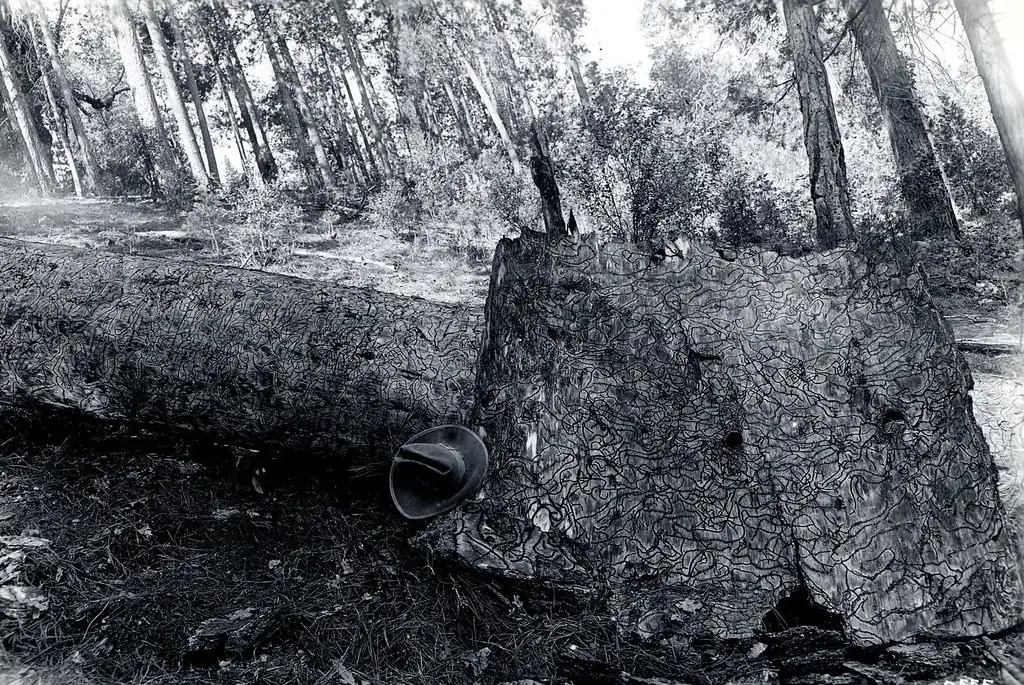
- Under the bark, the adult beetles cut winding, criss-crossing galleries that look like spaghetti; the USDA Forest Service notes these winding, S-shaped galleries are unique to the western pine beetle.[1][2]
- Woodpeckers flaking off the outer bark to reach the larvae is a common sign of an attacked tree.[1][2]
- Attacked trees push out resin as pitch tubes, often creamy white with reddish boring dust, though trees in drought may not form them; the needles of killed trees fade from yellow-green to red or reddish brown.[2][1]
Look-alikes
| Look-alike | How to tell them apart |
|---|---|
| Mountain pine beetle | Also attacks the main trunk of pines, but makes vertical egg galleries and attacks many pine species rather than just ponderosa pine.[1][2] |
| Pine engraver | Ips beetles usually attack the tops of trees and smaller material.[1] |
Where it lives
The Forest Service reports it from British Columbia south through Washington, Oregon, Nevada and California, east to Montana, Idaho, Utah, Colorado, Arizona, New Mexico and West Texas, and south into northern Mexico. Oregon's forestry department covers it as a pest of ponderosa pine in Oregon.[2][1]
Biology and life cycle
It mainly overwinters as larvae under the bark and has two generations a year in Oregon.[2][1]
The beetles carry blue-stain fungi into the tree, and together the beetles and fungi girdle it by destroying the phloem, the inner bark tissue that moves water and sugars.[2]
Damage and signs
- It attacks ponderosa pines more than about 6 inches across, preferring large trees, and also attacks Coulter pine in California.[1][2]
- Outbreaks usually occur in trees weakened by drought, fire, root disease, soil compaction or mechanical damage, and infestations increase sharply after drought; dense stands are highly susceptible.[1][2]
Health risk
It attacks pine trees only; none of the sources reports any harm to people or pets.[1]
Control
Prevention
Thinning overcrowded ponderosa pine stands reduces their susceptibility, and the USDA Forest Service rates thinning to lower stand density among the most effective ways to prevent losses.[1][2]
Sanitation
Remove green trees with pitch tubes or woodpecker flaking, finishing before the beetles emerge in March and April in Oregon.[1]
Pesticides
Preventive insecticides on high-value trees must be applied before the beetle flights.[1]
Common questions
- What are the winding tunnels under the bark of my dead ponderosa pine?
- Winding, criss-crossing galleries in the inner bark of a ponderosa pine are the signature of the western pine beetle.[1][2]
- How can I protect my ponderosa pines?
- Thin crowded stands and remove infested trees before the beetles emerge; preventive insecticides for high-value trees must go on before the spring flights.[1][2]
Sources
- Oregon Department of Forestry, “Western Pine Beetle (Forest Health Fact Sheet, March 2017).” egov.oregon.gov/odf/Documents/forestbenefits/Western%20Pine%20Beetle.pdf (accessed 2026-11-12)
- USDA Forest Service, “Western Pine Beetle (Forest Insect and Disease Leaflet 1).” www.fs.usda.gov/sites/default/files/users/user3914/FHP-files/FIDL-01-WesternPineBeetle.pdf (accessed 2026-11-12)
- iNaturalist, “Dendroctonus brevicomis taxon page (order and family).” www.inaturalist.org/taxa/218218 (accessed 2026-10-06)