On this page
How to identify it
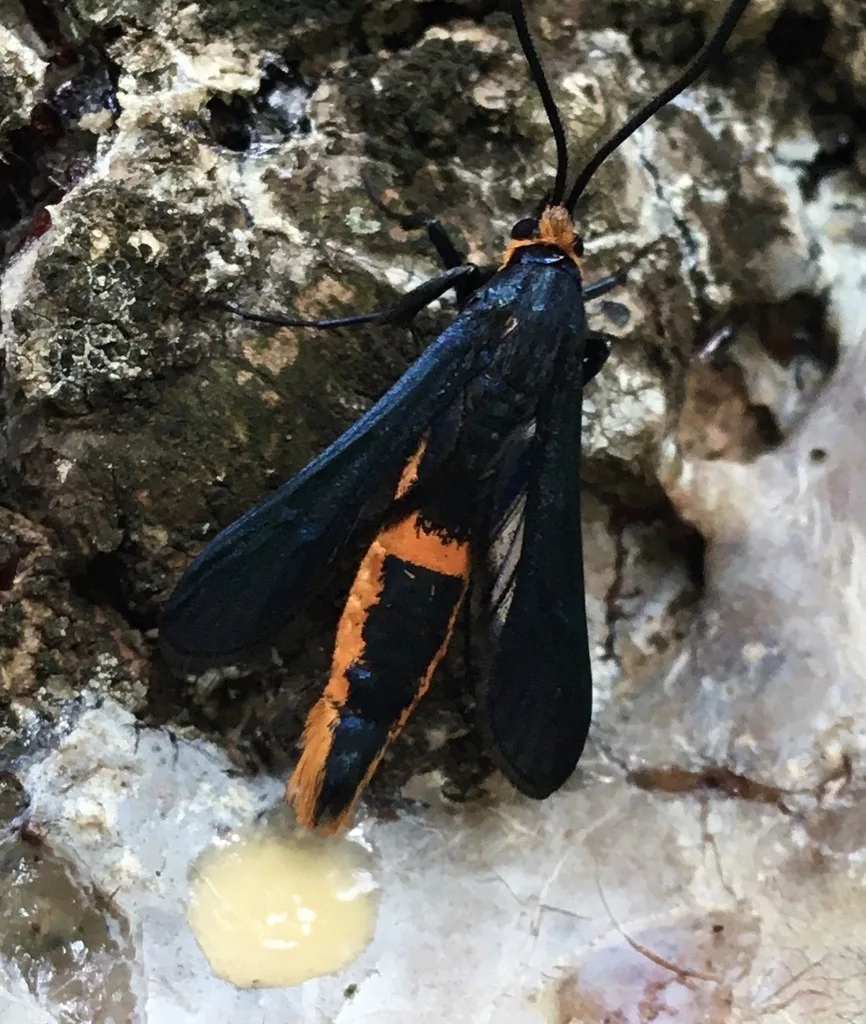
- Adults may resemble wasps; Illinois says pitch moth adults resemble yellowjackets. UMass describes them as blue-black above, with a red-orange patch under the abdomen, orange along its sides and some orange on top of the fourth abdominal segment, and opaque black-blue forewings 0.47 to 0.59 inches long.[2][1]
- Larvae are white with dark brown heads and tunnel into the trunk, often right beneath a branch or at a scar or broken branch.[2][1]
- The main sign is a rounded mass of pitch, about 3 to 4 inches across, over the tunnel; active masses can look dusted with white powder.[2][1]
Look-alikes
| Look-alike | How to tell them apart |
|---|---|
| Western pitch moths | Illinois says there are many types of pitch moths, all in the genus Synanthedon, and that the larvae of some species tunnel into the cambium and make holes from which sap oozes.[1] |
| Pinyon pitch mass borer | On pinyon, Colorado State describes the pinyon "pitch mass" borer, Dioryctria ponderosae, a different moth whose pale yellow or pink larvae with light brown heads live underneath a pitch mass; its life cycle is complete in one, sometimes two, years.[3] |
Where it lives
UMass calls it a native clearwing moth common to conifers in New England and beyond, and says it occurs sporadically on individual trees. Illinois Extension lists Austrian, eastern white, Scots and jack pines and white, Norway and Colorado blue spruce as hosts.[2][1]
Biology and life cycle
Illinois says adults are only seen during the summer and that single eggs are laid on the bark. UMass says adults emerge, mate and lay eggs some time in July, with emergence by July and August, and that by late summer the larvae bore into the tree.[1][2]
UMass says two or three years are required to complete the life cycle and that caterpillars may take up to two years to mature; Illinois says it can take up to three years. UMass says pupation is in a silk-lined cell in the pitch mass from the end of May through June.[2][1]
Damage and signs
Health risk
The moths may resemble wasps, but their larvae feed in trees. UMass and Illinois Extension don't mention any risk to people or pets.[2][1]
Control
Prevention
UMass says larvae may preferentially bore into the tree beneath a broken branch or scar. Colorado State's pinyon fact sheet says the pinyon pitch mass borer lays eggs in tree wounds and advises avoiding wounding trees to keep pinyons healthy.[2][3]
Traps and physical control
Each pitch mass holds a single larva. UMass says you can pull away the pitch and destroy it; pulling the caterpillar out of the pitch kills it.[2]
Biological control
UMass says parasitism by natural enemies is reported to be relatively common, by parasitic wasps in the family Eulophidae and by a caterpillar-eating fly.[2]
When to call a professional
UMass says chemical management is often unnecessary because this native insect typically does not cause significant damage to the overall health of its host. Illinois says to check with your local land-grant university (Cooperative) Extension Service for a recommended insecticide.[2][1]
Why sap masses appear where they do
The larva often enters just below a branch or at an old wound, and the tree's pitch builds up over the tunnel into a hemispherical mass.[2]
For monitoring, UMass notes that males are strongly drawn to an artificial sex pheromone lure, which helps because the adults are otherwise hard to find; the lure may not be easy to buy.[2]
Where the sources disagree
Life cycle: UMass says two or three years, with caterpillars taking up to two years to mature; Illinois says up to three years.[2][1]
Hosts: UMass also lists mugo pine; Illinois lists Austrian, eastern white, Scots and jack pines and white, Norway and Colorado blue spruce.[2][1]
What the adults look like: UMass says they may resemble wasps; Illinois says pitch moth adults resemble yellowjackets.[2][1]
Insecticides: UMass says chemical management is often unnecessary; Illinois says to check with your local Extension Service for a recommended insecticide.[2][1]
Common questions
- What are the globs of sap on my pine trunk?
- Rounded pitch masses a few inches across, often below a branch or at a wound, are a classic sign of pitch mass borer larvae tunneling in the trunk.[2][1]
- Is the wasp-like insect on my pine a wasp?
- It may be a pitch mass borer moth. UMass says the adults may resemble wasps, and Illinois says pitch moth adults resemble yellowjackets.[2][1]
- How long does a pitch mass borer live in the tree?
- Two to three years; Illinois says up to three.[2][1]
Sources
- University of Illinois Extension, “Pitch Mass Borer.” extension.illinois.edu/insects/pitch-mass-borer (accessed 2026-11-13)
- UMass Extension Landscape, Nursery and Urban Forestry Program (Landscape Insect & Mite Guide), “Synanthedon pini (Pitch Mass Borer).” www.umass.edu/agriculture-food-environment/landscape/publications-resources/insect-mite-guide/synanthedon-pini (accessed 2026-11-13)
- Colorado State University Extension, “Pinyon Pine Diseases and Insects (Fact Sheet 2.948).” csfs.colostate.edu/wp-content/uploads/2024/01/Pinyon-Pine-Diseases-and-Insects-Fact-Sheet-2.948.pdf (accessed 2026-11-13)
- Global Biodiversity Information Facility (GBIF), “Synanthedon pini (Kellicott, 1881) (GBIF Backbone Taxonomy).” api.gbif.org/v1/species/9891979 (accessed 2026-11-13)
- iNaturalist, “Synanthedon pini taxon page (order and family).” www.inaturalist.org/taxa/232122 (accessed 2026-10-06)