On this page
How to identify it
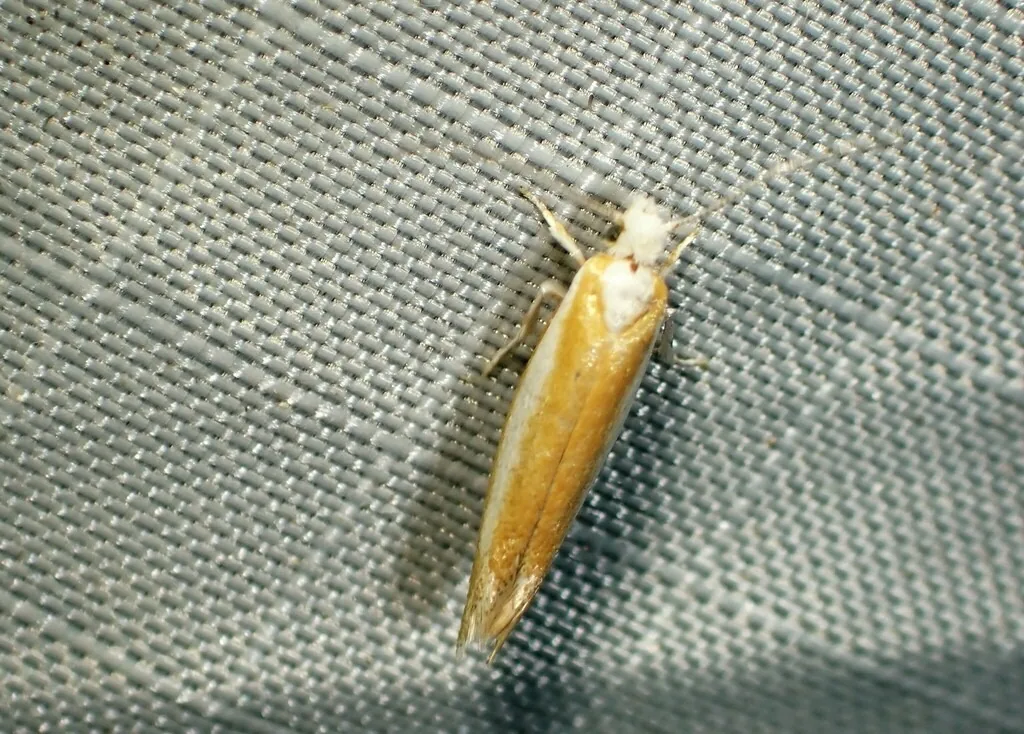
- Adults are silvery moths about 1/2 inch across; the Forest Service describes a silvery white body edged in yellow and light golden-yellow forewings with a broad white central band.[1][2]
- Young larvae are bright orange with a black head. Older larvae are tan, about 1/2 inch long; the Forest Service adds two dull orange stripes and says they turn green just before pupating.[1][2]
- Damaged needles droop or stick out at a sharp angle and may be cut off within the sheath. The first sign is fading of developing needles with fine silk at their bases; on the ground, look for needles bound into tubes.[1][2]
Where it lives
The Forest Service calls it native over much of North America; jack pine is the main host in the Great Lakes region, and ponderosa, Jeffrey and lodgepole pines in the West. Nearly all hard pines and many hybrids can host it, and the PNW handbook adds western white pine.[2][1]
Biology and life cycle
It overwinters as a young larva inside a needle. As the new shoots lengthen in spring it leaves, moves to the new growth and feeds inside the sheaths of young needles, damaging several needle bundles before pupating on the shoot tip.[1][2]
Eggs are laid singly on needles, mostly current-year foliage, from early to midsummer; there's one generation a year.[1][2]
It seems to prefer smaller trees. The Forest Service says trees under 4 years old were not attacked, though in one 1959 outbreak trees up to 60 feet tall were heavily infested.[1][2]
Damage and signs
- Young larvae make a fine, threadlike mine along the needle edge; older larvae cut longer needles off inside the sheath, and those needles droop and later blow away, leaving a thinned tip. The Forest Service observed no outright tree killing, but nearly total defoliation in some years, which matters most in arboreta, ornamental plantings and Christmas tree plantations.[2][1]
Health risk
The larvae feed only inside pine needles; neither the PNW handbook nor the Forest Service leaflet describes any risk to people or pets.[1][2]
Control
Prevention
Look under trees for needles bound into tubes, and on branches for needles held together instead of fanned out.[1]
Traps and physical control
On smaller trees, prune out and destroy heavily infested branch tips or needle clusters in early spring.[1]
Biological control
Parasitic wasps are an important natural check; the Forest Service reared six parasite species from the sheathminer in one study.[2]
Why it's easy to miss
The Forest Service notes that it's inconspicuous unless numbers are large, and that severe infestations had been recorded only in British Columbia and California.[2]
Common questions
- Why are the needles on my young pine drooping and stuck together?
- Pine needle sheathminer larvae feeding inside the needle sheaths can make new needles fade and droop, and webbing can bind needles together.[1][2]
- When should infested pine tips be pruned?
- In early spring; on smaller trees, prune out and destroy heavily infested tips or needle clusters.[1]
Sources
- Pacific Northwest Pest Management Handbooks (OSU, WSU, University of Idaho), “Pine (Pinus): Pine needle sheathminer (Insect Management Handbook).” pnwhandbooks.org/insect/hort/landscape/hosts-pests-landscape-plants/pine-pinus-pine-needle-sheathminer (accessed 2026-11-13)
- USDA Forest Service (Forest Insect & Disease Leaflets), “Pine Needle-sheath Miner (FIDL 65).” www.fs.usda.gov/foresthealth/docs/fidls/FIDL-65-PineNeedlesheathMiner.pdf (accessed 2026-11-13)
- Global Biodiversity Information Facility (GBIF), “Zelleria haimbachi Busck, 1915 (GBIF Backbone Taxonomy).” api.gbif.org/v1/species/5119482 (accessed 2026-11-13)
- iNaturalist, “Zelleria haimbachi taxon page (order and family).” www.inaturalist.org/taxa/233970 (accessed 2026-10-06)