On this page
How to identify it
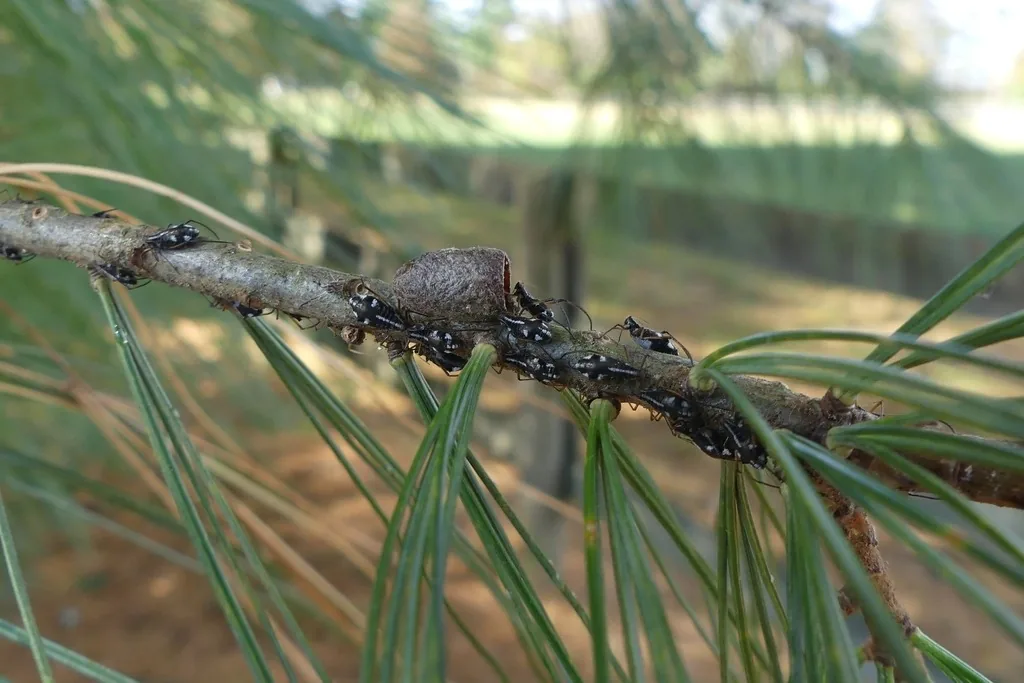
- A big, long-legged aphid that runs quickly when disturbed. NC State says it is black with white spots; UMass describes it as shiny black with a white stripe down the middle of the back and rows of white spots on the sides, and the University of Tennessee as shiny dark brown and spider-like.[2][1][3]
- Sources differ on size: UMass says the winged form is up to 0.16 inch long, while NC State calls it almost 1/4 inch and the University of Tennessee 1/4 inch.[1][2][3]
- Eggs are oval and shiny black, laid end to end in rows on the needles. UMass and UNH (from Maine Forest Service sheets) say rows of 5 or 6; the University of Tennessee says eight or more. UNH says they are easily seen with the naked eye; UMass suggests magnification.[1][4][3]
Look-alikes
Where it lives
Found wherever eastern white pine grows; it is native to New England, other parts of the United States and eastern Canada. GBIF holds 105 U.S. records since 1990 from 18 state-level areas, the most from Massachusetts (19), Pennsylvania (17) and Tennessee (14).[3][1][5]
Biology and life cycle
Eggs hatch very early in spring. All spring and summer aphids are females, winged or wingless, that give birth to live young; males and egg-laying females appear only in the fall generation, which lays the overwintering eggs.[2][1][3]
NC State reports up to six generations a year in North Carolina. Aphids are often numerous in fall and, in mild weather, through late winter and early spring; at higher elevations they overwinter only as eggs.[2][1][3]
Ants feed on the honeydew and protect the aphids from their natural enemies, which helps colonies build up.[3]
Like other aphids it relies on bacteria living inside its body to make nutrients missing from sap. A 2018 genome study found white pine aphids carry three fixed bacterial symbionts, Buchnera, a Sodalis and Serratia symbiotica, but only the first two still supply essential nutrients; the study's title calls the third a 'freeloader'.[6]
Damage and signs
- Light to moderate infestations cause little harm, especially on larger trees. Heavy infestations produce large amounts of honeydew that grows black sooty mold, and can cause flagging and death of twigs and seedlings and reduced growth of small trees.[2][1][3][4]
- Severely infested parts of a tree turn yellow and drop needles, and dry weather in late summer increases needle drop. Sooty mold lowers the quality of the tree and can cut the light reaching the needles.[3]
Health risk
It feeds on pine sap. UMass, NC State, the University of Tennessee and UNH don't mention any risk to people or pets. NC State notes that crushing the aphids can leave a purple stain.[1][2][3][4]
Control
Prevention
Look for aphids on twigs and small branches in May and June, and for the black eggs on needles earlier in spring. UMass and the University of Tennessee suggest treating an individual tree when more than 30 percent of its shoots have aphid colonies; decide sooner on small trees and seedlings.[1][3]
Traps and physical control
Remove and destroy the shiny black egg rows before they hatch in spring, or knock aphids off with a strong jet of water from a hose.[1]
Biological control
Lacewings, lady beetles, hover fly larvae, predatory midges and braconid wasps attack white pine aphids (UMass), and NC State says that in damp weather an aphid-killing fungus (Verticillium lecanii) can wipe out colonies. Conserve these before reaching for a spray.[1][2]
Pesticides
If natural enemies fail, insecticidal soaps (such as M-Pede or Safer Insecticidal Soap) and horticultural oils (such as SunSpray Ultra-Fine) are labeled for aphids, and EPA's product search lists all three with active registrations. The University of Tennessee also suggests a dormant oil before spring growth starts, but not until the temperature stays above 40°F for 24 hours. NC State says oils help disperse sooty mold but should be avoided late in the season because they strip the bluish waxy bloom from white pine needles; then a systemic such as imidacloprid, which EPA lists in many active products, may be better.[2][3][7][8][9][10]
The University of Tennessee's list for spring and summer infestations also includes cyfluthrin (Tempo) and pymetrozine (Endeavor); EPA's product search lists Tempo 20 WP and Endeavor with active registrations. Read and follow the label directions.[3][11][12]
Where the sources disagree
Size: UMass says the winged form is up to 0.16 inch long; NC State says almost 1/4 inch; the University of Tennessee says 1/4 inch.[1][2][3]
Color: NC State says black with white spots; UMass says shiny black; the University of Tennessee says shiny dark brown.[2][1][3]
Eggs per row: UMass and UNH say 5 or 6; the University of Tennessee says eight or more.[1][4][3]
Seeing the eggs: UNH says they are easily seen with the naked eye; UMass suggests magnification.[4][1]
Common questions
- What are the black bugs crawling off my Christmas tree?
- Often white pine aphids leaving a white pine Christmas tree as it dries out. NC State warns that crushing them can leave a purple stain, and says people sometimes mistake them for ticks.[2]
- What are the black dots lined up on my pine needles?
- Probably white pine aphid eggs, laid in rows on the needles in fall to overwinter. You can remove them before they hatch in spring.[1][4]
- When should I treat my white pines?
- UMass and the University of Tennessee use a threshold of more than 30 percent of shoots with aphid colonies; light infestations on larger trees can be tolerated.[1][3]
- Will they kill my tree?
- Large trees usually tolerate them, but heavy infestations can kill twigs and seedlings and slow the growth of small trees.[1][2][3]
Sources
- UMass Extension Landscape, Nursery and Urban Forestry Program (Landscape Insect & Mite Guide), “Cinara strobi (White Pine Aphid).” www.umass.edu/agriculture-food-environment/landscape/publications-resources/insect-mite-guide/cinara-strobi (accessed 2026-11-13)
- NC State Extension, “White Pine Aphid (PDIC Factsheet).” content.ces.ncsu.edu/white-pine-aphid (accessed 2026-11-13)
- University of Tennessee Extension, “White Pine Aphid, SP290-P (F. A. Hale; originally by J. Yanes Jr. and H. E. Williams).” trace.tennessee.edu/bitstreams/9b74616d-08c1-4963-901e-6ace86cadff4/download (accessed 2026-11-13). PDF from the TRACE record https://trace.tennessee.edu/utk_agexfores/93
- University of New Hampshire Cooperative Extension, “Common Insect Pests of Christmas Trees (excerpted from Maine Forest Service insect fact sheets).” extension.unh.edu/resources/files/Resource000986_Rep2299.pdf (accessed 2026-11-13)
- Global Biodiversity Information Facility (GBIF), “Cinara strobi: U.S. occurrence records since 1990 by state (GBIF occurrence API).” api.gbif.org/v1/occurrence/search?taxonKey=5159337&country=US&hasGeospatialIssue=false&occurrenceStatus=PRESENT&year=1990%2C2026&facet=stateProvince&facetLimit=400&limit=0 (accessed 2026-11-13). 105 records from 18 state-level areas; Massachusetts 19, Pennsylvania 17, Tennessee 14; fetched 2026-11-13.
- Genome Biol Evol 2018;10(9):2178-2189, via PubMed, “A Freeloader? The Highly Eroded Yet Large Genome of the Serratia symbiotica Symbiont of Cinara strobi.” pubmed.ncbi.nlm.nih.gov/30102395/ (accessed 2026-11-13)
- U.S. EPA Pesticide Product Label System, “Pesticide Product Label System: product-name search 'M-Pede'.” ordspub.epa.gov/ords/pesticides/cswu/ProductSearch/partialprodsearch/v2/riname/M-Pede (accessed 2026-11-13). 11 rows, 6 Active, including 10163-324 M-PEDE INSECTICIDE/FUNGICIDE; saved 2026-11-13.
- U.S. EPA Pesticide Product Label System, “Pesticide Product Label System: product-name search 'Insecticidal Soap'.” ordspub.epa.gov/ords/pesticides/cswu/ProductSearch/partialprodsearch/v2/riname/Insecticidal%20Soap (accessed 2026-11-13). 92 rows, 72 Active, including 42697-1 SAFER INSECTICIDAL SOAP CONCENTRATE; saved 2026-11-13.
- U.S. EPA Pesticide Product Label System, “Pesticide Product Label System: product-name search 'SunSpray'.” ordspub.epa.gov/ords/pesticides/cswu/ProductSearch/partialprodsearch/v2/riname/SunSpray (accessed 2026-11-13). 33 rows, 9 Active, including 86330-11 SUNSPRAY ULTRA-FINE SPRAY OIL; saved 2026-11-13.
- U.S. EPA Pesticide Product Label System, “Pesticide Product Label System: product-name search 'Imidacloprid'.” ordspub.epa.gov/ords/pesticides/cswu/ProductSearch/partialprodsearch/v2/riname/Imidacloprid (accessed 2026-11-13). 269 rows, 222 Active; saved 2026-11-13.
- U.S. EPA Pesticide Product Label System, “Pesticide Product Label System: product-name search 'Tempo'.” ordspub.epa.gov/ords/pesticides/cswu/ProductSearch/partialprodsearch/v2/riname/Tempo (accessed 2026-11-13). 71 rows, 23 Active, including 101563-58 TEMPO 20 WP and 101563-86 TEMPO SC ULTRA INSECTICIDE; saved 2026-11-13.
- U.S. EPA Pesticide Product Label System, “Pesticide Product Label System: product-name search 'Endeavor'.” ordspub.epa.gov/ords/pesticides/cswu/ProductSearch/partialprodsearch/v2/riname/Endeavor (accessed 2026-11-13). 1 row: 100-913 ENDEAVOR, Active; saved 2026-11-13.
- Global Biodiversity Information Facility (GBIF), “Cinara strobi (Fitch, 1851) (GBIF Backbone Taxonomy).” api.gbif.org/v1/species/5159337 (accessed 2026-11-13). ACCEPTED; order Hemiptera, family Aphididae