On this page
How to identify it
- On white pine, needles turn yellow to brown from the tip down and the new shoots droop; heavy infestations kill the current year's shoots in late summer, and moderate ones cause the shoots to die the next spring.[2][1]
- A telltale sign on pine: stunted needles and stunted branch sections alternating with normal ones along the same branch, a pattern researchers called probably unique to this insect.[7]
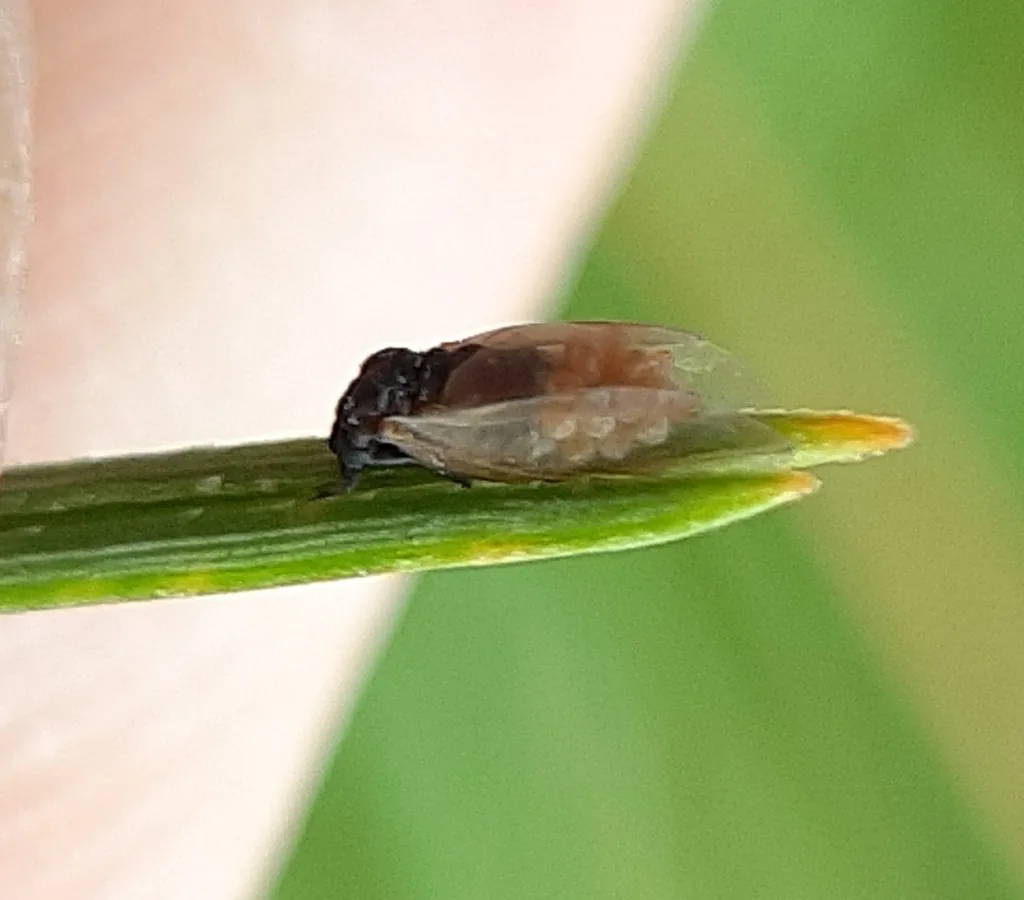
- The adults are tiny and scale-like with a fringe of white hairs, attached to the pine needles by their mouthparts. Pineus adelgids such as this one produce abundant pale wax where they feed, and the adult females are dark blue to purplish black.[2][1][4]
- On red and black spruce it makes compact galls at the shoot tips that look like small cones. Pineus galls are typically smaller and less prominent than Cooley spruce gall adelgid galls.[2][1][4]
- Because the life cycle takes two years, with the move from spruce to pine usually seen in odd-numbered years in the Maritimes, heavily infested white pines brown every other year.[1]
Look-alikes
| Look-alike | How to tell them apart |
|---|---|
| Pine bark adelgid | A related Pineus adelgid of white pine that also produces pale wax. The pine leaf adelgid feeds on the current year's shoots and kills them, and it needs red or black spruce as its other host.[4][1] |
| Eastern spruce gall adelgid | Also makes cone-like galls on spruce shoots. The pine leaf adelgid's galls form on red and black spruce, and the insects that leave them in mid-June fly to white pine rather than staying on spruce.[1][2] |
| Cooley spruce gall adelgid | Makes larger, more prominent spruce galls and alternates with Douglas-fir; Pineus galls are typically smaller and less prominent, and the pine leaf adelgid alternates with eastern white pine.[4][1] |
| White pine aphid | Dark brown, shiny aphids that cluster on white pine branches or the leader. Pine leaf adelgids are tiny, scale-like insects with a fringe of white hairs that arrive from spruce galls and feed on the new shoots.[2] |
Where it lives
Canada and the northeastern United States, including Maine, New Hampshire, Vermont and New York. It is considered a very important pest of white pine growing next to red and black spruce in the Maritime Provinces.[1]
Biology and life cycle
Red and black spruce are one host and eastern white pine is the other. The cycle has at least five distinct forms and takes two years, with the winged forms alternating between spruce and pine.[1][5][2]
The galls form on spruce twigs in spring. About mid-June winged forms leave the galls and fly to the old needles of white pine, where they produce wingless offspring that crawl to the new shoots and feed by piercing the tissues.[1][5]
The next year winged forms develop on pine and fly back to spruce. Two successive wingless generations follow there, and the second overwinters and produces the galls the next spring. UNH sums it up: spruces are infested the first winter, and nearby white pines through the remaining stages, including the second winter.[1][2]
History: Asa Fitch described the insect from white pine needles in 1858, and in 1906 the entomologist Patch watched the winged form fly from black spruce galls to white pine, proving that the spruce gall-maker and the pine insect were the same species.[6]
Galls are not spread evenly: they cluster on the upper crown branches and on larger spruces, and red spruce is more heavily infested where red and black spruce grow together.[8]
Damage and signs
- Severe infestations of nymphs on white pine kill the current year's shoots in late summer, and moderate infestations may cause the shoots to die the next spring. UNH lists drooping shoots, reduced growth or death of the tree.[1][2]
- Infestation reduces radial growth of white pine, with the greatest loss in the lower stem; lighter infestations show up as shorter needles in the year of attack and shorter branch growth the following year.[7]
- Damage to spruce is limited to the cone-like galls on new shoots, which are unsightly but cause little injury to the tree.[1][2]
Health risk
None of the sources mention any effect on people or pets; the insect feeds only on pine and spruce sap.[1][2][4]
Control
Prevention
Keep trees vigorous: vigorous plants tolerate moderate adelgid populations. Avoid excess fertilizer and quick-release fertilizers, which can promote adelgids, and avoid overspraying pines for aphids, which can kill the natural predators.[4][2]
Traps and physical control
A forceful stream of water aimed at the cottony masses dislodges and kills many adelgids. On spruce, to improve looks and provide some control, clip and dispose of infested shoots while the galls are still green, before the insects emerge.[4]
Biological control
Brown and green lacewings, aphid fly and predaceous midge larvae, and several small lady beetles prey on adelgids.[4]
Pesticides
If numbers are high, especially on young trees, UC IPM lists horticultural or narrow-range oil and insecticidal soap applied in spring when the crawlers are abundant, and notes that imidacloprid can be effective; oil can remove the bluish color of blue spruce without harming the tree. For Christmas tree plantings UNH says occasional outbreaks may need a spray of the pine foliage in late June, repeated 10 days later. Follow the product label.[4][2]
Where sources disagree
Treatment: UC IPM says vigorous plants tolerate moderate adelgid populations and most adelgids are unlikely to seriously harm trees, while Natural Resources Canada calls the pine leaf adelgid a very important pest of white pine next to red and black spruce, and UNH says outbreaks in Christmas tree plantings may need spraying.[4][1][2]
Common questions
- Why do my white pine tips die every other year?
- The pine leaf adelgid's two-year cycle sends a wave of winged migrants from spruce galls to white pine, usually in odd-numbered years in the Maritimes. Their offspring kill the current shoots, so heavily infested pines brown every other year.[1][5]
- What is the white fluff on my white pine?
- On white pine, white wax can come from the pine leaf adelgid or its relative the pine bark adelgid; both Pineus species produce abundant pale wax where they feed. Pine leaf adelgid needs nearby red or black spruce, and it kills new shoots rather than just coating the bark.[4][1]
- Should I treat the galls on my spruce?
- Usually not. The galls are unsightly but cause little injury. If they bother you, clip off the green galls before the insects emerge; any treatment for shoot damage is aimed at the nearby white pine.[1][4]
- Who first figured out its life cycle?
- Entomologist Patch, working in Maine, watched the winged form fly from black spruce galls to white pine in 1906, which showed that two insects described under different names were one species.[6][5]
Sources
- Natural Resources Canada, Canadian Forest Service, “Pine leaf adelgid, Trees, insects, mites, and diseases of Canada's forests.” tidcf.nrcan.gc.ca/en/insects/factsheet/5328 (accessed 2026-11-12)
- University of New Hampshire Cooperative Extension, “Christmas Tree Pest Manual, Pesticide Safety Education Program (S.R. Swier and P. Auger), pine leaf adelgid entry.” extension.unh.edu/sites/default/files/migrated_unmanaged_files/Resource000221_Rep240.pdf (accessed 2026-11-12)
- iNaturalist, “Pineus pinifoliae taxon page (order and family).” www.inaturalist.org/taxa/454598 (accessed 2026-11-12)
- University of California Statewide IPM Program, “Pest Notes: Adelgids.” ipm.ucanr.edu/home-and-landscape/adelgids/ (accessed 2026-11-12)
- The Canadian Entomologist 82:117-123, “The Life-History of Pineus pinifoliae (Fitch) and its Effect on White Pine (Balch and Underwood 1950).” doi.org/10.4039/Ent82117-6 (accessed 2026-11-12). Cited from the Crossref abstract.
- The Canadian Entomologist 87:201-209, “The External Morphology of the Five Forms of Pineus pinifoliae (Fitch) (Underwood 1955).” doi.org/10.4039/Ent87201-5 (accessed 2026-11-12). Cited from the Crossref abstract.
- The Canadian Entomologist 96:765-772, “Impact of Pine Leaf Aphid, Pineus pinifoliae, on its Secondary Host, Eastern White Pine (DeBoo, Dimond and Lowe 1964).” doi.org/10.4039/Ent96765-5 (accessed 2026-11-12). Cited from the Crossref abstract.
- The Canadian Entomologist 97:952-961, “Sampling Populations of Pine Leaf Adelgid Pineus pinifoliae (Fitch): I. The Gall and Associated Insects (Howse and Dimond 1965).” doi.org/10.4039/Ent97952-9 (accessed 2026-11-12). Cited from the Crossref abstract.