On this page
How to identify it
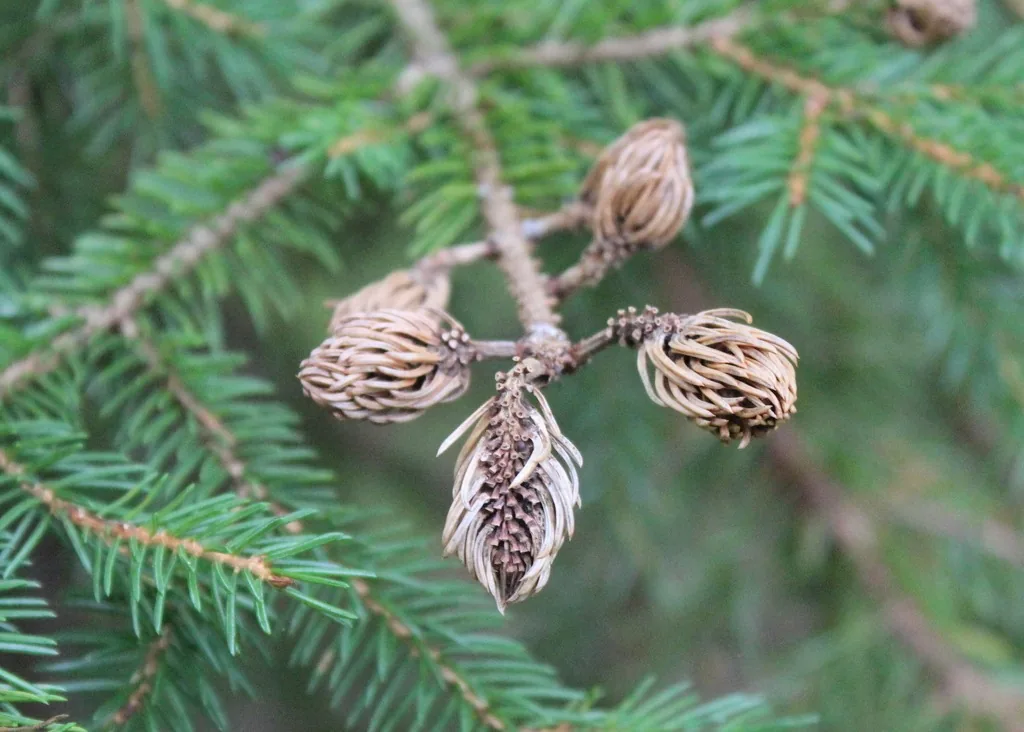
- Galls are short pineapple-shaped growths under 25 mm, green at first and brown once they open.[1]
- Eggs are laid under a coating of white, woolly wax. In late winter, overwintering nymphs show as white waxy spots at needle and bud bases. A 1981 USDA Forest Service report describes the overwintering nymphs as covered with waxy threads that look like small tufts of wool.[1][2][4]
- Galls have normal twig growth beyond them. Brown, cracked galls are already empty.[2]
Where it lives
UMass says it came to North America from eastern Europe before 1900. Penn State calls it a key pest of Norway spruce in the northeastern U.S., occasionally on white, red and Colorado blue spruce; UMass also lists black and Engelmann spruce as hosts. The USDA Forest Service names Norway and white spruce as the major hosts, with red and Colorado blue spruce also attacked.[2][1][4]
Biology and life cycle
Female nymphs overwinter in bark crevices on new twigs, especially at bud bases. In spring they mature into tiny stem mothers about 1/16 inch long, and each lays 100 to 200 eggs about when buds open. The Forest Service report adds that no males have ever been observed.[1][2][4]
Nymphs hatch in 7 to 10 days, crawl into the buds and feed, and their feeding makes a gall form where needles should develop. They stay protected inside until the galls dry and open, which Penn State puts at late July through October; winged females then lay the eggs of the overwintering generation. Penn State reports one generation a year.[1][2]
When the galls open in late summer, the full-grown nymphs become winged females. They can fly but rarely move to another tree; each lays about 60 eggs on the same tree and dies, her body covering the eggs. The eggs hatch in about two weeks, and the nymphs crawl to overwintering sites.[4]
Damage and signs
- Sources weigh the harm differently. Penn State says infested trees are seldom killed but can look much worse; UMass calls it potentially very serious over time, causing twig death and weakening trees so secondary pests move in; a 2026 genome study describes it as not a major forest pest but one that weakens trees.[1][2][3]
- Galls at the base of shoots can weaken stems so they break more easily under snow.[2]
- The Forest Service report says it rarely kills trees; branch dieback can occur when galls encircle a twig and cut off water and nutrients. Usually the galls only spoil the trees' looks, so it is mainly a pest of nurseries, Christmas tree plantations and ornamentals, and heavy infestations are rarely found in forest stands.[4]
- Stressed, slow-growing trees on poor sites are hit harder than vigorous trees on good sites. In Shenandoah National Park in 1981, Forest Service entomologists found red spruce seedlings lightly infested and stunted, but concluded that poor light and seedbed conditions, not the insect, were holding back regeneration, and that it was not killing red spruce.[4]
Health risk
It feeds on spruce; neither Penn State nor UMass mentions a risk to people.[1][2]
Control
Traps and physical control
On a few small trees, prune and destroy green galls in June or July, before they open. Removing brown, cracked galls does nothing, since the insects have already left.[1][2]
Biological control
UMass says no natural enemies have been reported for it in North America. Some insecticides kill the predators of spruce spider mites, so watch for mite outbreaks after treating.[2][1]
Pesticides
Dormant horticultural oil before new growth starts, with temperatures above freezing, or an insecticide in mid-September to early October or in April before budbreak, targets overwintering stages. Cover the bud bases well. UMass notes late-summer timing is hard to get right.[1][2]
What research says about resistant spruce
In a study by Swedish researchers of Norway spruce families, some were resistant to the adelgid and others susceptible. Drought stress shrank galls, but genetically based resistance affected stem mother survival and gall numbers more than drought did.[5]
Where the sources disagree
Egg hatch: Penn State says nymphs hatch in 7-10 days; the 1981 Forest Service report says about two weeks.[1][4]
Hosts: Penn State says it occasionally infests white spruce, while the Forest Service report lists white spruce with Norway spruce as a major host.[1][4]
Harm: the Forest Service report says it rarely causes tree mortality, in line with Penn State; UMass rates it potentially very serious over time.[4][1][2]
Common questions
- What are the pineapple-shaped lumps on my spruce?
- They're likely galls made by the eastern spruce gall adelgid.[1]
- Will horticultural oil hurt my blue spruce?
- Yes. Penn State says horticultural oil removes the blue bloom from Colorado blue and Koster spruce.[1]
- Is the eastern spruce gall aphid the same insect?
- Yes. Older USDA Forest Service reports call Adelges abietis the eastern spruce gall aphid.[4]
Sources
- Penn State Extension, “Eastern Spruce Gall Adelgid.” extension.psu.edu/eastern-spruce-gall-adelgid (accessed 2026-11-14)
- UMass Amherst Extension, Landscape, Nursery and Urban Forestry Program, “Adelges abietis: Eastern Spruce Gall Adelgid (Insect & Mite Guide).” www.umass.edu/agriculture-food-environment/landscape/publications-resources/insect-mite-guide/adelges-abietis (accessed 2026-11-14)
- G3 (Bethesda) 2026, via PubMed, “Chromosome scale genomes of two invasive Adelges species enable virtual screening for selective adelgicides (2026).” pubmed.ncbi.nlm.nih.gov/41042102/ (accessed 2026-11-14)
- USDA Forest Service, Forest Pest Management, Asheville Field Office (scan at Internet Archive), “Biological Evaluation of the Eastern Spruce Gall Aphid on Red Spruce in the Limberlost, Shenandoah National Park, Forest Pest Management Report 82-1-6 (C. M. Huber, November 1981).” archive.org/details/nfsl_1_112535 (accessed 2026-11-14). Read from the Internet Archive's full text of the National Forest Service Library scan.
- Oecologia 2000;123(2):223-231, via PubMed, “Interactive effects of host resistance and drought stress on the performance of a gall-making aphid living on Norway spruce (2000).” pubmed.ncbi.nlm.nih.gov/28308727/ (accessed 2026-11-14)
- Global Biodiversity Information Facility (GBIF), “Adelges abietis (Linnaeus, 1758) (GBIF Backbone Taxonomy).” api.gbif.org/v1/species/2049661 (accessed 2026-11-14)
- iNaturalist, “Adelges abietis taxon page (order and family).” www.inaturalist.org/taxa/204565 (accessed 2026-11-14)