On this page
How to identify it
- Under the wax the insect is about 0.03 inch long, black and short-legged; UMass describes it as black, sometimes purple to yellow, rounded with a pointed end, and Illinois as teardrop-shaped.[1][4][3]
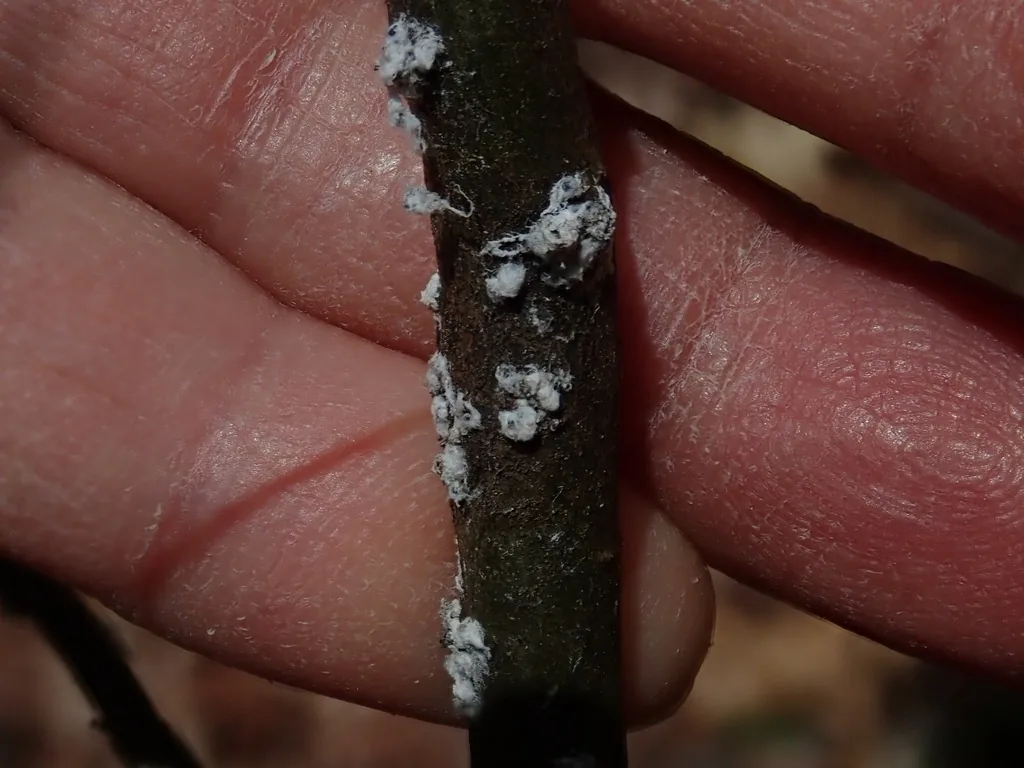
- White cottony masses appear on the trunk, larger branches and twigs; on seedlings and young trees they may sit at the needle bases or on new shoots instead.[1][2]
- The wax stays on the bark after the insects die, so use a hand lens to check whether the colonies underneath are still alive.[2][4]
Look-alikes
Where it lives
Iowa State says it occurs across the eastern U.S. on white, Scots and Austrian pines, and Illinois names eastern white pine as the pine most often attacked in the Midwest. UMass adds jack, pitch and ponderosa pines; spruce is an alternate host, but the adelgid can't complete its life cycle on spruce. The PNW Insect Management Handbook covers it in the Pacific Northwest too.[2][3][4][1]
Biology and life cycle
It overwinters on the tree as an immature insect (often the third stage in the north, says UMass) and covers itself with waxy tufts as the weather warms.[1][4]
Small clusters of yellowish eggs are laid in the tufts in spring, up to about 25 per female; the crawlers that hatch spread over the tree or are blown or carried to other trees, then settle and stay put.[1][4]
UMass reports five or more generations a year, more in warmer climates, with both winged and wingless adults. A Virginia Tech study in southwestern Virginia found no single overwintering stage there, eggs from late March to early December, and two distinct spring generations before generations began to overlap.[4][5]
Damage and signs
- These sap feeders draw from the tissue under the bark. Light infestations do little, and Iowa State says large, older trees are unlikely to be much affected; heavy, repeated attacks on saplings or newly planted or stressed trees cause yellowing needles, stunting and dieback, and possibly death.[2][3][4][1]
Health risk
Pine bark adelgids feed on the sap of pines; none of the extension sources consulted (PNW handbook, Iowa State, Illinois, UMass) describes any risk to people or pets.[1][2][3][4]
Control
Prevention
Before budbreak, check trunk bark, shoots and branch undersides for white cottony colonies and for natural enemies. UMass suggests planting white pine seedlings away from mature Austrian and Scots pines.[1][4]
Sanitation
Where practical, remove and destroy heavily infested branches and trees.[1]
Traps and physical control
Wipe small colonies off by hand or with a stiff brush, or wash them off with a strong stream of water.[1][4]
Biological control
Lady beetles, lacewings and syrphid fly larvae eat adelgids, and UMass says natural enemies typically keep it in check. Check for live insects or crawlers before acting.[1][4]
Pesticides
Iowa State says spraying isn't needed on healthy trees. If a young or stressed tree needs help, it suggests dormant oil in early spring before bud break, or horticultural oil, insecticidal soap or a labeled insecticide from mid-April to May, aimed at the trunk and main branches; more than one application may be needed. Follow the label.[2]
Does a white-trunked pine need treating?
Usually not. Iowa State and UMass both say healthy trees can tolerate it, populations rise and fall from year to year with weather and predators, and the cottony coating stays even after the insects die.[2][4]
Watch small, newly transplanted or stressed trees more closely; that's where Iowa State and Illinois report real harm, and good watering and care help them recover.[2][3]
Common questions
- What is the white fuzz on my pine trunk?
- Most likely pine bark adelgids, tiny sap-feeding insects that cover themselves with white cottony wax. On heavily infested trunks the bark looks painted white.[1][2]
- Can pine bark adelgids kill a tree?
- Rarely on healthy, established trees. Severe infestations repeated year after year can stunt or kill seedlings, saplings and stressed trees.[2][3][1]
Sources
- Pacific Northwest Pest Management Handbooks (OSU, WSU, University of Idaho), “Pine (Pinus): Pine bark adelgid (Insect Management Handbook).” pnwhandbooks.org/insect/hort/landscape/hosts-pests-landscape-plants/pine-pinus-pine-bark-adelgid (accessed 2026-11-13)
- Iowa State University Extension and Outreach, “Pine Bark Adelgid.” yardandgarden.extension.iastate.edu/encyclopedia/pine-bark-adelgid (accessed 2026-11-13)
- University of Illinois Extension, “Pine Bark Adelgids.” extension.illinois.edu/insects/pine-bark-adelgids (accessed 2026-11-13)
- UMass Amherst Extension Landscape, Nursery and Urban Forestry Program, “Pineus strobi (Insect & Mite Guide).” www.umass.edu/agriculture-food-environment/landscape/publications-resources/insect-mite-guide/pineus-strobi (accessed 2026-11-13)
- Environmental Entomology, via PubMed, “Phenology of the Pine Bark Adelgid, Pineus strobi (Hemiptera: Adelgidae), in White Pine Forests of Southwestern Virginia (Wantuch, Kuhar & Salom, 2017).” pubmed.ncbi.nlm.nih.gov/29106470/ (accessed 2026-11-13)
- Global Biodiversity Information Facility (GBIF), “Pineus strobi (Hartig, 1839) (GBIF Backbone Taxonomy).” api.gbif.org/v1/species/2049607 (accessed 2026-11-13)
- iNaturalist, “Pineus strobi taxon page (order and family).” www.inaturalist.org/taxa/228144 (accessed 2026-10-06)