On this page
How to identify it
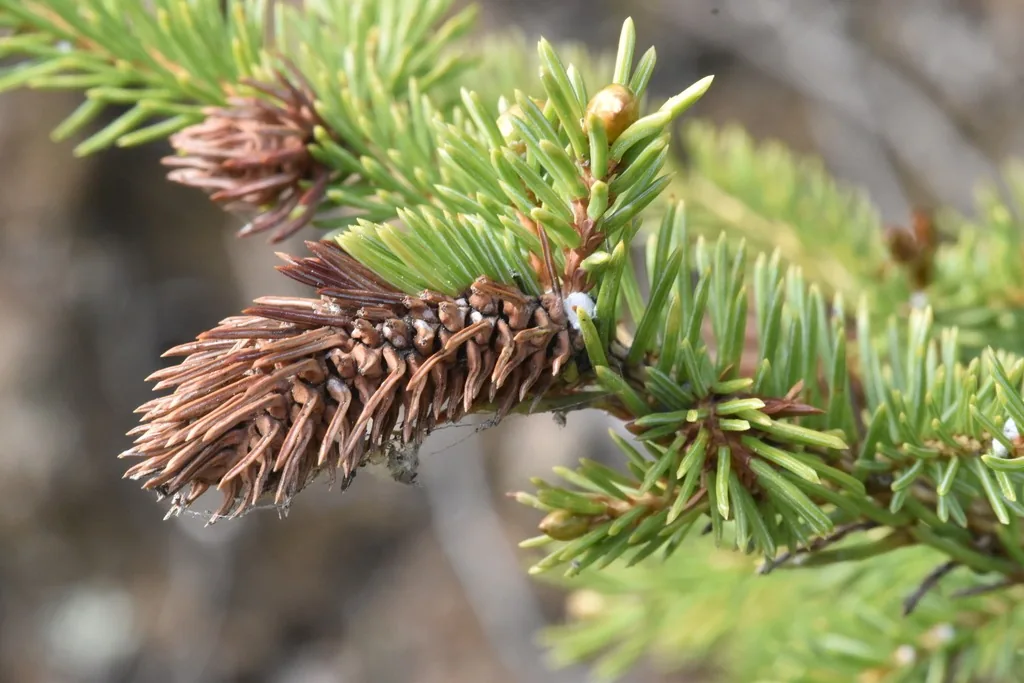
- Galls form at the tips of new spruce growth, green to purple, turning brown as they dry from midsummer. Size estimates vary: UC IPM says 1/2 to 3 inches long, New Hampshire 1 to 2 inches, and Minnesota and Colorado 2 to 4 inches.[1][3][2][4]
- On Douglas-fir, nymphs settle under white, cottony tufts on needles, shoots and cones.[1]
- Empty galls harden and can persist for years.[1]
- People often mistake the browned galls for seed cones; Montana State says they look like miniature pine cones by late summer.[4][5]
Look-alikes
| Look-alike | How to tell them apart |
|---|---|
| Eastern spruce gall adelgid | It makes smaller 1/2- to 1-inch, pineapple-shaped galls at the base of new shoots and lives on spruce alone.[2] |
Where it lives
It's native to the Rocky and Cascade mountains. Spruce is the main host and Douglas-fir the alternate; in Minnesota it's mostly on Colorado blue and white spruce, and in the Northeast on blue spruce and Douglas-fir grown as ornamentals and Christmas trees. In California it's mostly on the North Coast and in mountains where Douglas-fir is common.[6][2][7][1]
Biology and life cycle
The full cycle has five forms, three on spruce and two on Douglas-fir, and takes at least two years. It can keep breeding on Douglas-fir alone.[7]
UC IPM says galls form on spruce only when Douglas-fir is nearby. Other sources are less firm: New Hampshire says it doesn't need both hosts but is worse where both grow, and Colorado observations suggest some spruce-to-spruce movement.[1][3][4]
Immature females overwinter at the base of spruce buds, lay several hundred eggs in spring, and the nymphs feed at needle bases until a gall closes around them. About midsummer the galls open and winged adults fly off, most of them to Douglas-fir.[7][4][1]
Damage and signs
- Heavy feeding on Douglas-fir distorts and spots needles and makes them drop early.[1]
- Spruce damage is rare and mostly cosmetic; heavy galling can slightly slow growth or spoil the shape of young trees. On Engelmann spruce, galls weighed about twice as much as normal shoots, while the surrounding shoots were unaffected.[2][4][7][8]
- Galling is usually heaviest on the shaded north and east sides, and numbers rise and fall in cycles from year to year.[4]
Health risk
It feeds only on spruce and Douglas-fir. UC IPM, Minnesota Extension and Colorado State describe it only as a pest of conifers and don't mention any risk to people or pets.[1][2][4]
Control
Prevention
Control is generally not needed; most galls don't seriously harm plants. Avoid planting spruce and Douglas-fir close together.[2][1][4][3]
Traps and physical control
On a few small trees, clip galls while they're still green, in June or July before the adelgids leave. Once galls turn brown the insects are gone, so removing them does nothing, as Colorado and Montana point out.[9][1][7][4][5]
Pesticides
Any spray has to go on before galls form, in fall or in early spring before the overwintering females swell; sprays after that don't prevent galls.[4][7][1]
On Douglas-fir
Feeding under the needles causes yellow spots, bent needles and early needle drop, but no galls. Heavily infested needles can look snow-covered from the white wax.[1][4][7]
UC IPM suggests a forceful stream of water to knock off the woolly masses.[1]
Where the sources disagree
Gall size: UC IPM says 1/2 to 3 inches long, New Hampshire 1 to 2 inches, and Minnesota and Colorado State 2 to 4 inches.[1][3][2][4]
Two hosts: UC IPM says galls form on spruce only when Douglas-fir is nearby, and Penn State says the spruce forms must eventually find Douglas-fir; Colorado State says the adelgid normally needs both but that some spruce-to-spruce movement may occur, and New Hampshire says it does not need both hosts.[1][7][4][3]
Length of the cycle: Colorado State says the life cycle often takes a year; Penn State says completing all five forms on both hosts takes at least two years.[4][7]
Spray timing on spruce: Penn State says mid-September through early October, or in spring before budbreak; Colorado State says warm periods in mid-October or November, or late March through April; UC IPM says to watch the overwintering females in late winter and spring and spray when they begin to swell.[7][4][1]
Broad-spectrum insecticides: Colorado State says carbaryl and permethrin were the most effective foliar treatments in its trials; UC IPM advises avoiding residual broad-spectrum insecticides such as carbaryl and pyrethroids, which can cause spider mite numbers to rise.[4][1]
Common questions
- What are the cone-like growths on my blue spruce?
- They're probably Cooley spruce galls, formed by the adelgid at shoot tips.[2][1][4]
- Why do I see white fluff on Douglas-fir needles?
- Cooley spruce gall adelgid nymphs cover themselves with white cottony tufts on Douglas-fir.[1]
- Should I cut off the brown galls?
- Only for looks. The adelgids have already left brown galls, so removing them won't reduce next year's numbers; clipping helps only while galls are still green.[4][5][1]
Sources
- University of California Statewide IPM Program, “Adelgids (Pests in Gardens and Landscapes).” ipm.ucanr.edu/PMG/GARDEN/PLANTS/INVERT/adelgids.html (accessed 2026-11-13)
- University of Minnesota Extension, “Insect and mite galls (Yard and garden insects).” extension.umn.edu/yard-and-garden-insects/insect-and-mite-galls (accessed 2026-11-13)
- University of New Hampshire Extension, “Spruce Gall Adelgids (fact sheet).” extension.unh.edu/resource/spruce-gall-adelgids-fact-sheet (accessed 2026-11-13)
- Colorado State University Extension, “Cooley Spruce Galls (Fact Sheet 5.534).” extension.colostate.edu/topic-areas/insects/cooley-spruce-galls-5-534/ (accessed 2026-11-13)
- Montana State University Extension, Urban and Horticulture IPM, “Cooley Spruce Gall Adelgid.” urbanipm.montana.edu/entomology/resources/fact-sheets/cooley-spruce-gall-adelgid.html (accessed 2026-11-13)
- Molecular Ecology, 2009 (via PubMed), “Phylogeography of a specialist insect, Adelges cooleyi: historical and contemporary processes shape the distribution of population genetic variation (abstract).” pubmed.ncbi.nlm.nih.gov/19192184/ (accessed 2026-11-13)
- Penn State Extension, “Cooley Spruce Gall Adelgid.” extension.psu.edu/cooley-spruce-gall-adelgid (accessed 2026-11-13)
- Oecologia, 1996 (via PubMed), “The functional resource of a gall-forming adelgid (abstract).” pubmed.ncbi.nlm.nih.gov/28307083/ (accessed 2026-11-13)
- University of California Statewide IPM Program, “Gall Makers (Pests in Gardens and Landscapes).” ipm.ucanr.edu/PMG/GARDEN/PLANTS/INVERT/gallmakers.html (accessed 2026-11-13)
- Global Biodiversity Information Facility (GBIF), “Adelges cooleyi (Gillette, 1907) (GBIF Backbone Taxonomy).” api.gbif.org/v1/species/2049732 (accessed 2026-11-13)