On this page
How to identify it
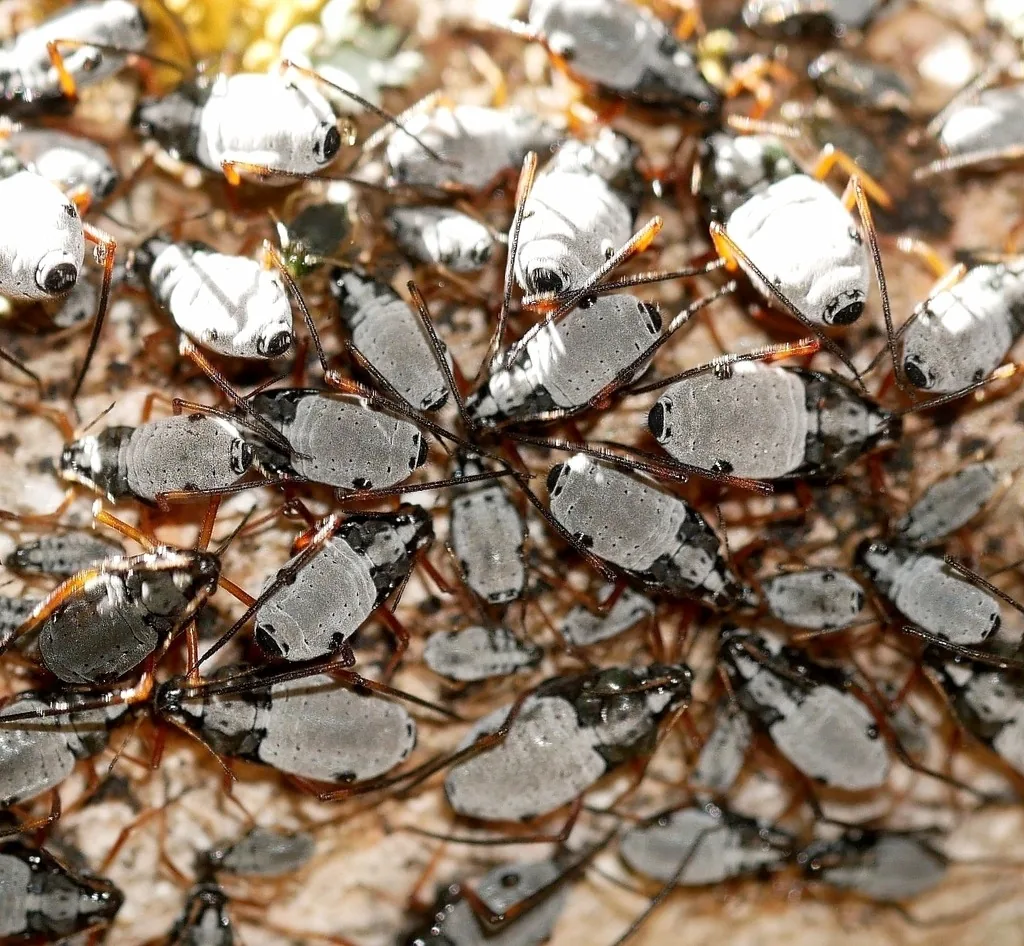
- They're large for aphids, with long legs, and brownish black to purple-black; some species carry a gray or white powdery wax. Sizes vary by source: 0.13 to 0.2 inch (PNW), up to 1/5 inch (Utah State), or about 6.5 mm, roughly 1/4 inch (Colorado State).[1][6][3]
- They gather in big colonies, up to several hundred aphids, on branches (especially the undersides), twigs and trunks. In groups they can blend in with the bark.[1][4][5][3]
- Aphids that drop onto foliage or decks can look somewhat like spiders, and NC State says people who find them indoors often mistake them for ticks. Squashed aphids leave a purple stain.[1][4][3]
Look-alikes
| Look-alike | How to tell them apart |
|---|---|
| Other aphids | Most landscape aphids are only 1/16 to 1/8 inch long and tend to match the color of their host plant.[2] |
Where it lives
Cinara aphids feed only on conifers, and most species stick to one tree species or genus. Hosts named by extension sources include fir (PNW), Fraser fir and white pine (NC State), and pine, juniper and spruce (Colorado State). Colorado State counts about three dozen species in the Rocky Mountain region.[1][4][3]
Biology and life cycle
Eggs overwinter on needles and bark; Montana says females lay them on needles in late summer, while NC State says egg-laying is uncommon in western North Carolina. Large black stem mothers hatch in early spring and give birth to live young without mating.[1][5][4][3]
There are several generations a year. Colorado State says numbers usually peak in late spring and fall off by early summer. In spring they tend to gather on the terminal growth and upper branches; in cool weather and in fall they shift lower on the trunk and branches.[1][3][5][4]
They survive below-freezing temperatures, so live aphids can still be on trees at Christmas tree harvest and become active indoors.[4]
Damage and signs
- Heavy feeding can yellow and curl needles and make them drop early, defoliating branches, and Montana and Colorado State mention dieback and stunting on young trees. Utah State, though, says they have little effect on tree health, and NC State says they usually have no visible effect on Fraser fir Christmas trees.[1][5][3][6][4]
- Copious honeydew attracts yellowjackets, other wasps and ants, and black sooty mold growing on it blocks light to the needles. Colorado State says the honeydew and mold are often a bigger problem than the feeding itself.[1][3]
- Colorado State says problems are most likely in the growing season after a mild winter. NC State says that in rare drought years, very high numbers before bud break can shorten new growth on Fraser fir.[3][4]
Health risk
NC State says Cinara aphids don't bite or sting and don't carry diseases. They do stain fabric purple when squashed, and their honeydew draws yellowjackets and other wasps.[4][3][1]
Control
Prevention
Check early in the season, when aphids are fewer; a dark plate under the branches shows spatters of honeydew from the first activity.[2]
Avoid heavy nitrogen fertilizer and heavy watering, which produce the succulent growth aphids favor.[2]
Keep trees growing well: heavy aphid numbers can signal stress from planting too deep or underwatering, and Colorado State advises avoiding root injury and soil compaction.[5][3]
Traps and physical control
Wash aphids off with a strong stream of water or wipe them off by hand.[2]
For Christmas trees and wreaths, shake and hose them off before bringing them inside. Vacuum aphids off furnishings with a vacuum that has no beater bar, and don't crush them.[4][3]
Biological control
Lady beetles, syrphid fly larvae, green lacewings and parasitoid wasps attack aphids; avoid broad-spectrum sprays that kill them.[2]
Pesticides
Sprays usually aren't needed: Utah State says to tolerate them and WSU generally doesn't recommend pesticides. Where treatment is warranted, Colorado State and Utah State mention a systemic insecticide in spring, Montana a contact insecticide labeled for the host in spring, and Colorado State insecticidal soap while numbers are low. WSU says homeowners shouldn't spray trees over 10 feet tall.[6][7][3][5]
Common questions
- What are the big dark bugs clustered under my fir branches?
- Likely giant conifer aphids, which form large colonies on branch undersides.[1]
- Why are so many yellowjackets around my pine tree?
- Giant conifer aphids produce copious honeydew that attracts yellowjackets and other wasps.[1]
- Why are bugs crawling off my Christmas tree?
- Often Cinara aphids, which survive cold and become active in a warm house. They don't bite or carry disease. Vacuum them up without crushing them, since they leave purple stains.[4][3]
Sources
- Pacific Northwest Pest Management Handbooks (OSU, WSU, University of Idaho), “Fir (Abies): Giant conifer aphid (Insect Management Handbook).” pnwhandbooks.org/insect/hort/landscape/hosts-pests-landscape-plants/fir-abies-giant-conifer-aphid (accessed 2026-11-13)
- Pacific Northwest Pest Management Handbooks (OSU, WSU, University of Idaho), “Landscape pests: Aphid (Insect Management Handbook).” pnwhandbooks.org/insect/hort/landscape/common/landscape-aphid (accessed 2026-11-13)
- Colorado State University, Department of Agricultural Biology, “Giant conifer aphids.” agsci.colostate.edu/agbio/?p=44790 (accessed 2026-11-13)
- NC State Extension (Christmas Trees), “Cinara Aphids on Christmas Trees in North Carolina.” christmastrees.ces.ncsu.edu/christmastrees-cinara-aphids-on-christmas-trees-in-north-carolina/ (accessed 2026-11-13)
- Montana State University Extension, “Giant Conifer Aphids (Urban IPM fact sheet).” urbanipm.montana.edu/entomology/resources/fact-sheets/giant-conifer-aphids.html (accessed 2026-11-13)
- Utah State University Extension, “Giant Conifer Aphids (Ornamental Pest Guide).” extension.usu.edu/planthealth/ipm/ornamental-pest-guide/arthopods/aphids-adelgids/giant-conifer-aphids (accessed 2026-11-13)
- Washington State University Extension, “Common Insects and Mites: Conifer aphids (HortSense).” hortsense.cahnrs.wsu.edu/fact-sheet/common-insects-and-mites-conifer-aphids/ (accessed 2026-11-13)
- Global Biodiversity Information Facility (GBIF), “Cinara Curtis, 1835 (GBIF Backbone Taxonomy).” api.gbif.org/v1/species/2073197 (accessed 2026-11-13)