On this page
How to identify it
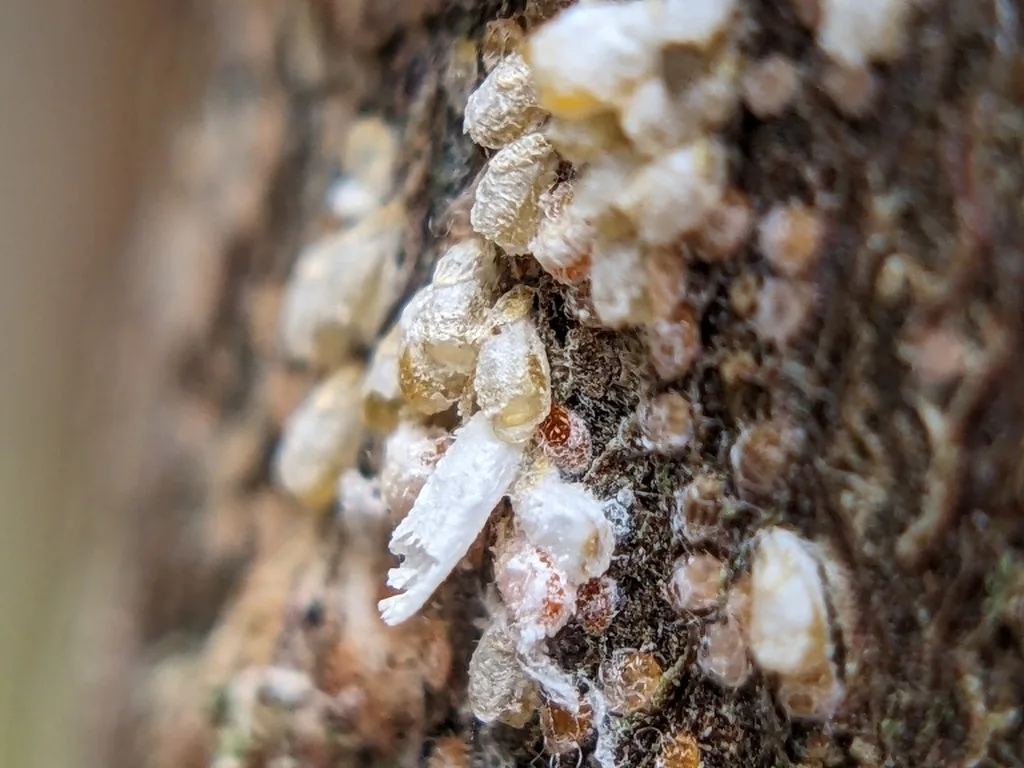
- Female covers are round and white to grayish white with a yellowish spot near the middle (the shed skins of earlier stages). Sizes vary by source: Clemson gives 1/16 to 1/8 inch across and Defra 2.0 to 2.5 mm.[1][3][4][2]
- Male covers are narrow, ridged and bright white and often occur in masses; with the males' white fluffy wax they can make bark look flocked with snow. Infestations sit mainly on the trunk and larger limbs but can also reach fruit and leaves.[3][2][4][1]
Look-alikes
| Look-alike | How to tell them apart |
|---|---|
| San Jose scale | San Jose scale gives birth to live crawlers rather than laying eggs and has four to six generations a year in South Carolina, against three for white peach scale.[1] |
| Japanese maple scale | Japanese maple scale is smaller, under 2 mm, with an oyster-shell-shaped white cover; flip it over and the insect and its eggs are purple.[5] |
| White prunicola scale | A close relative that UMass says is often confused with white peach scale. It's a temperate species, and north of Maryland it's more likely to be the one you're seeing.[2] |
Where it lives
Thought to have come from eastern Asia (UMass says Japan or China), it was first described from Italy in 1886 and now occurs in warmer regions worldwide. In the United States UMass calls it common in the eastern coastal states, particularly from Maryland south; EPPO lists it from Alabama, the District of Columbia, Florida, Georgia, Hawaii, Louisiana, Maryland, Mississippi, Missouri, North Carolina, South Carolina, Tennessee, Texas and Virginia.[2][4][6]
Biology and life cycle
Adult females spend the winter on the bark and start laying eggs under their covers in early April in the Carolinas; in Massachusetts egg laying may not begin until late April or May. The eggs hatch in a few days, and the crawlers wander for a while (NC State says about 12 hours, Clemson a few days) before settling to feed. Males have no working mouthparts and live about a day.[1][2][3]
Crawlers move only short distances on their own (up to about 1 m, Defra says) but are carried farther by wind, flying insects and birds, and over long distances on nursery stock. A 2026 review adds that the scale survives cold storage of fresh fruit, which helps it move in trade.[4][7]
NC State sees three distinct peaks of crawlers in North Carolina, in early May, mid July and early September, and UMass says the fall generation there spreads the scale most rapidly.[3][2]
Damage and signs
- Feeding drains sap and reduces vigor, causing stunting, leaf drop and sparse yellow foliage, smaller fruit and early fruit drop, and dieback of twigs and branches. Populations can build quickly, and heavy infestations can kill large branches or whole trees; Defra says young plants can die very quickly.[1][4][2][3]
- Hosts include peach, cherry and other stone fruits, pear, mulberry, lilac, privet, walnut and catalpa; NC State says more than 100 host plants have been recorded, and UMass says hosts span 90 plant families.[3][2][4]
Health risk
It feeds on plant sap. Clemson HGIC, NC State, UMass and Defra describe plant damage only and don't mention any risk to people or pets.[1][3][2][4]
Control
Sanitation
Prune out and destroy infested parts where practical; UMass notes that's often impossible when the scale is on the trunk and main limbs.[4][2]
Traps and physical control
On small trunks, UMass suggests brushing the scales off with a soft brush. Defra suggests wrapping sticky tape, sticky side out, around the trunk and branches: crawlers show up on it as a dusty film, which tells you when to spray.[2][4]
Biological control
Tiny parasitic wasps attack it: NC State names Encarsia berlesi and Aphytis proclia, and UMass says Encarsia wasps have been effective. NC State notes they sometimes can't hold it down, and Defra says natural enemies work less well in towns and cities.[3][2][4]
Pesticides
Horticultural oil is the main option for home trees. Clemson recommends a dormant-season spray before budbreak, when it's above 40 F, to smother overwintering females. NC State says oil can also be used at a growing-season rate from late spring into December and suggests a second application two or three weeks after the first.[1][3]
For a tree too large to spray, NC State suggests having a licensed landscaper apply Safari (dinotefuran) to the soil in early May, which it says should give at least 12 months of control. Defra notes the scale's waxy cover protects it from sprays and that treatment may be needed over more than one season.[3][4]
Where the sources disagree
Generations: Clemson gives three a year in South Carolina and NC State at least three in North Carolina. UMass says two in the North and up to four in the South, and Defra one to four depending on climate, with one most likely in the UK.[1][3][2][4]
Eggs per female: NC State says 80 to 100, UMass over 100 and Defra 100 to 150; UMass and Defra both say the number depends on the host plant.[3][2][4]
Egg color: NC State says male eggs are white and female eggs orange, and UMass gives coral for females and whitish pink for males. Defra reverses it, with orange male eggs and white female eggs.[3][2][4]
Regulatory status
EPPO lists white peach scale as a regulated non-quarantine pest in the European Union (Regulation (EU) 2019/2072, Annex IV).[6]
Defra says it doesn't occur in Britain, but outbreaks have been found in England since 2006, mostly on peach under protection, and statutory action was taken against infested imported lilac in 2007 and dogwood in 2009 at commercial nurseries. Suspected outbreaks in the UK should be reported to the plant health authorities.[4]
Common questions
- What is the white crust on my peach tree branches?
- It may be white peach scale, especially if the bark looks flocked with white male covers among round grayish female covers with a yellow spot. In the Northeast, UMass says white prunicola scale is more likely.[3][2][1]
- When should I spray oil for peach scale?
- Clemson recommends a dormant spray before budbreak, on a day above 40 F. NC State says a growing-season oil from late spring also works, ideally repeated after two or three weeks.[1][3]
Sources
- Clemson Cooperative Extension, Home & Garden Information Center, “Peach Insect Pests (HGIC 2210).” hgic.clemson.edu/factsheet/peach-insect-pests/ (accessed 2026-11-13)
- UMass Extension Landscape, Nursery and Urban Forestry Program, “Pseudaulacaspis pentagona (Insect & Mite Guide).” www.umass.edu/agriculture-food-environment/landscape/publications-resources/insect-mite-guide/pseudaulacaspis-pentagona (accessed 2026-11-13)
- NC State Extension, “White Peach Scale Insect (PDIC Factsheet; James Baker).” content.ces.ncsu.edu/white-peach-scale (accessed 2026-11-13)
- Department for Environment, Food and Rural Affairs (Defra), UK Plant Health Portal, “Plant Pest Factsheet: White peach scale, Pseudaulacaspis pentagona (Malumphy et al., revised 2016).” planthealthportal.defra.gov.uk/assets/factsheets/Defra-Factsheet-Pseudaulacaspis-pentagonaV3.pdf (accessed 2026-11-13)
- University of Kentucky Entomology (ENTFACT), “Managing Japanese Maple Scale in Kentucky Nurseries (ENTFACT-463).” entomology.mgcafe.uky.edu/ef463 (accessed 2026-11-13)
- European and Mediterranean Plant Protection Organization (EPPO) Global Database, “Pseudaulacaspis pentagona (PSEAPE) datasheet.” gd.eppo.int/taxon/PSEAPE/datasheet (accessed 2026-11-13)
- Insects 2026;17(8):758, via PubMed, “Current Status of Pseudaulacaspis pentagona (Targioni-Tozzetti): Context, Impact and Challenges for Integrated Management in Ecuador (Basantes-Vizcaino et al.).” pubmed.ncbi.nlm.nih.gov/42652413/ (accessed 2026-11-13)
- Global Biodiversity Information Facility (GBIF), “Pseudaulacaspis pentagona (Targioni Tozzetti, 1886) (GBIF Backbone Taxonomy).” api.gbif.org/v1/species/8321970 (accessed 2026-11-13)
- iNaturalist, “Pseudaulacaspis pentagona taxon page (order and family).” www.inaturalist.org/taxa/716067 (accessed 2026-10-06)