On this page
How to identify it
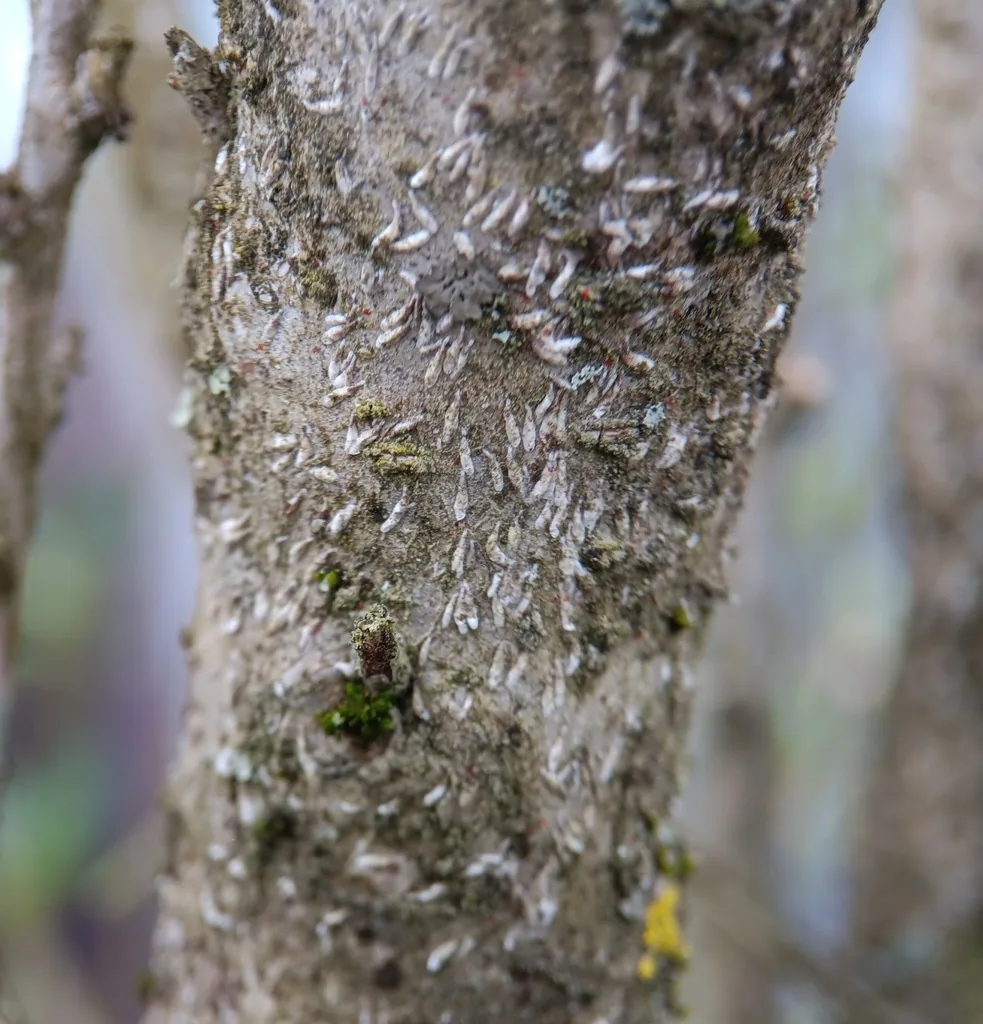
- Female covers are 1 to 2 mm, elongate and oyster-shaped, white to grayish-white, with a bronze tip; when the wax rubs off they look brown and mottled.[1][2]
- Under the cover is a purple or lavender insect. Kentucky, UMass and Missouri describe the eggs as purple too, while Penn State calls them white with a purple hue and the crawlers white.[1][3][4][2]
Look-alikes
| Look-alike | How to tell them apart |
|---|---|
| Oystershell scale | Kentucky says it superficially resembles oystershell scale; look for the white wax coat and the purple insect underneath.[1] |
| White peach scale | White peach and white prunicola scales have rounded white covers that look like a fried egg, sunny side up; Japanese maple scale's cover is elongate. Clusters of their males can make bark look woolly.[2] |
Where it lives
First detected in Connecticut in 1914, it's now recorded across much of the eastern US, from New England to Georgia and Louisiana, and in Missouri. Abroad, EFSA lists Asia, North America and parts of non-EU Europe.[3][2][4][5]
Biology and life cycle
Generations differ by region: one in Pennsylvania and probably one in New England, two in central Kentucky and the mid-Atlantic and Southeast. Females lay about 25 eggs under the cover in late spring, which hatch in 7 to 21 days.[2][3][1][4]
Egg hatch is drawn out, lasting about 10 weeks in the mid-Atlantic, so crawlers keep appearing for a long time; they start making wax within three days of hatching.[3][1]
Crawlers first appear around mid-May in New England, about when Ivory Silk Japanese tree lilac and oakleaf hydrangea bloom. In Pennsylvania they're active from late May into early August.[3][2]
Because most life stages can't move, it travels mainly on nursery plants.[5]
Damage and signs
Health risk
It feeds only on plants; none of the extension sources lists a risk to people.[1][2]
Control
Traps and physical control
Scout in the dormant season, when covers are easiest to see; check branch collars and, on shrubs, the first 8 inches of stem above the soil. From May, sticky tape wrapped sticky-side-out around twigs catches crawlers.[2][3][1]
Prune out heavily infested branches and remove badly infested trees. Light infestations can be scrubbed off with a soft brush or toothbrush and water.[2][3][4]
Biological control
Parasitic wasps, lacewings, lady beetles and predatory flies attack it. A Tennessee nursery survey found three parasitic wasps new to the state, with about 7 to 8% of scales parasitized despite routine spraying.[4][6]
Pesticides
Kentucky says dormant oil suppresses it but is unlikely to wipe it out, and lists systemic products used in nurseries. Penn State cautions that soil-applied systemics may work less well because the scale lives on twigs and trunks, and advises timing treatments to crawler activity.[1][2]
Other names
Penn State notes it's also called Japanese scale or pear white scale.[2]
How many plants does it attack?
Counts vary widely by source. Penn State cites literature listing 16 genera in 13 families; Kentucky reports NC State's tally of 45 genera in 27 families; and EFSA's review lists 60 species in 35 families, favoring smooth-barked woody plants.[2][1][5]
Hosts named by UMass and Missouri include maple, cherry, pear, crabapple, dogwood, redbud, holly, lilac, linden, privet, serviceberry and zelkova.[3][4]
Common questions
- What are the tiny white specks on my maple twigs?
- Possibly Japanese maple scale: white, oyster-shaped covers 1 to 2 mm long with a purple insect underneath.[1][2]
- Is Japanese maple scale only on Japanese maples?
- No. Despite the name it attacks many woody plants, including maple, cherry, pear, dogwood, redbud, magnolia, holly, privet and serviceberry.[1][3][4]
- When should I look for crawlers?
- Start in mid to late May and keep watching into summer; hatching is spread out over about 10 weeks in the mid-Atlantic.[3][2]
Sources
- University of Kentucky Entomology (ENTFACT), “Managing Japanese Maple Scale in Kentucky Nurseries (ENTFACT-463).” entomology.mgcafe.uky.edu/ef463 (accessed 2026-11-12)
- Penn State Extension, “Japanese Maple Scale.” extension.psu.edu/japanese-maple-scale (accessed 2026-11-12)
- UMass Amherst Center for Agriculture, Food, and the Environment, “Japanese Maple Scale.” www.umass.edu/agriculture-food-environment/landscape/fact-sheets/japanese-maple-scale (accessed 2026-11-12)
- University of Missouri Extension, Plant Diagnostic Clinic, “Japanese Maple Scale (MU-PDC 2021).” extension.missouri.edu/media/wysiwyg/Extensiondata/Pro/PlantDiagnosticClinic/Docs/japanese-maple-scales.pdf (accessed 2026-11-12)
- EFSA Journal (EFSA Panel on Plant Health), 2018 (via PubMed), “Pest categorisation of Lopholeucaspis japonica (abstract).” pubmed.ncbi.nlm.nih.gov/32625986/ (accessed 2026-11-12)
- Journal of Insect Science, 2024 (via PubMed), “New records of three parasitoids, Pteroptrix chinensis, Aphytis hispanicus, and Marlattiella prima (Hymenoptera: Aphelinidae) associated with an exotic scale, Lopholeucaspis japonica (Hemiptera: Diaspididae) in Tennessee (abstract).” pubmed.ncbi.nlm.nih.gov/38491949/ (accessed 2026-11-12)
- Global Biodiversity Information Facility (GBIF), “Lopholeucaspis japonica (Cockerell, 1897) (GBIF Backbone Taxonomy).” api.gbif.org/v1/species/2083529 (accessed 2026-11-12)