On this page
How to identify it
- Look for loose silk webs or tubes at the base of the needles, filled with frass, clipped and partly eaten needles and cast skins; webbing gets more conspicuous as the season goes on.[1][2]
- Larvae are olive green to greenish brown with purplish-red stripes along the body and an orange-yellow to light brown head, and are about 15 to 20 mm (roughly 5/8 to 3/4 inch) long when full grown.[2][1]
- Unlike moth caterpillars, the larvae have no fleshy prolegs on the abdomen, only short legs behind the head, so they crawl poorly and quickly pull back inside the silk when disturbed.[1][2]
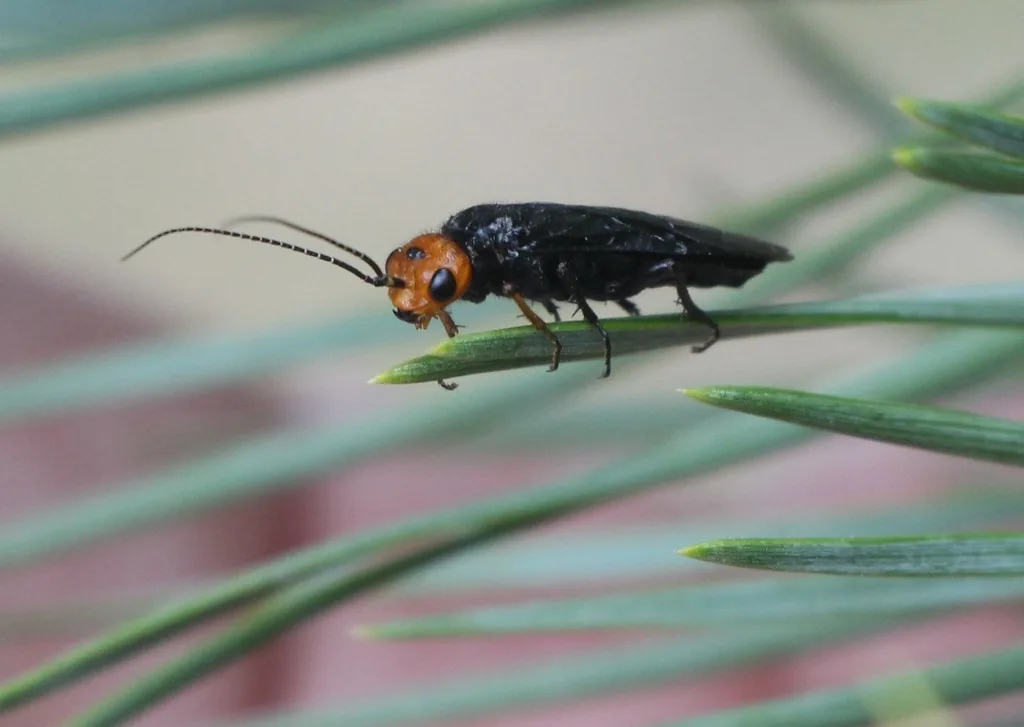
- Adults are sawflies: females are black or bluish black with a red head, and males are black with a yellow face and yellow front legs.[2]
Look-alikes
| Look-alike | How to tell them apart |
|---|---|
| Pine webworm | A moth caterpillar, not a sawfly, that also webs pine needles. Its adults appear from June into early August, and it can have two or three generations a year in the South, while the pine false webworm has one, with adults in spring.[5][1][2] |
Where it lives
Introduced from Europe and first recorded in North America in Pennsylvania in 1925. It spread through much of the northeastern United States and the Lake States, east to New Jersey, New York and New England and west to Wisconsin; it has been in Ontario since 1961 and has also turned up in Alberta, Newfoundland and southern Quebec. GBIF U.S. records are most frequent from New York, Connecticut, New Jersey and Michigan.[1][2][4][8]
Biology and life cycle
There is one generation a year: larvae overwinter in earthen cells in the soil under the host, about 5 to 8 cm down (UMass) or in the upper 10 cm (NRCan), and pupate in spring. UMass puts adult emergence at about mid-April to mid-May; in Ontario adults emerge mid to late May.[1][2]
Females cut small slits in the previous year's needles and lay their eggs end to end in small groups of about 3 to 10; NRCan says 30 to 40 eggs per female. Eggs hatch in about 10 to 14 days.[1][2]
Young larvae spin webs at the base of the needles, cut needles off and pull them into the web to eat; older larvae may move off to feed alone from their own silk tubes. When feeding ends, they drop to the soil.[1][2]
Some larvae stay in the soil through two winters before they emerge as adults.[2]
Females attract males with a sex pheromone, (Z)-6,14-pentadecadienal; researchers found it strongly attracted males in the field and suggested it could be used in lures.[6]
Damage and signs
- Larvae strip the older needles first; new growth is usually spared but can still die from the stress on a heavily defoliated tree.[1][2]
- Hosts include red and eastern white pine, which females prefer for egg laying, plus Scots, Austrian, mugo, Japanese red and jack pine; NRCan adds lodgepole and ponderosa pine growing alongside them.[1][2]
- Repeated heavy defoliation can kill pines: UMass notes that more than 70 percent defoliation in consecutive years may lead to tree death, and weakened pines can then be attacked by bark beetles or fungal disease.[1]
- For decades it was mainly a pest of young pines in Christmas tree farms, nurseries and landscapes; in the 1990s outbreaks began in older red and white pine plantations in Ontario and New York. About 570,000 acres in New York were heavily infested between 1989 and 1999.[2][4]
Health risk
It feeds only on pines; none of the sources reports any harm to people or pets.[1][2][4]
Control
Prevention
Watch for the distinctive adults in May, often seen flying in the tops of host trees, to judge whether treatment is needed and when.[2]
Traps and physical control
On landscape pines, small infestations can be pruned out and the webbed branches destroyed.[1]
Biological control
Natural enemies usually keep it in check in Europe; a European tachinid fly has been released in Ontario, and Natural Resources Canada names the tachinid Myxexoristops hertingi as the most promising biological control agent.[1][2]
In lab tests, a Bacillus thuringiensis strain with the Cyt1Ba toxin affected pine false webworm larvae, unlike the Bt kurstaki sold for moth caterpillars; this is research, not a product for home use.[7]
Pesticides
Sprays work poorly once the webs are large and dense because the larvae feed inside. If treatment is needed, apply just before or 1 to 2 days after egg hatch, or spray forcefully enough to get through the webs. Trials found permethrin and carbaryl most effective, and the growth regulator diflubenzuron also worked. Follow the label.[1][2]
Where sources disagree
Feeding time: UMass says larvae feed for about 18 to 20 days; NRCan says about 21 to 28 days, ending mid to late June.[1][2]
Egg groups: UMass says 3 to 10 eggs per group, NRCan 4 to 10.[1][2]
Pest status: NRCan says it is not a serious pest in its native Europe and Asia, while the USDA sawfly guide says it has caused severe defoliation in North America, Europe and Asia.[2][4]
Common questions
- What are the webs full of needles on my pine?
- Webs or tubes packed with clipped needles and frass at the base of older needles in late spring point to pine false webworm larvae feeding inside.[1][2]
- Is the pine false webworm a moth?
- No; despite the name it is a sawfly, a relative of bees and wasps named for the saw-like egg-laying organ the female uses to slit needles.[2]
- Will pine false webworm kill my pine?
- Light infestations are mostly unsightly, but heavy defoliation several years in a row can kill pines, especially young or stressed trees.[1][2]
- Will Bt spray kill pine false webworm?
- Not the usual kind. The Bt kurstaki sold for caterpillars targets moth larvae; sawfly larvae like this one were affected in lab tests only by a different Bt toxin (Cyt1Ba). The sources name permethrin, carbaryl or diflubenzuron timed to egg hatch instead.[7][2]
Sources
- UMass Extension Landscape, Nursery and Urban Forestry Program (Landscape Insect & Mite Guide), “Acantholyda erythrocephala (Pine False Webworm).” www.umass.edu/agriculture-food-environment/landscape/publications-resources/insect-mite-guide/acantholyda-erythrocephala (accessed 2026-11-12)
- Natural Resources Canada, Canadian Forest Service (Trees, insects and diseases of Canada's forests), “Pine false webworm (J. P. Brandt, revision 2024).” tidcf.nrcan.gc.ca/en/insects/factsheet/1000130 (accessed 2026-11-12)
- iNaturalist, “Acantholyda erythrocephala taxon page (order and family).” www.inaturalist.org/taxa/212218 (accessed 2026-11-12)
- USDA APHIS Identification Technology Program, IDtools, “Acantholyda (Sawfly Genera of the World).” idtools.org/sawfly/index.cfm?packageID=87&entityID=716 (accessed 2026-11-12)
- UMass Amherst Center for Agriculture, Food, and the Environment, “Pococera (formerly Tetralopha) robustella: pine webworm (Insect & Mite Guide).” www.umass.edu/agriculture-food-environment/landscape/publications-resources/insect-mite-guide/pococera-formerly-tetralopha-robustella (accessed 2026-11-12)
- Journal of Chemical Ecology 35(12), 2009 (Staples et al.), via PubMed, “Sex pheromone of the pine false webworm Acantholyda erythrocephala.” pubmed.ncbi.nlm.nih.gov/20063203/ (accessed 2026-11-12). Cited from the PubMed abstract.
- Journal of Invertebrate Pathology 113(2), 2013 (van Frankenhuyzen and Tonon), via PubMed, “Activity of Bacillus thuringiensis cyt1Ba crystal protein against hymenopteran forest pests.” pubmed.ncbi.nlm.nih.gov/23545068/ (accessed 2026-11-12). Cited from the PubMed abstract.
- Global Biodiversity Information Facility (GBIF), “Acantholyda erythrocephala: occurrence records.” www.gbif.org/species/1248774 (accessed 2026-11-12). State and country counts from the GBIF occurrence API, read 2026-11-12.