On this page
How to identify it
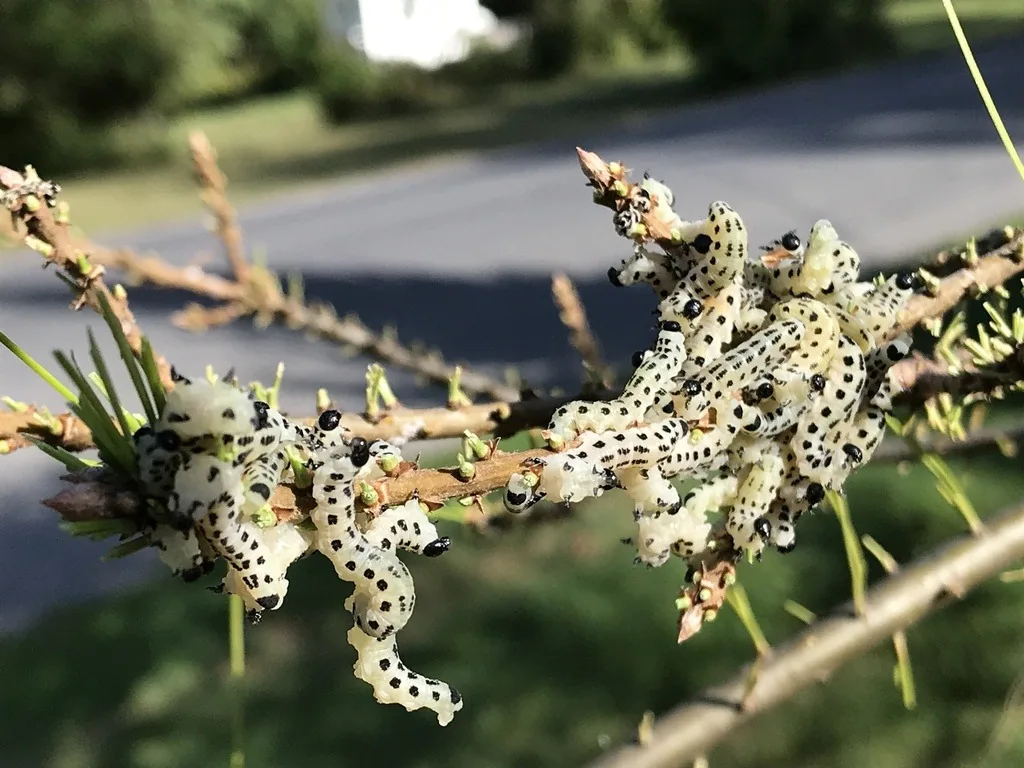
- Larvae are pale yellow to light cream with a shiny black head and four rows of black spots running the length of the body, plus a black spot at the tail end.[1][2]
- Full-grown larvae are about 1 inch (25 mm) long.[1]
- Larvae feed in groups, stripping one branch before they move to the next.[1][2]
- Like other sawfly larvae, they have six or more pairs of fleshy prolegs on the abdomen; moth and butterfly caterpillars have two to five pairs.[1]
Look-alikes
| Look-alike | How to tell them apart |
|---|---|
| Redheaded pine sawfly | Also yellow with rows of black spots, but it has a reddish-brown head and six rows of spots, and it prefers red and jack pines under 15 feet tall.[1] |
| European pine sawfly | Larvae are gray-green with black heads and light stripes, and they feed from mid-May through June on mugo, Scots, red and jack pines.[1] |
Where it lives
Covered as a pest of landscape and forest pines by University of Minnesota and University of Maine Extension; eastern white pine is its main host.[1][2]
Biology and life cycle
Larvae spend the winter as prepupae in cocoons in the soil, pupate in spring, and adults emerge several weeks later.[1][2]
Females cut tiny slits in the needles with their saw-like egg-laying organ and lay their eggs inside in spring; a female can produce sons from unfertilized eggs but daughters only after mating.[1][2]
UMN gives the larval feeding period as late June to early August, and UMaine says feeding is heaviest from July through early September; there is usually one generation a year.[1][2]
Young larvae eat only the outer part of a needle, while older larvae eat whole needles.[2]
Damage and signs
- Larvae eat both new and old needles on trees of all sizes and can completely defoliate a tree.[1][2]
- Eastern white pine is preferred. UMN says it also feeds on other pines such as red pine; UMaine names red, mugo and other short-needled pines.[1][2]
- UMN says conifers other than tamarack don't regrow needles once they're eaten.[1]
Health risk
The larvae feed on pine needles, and no cited source describes any risk to people or pets.[1][2]
Control
Prevention
Check pines for colonies of larvae in early summer, while they are still small.[1]
Traps and physical control
Small numbers of larvae can be picked off into a pail of soapy water, crushed, or knocked off with a strong spray of water (UMN).[1]
Pesticides
UMN says to treat larvae while they are young, half grown or less, and to spot-treat feeding groups; once larvae are full grown the damage is done. Insecticidal soap and horticultural oil work on small numbers of young larvae with little harm to natural enemies, while Btk, a caterpillar product, doesn't kill sawfly larvae. UMN also lists azadirachtin, spinosad and contact insecticides such as permethrin, bifenthrin and carbaryl. Follow the label.[1]
More from the research literature
University of Kentucky genetic studies treat the white pine sawfly and the redheaded pine sawfly as sister species adapted to different pines that diverged while still exchanging genes. A 2025 study found recent hybrid mixing between them varies by region and is predicted by climate change rather than urbanization.[4][5]
Common questions
- What are the yellow, black-spotted larvae eating my white pine?
- Groups of pale yellow larvae with shiny black heads and rows of black spots feeding on white pine in summer are white pine sawfly larvae.[1][2]
- Are white pine sawflies caterpillars?
- No. They are larvae of sawflies, which are related to wasps and bees, and they have more pairs of prolegs than moth caterpillars.[1]
Sources
- University of Minnesota Extension, “Sawflies (Yard and Garden Insects).” extension.umn.edu/yard-and-garden-insects/sawflies (accessed 2026-11-13)
- University of Maine Cooperative Extension, “White Pine Sawfly (Home and Garden IPM fact sheet).” extension.umaine.edu/home-and-garden-ipm/fact-sheets/common-name-listing/white-pine-sawfly/ (accessed 2026-11-13)
- Global Biodiversity Information Facility (GBIF), “Neodiprion pinetum (Norton) (GBIF Backbone Taxonomy).” api.gbif.org/v1/species/1249728 (accessed 2026-11-13)
- Molecular Ecology (via PubMed), “Recurrent selection shapes the genomic landscape of differentiation between a pair of host-specialized haplodiploids that diverged with gene flow (Glover et al., 2024) (abstract).” pubmed.ncbi.nlm.nih.gov/39165007/ (accessed 2026-11-13)
- Molecular Ecology (via PubMed), “Recent climate change and historical population structure predict spatial patterns of admixture between two host-specialised pine sawfly species (Glover and Linnen, 2025) (abstract).” pubmed.ncbi.nlm.nih.gov/41287918/ (accessed 2026-11-13)