On this page
How to identify it
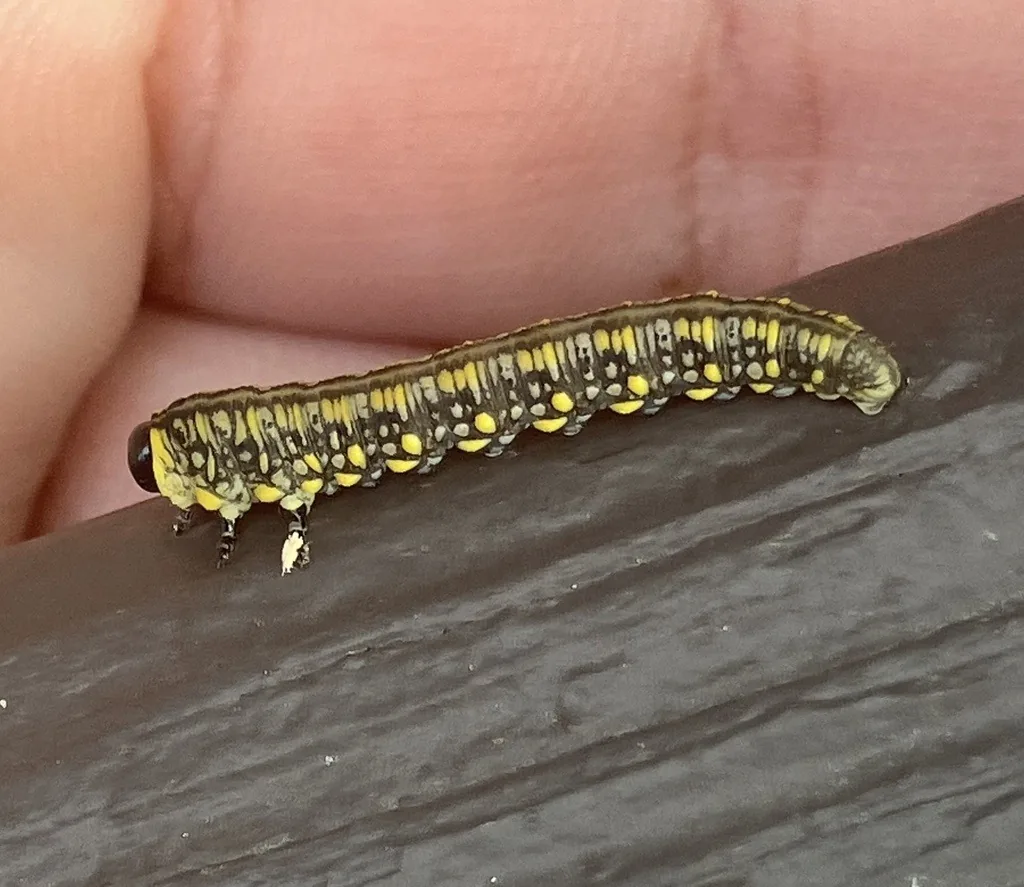
- Full-grown larvae are about an inch long with a shiny black head. NC State calls them whitish with yellow and black spots; UMass describes them as black or dark brown with two dark stripes on the back and yellow and white markings on the sides.[1][2]
- Females are stocky and yellow and black; males are smaller and blackish, with feathery antennae.[1]
- Sawfly larvae can be told from moth caterpillars by their prolegs: moth and butterfly caterpillars have 5 or fewer pairs of fleshy abdominal prolegs with tiny hooks.[2]
- UMaine says larvae that fall from overhead pines often turn up on deck railings, cars and house walls, and adults sometimes emerge indoors in spring.[3]
Look-alikes
| Look-alike | How to tell them apart |
|---|---|
| European and redheaded pine sawflies | Other sawfly larvae feed on the same hosts, so confirm by looking at the larvae themselves.[2] |
Where it lives
First found in the U.S. at New Haven, Connecticut, in 1914, it is established in New England and south to the mountains of North Carolina, where the Forest Service first reported it in 1978.[1][2][4]
Biology and life cycle
Females slit pine needles and lay eggs end to end inside, sealing the wound with froth; mature larvae spin tough cocoons on needles, twigs or bark.[1][2]
UMaine and NRCan describe two generations a year, with first-generation larvae in early summer and second-generation larvae from late July into September; UMass says the generations overlap heavily and larvae can be present into early October.[3][5][2]
Young larvae feed in groups; older larvae feed alone and eat whole needles, even bark once needles are gone. First-generation larvae eat the previous year's needles, and the second generation eats both old and new.[1][2][3]
Prepupae overwinter in cocoons, and UMass and NRCan say some cocoons can stay dormant for more than a year.[2][5][3]
Damage and signs
Health risk
It feeds on pine needles. NC State, UMass, UMaine and NRCan describe tree damage only and don't mention any risk to people or pets.[1][2][3][5]
Control
Traps and physical control
Wearing gloves, pick off young larvae while they still feed in groups and drop them into soapy water.[2]
Biological control
Parasitic wasps, especially Monodontomerus dentipes and Exenterus amictorius, are its main natural enemies; NC State credits Monodontomerus with keeping it largely under control there, and UMass says cold winters can kill up to half the second-generation larvae.[1][2][5]
Pesticides
Bt (Bacillus thuringiensis kurstaki) does not work on sawfly larvae. See where the sources disagree on spraying.[2]
Where the sources disagree
Austrian pine: UMaine lists it as a host; UMass says it may be somewhat resistant, and NRCan says it appears to be resistant.[3][2][5]
Generations in North Carolina: NC State says at least two a year and sometimes three; UMass says three.[1][2]
Spraying: NC State says most landscape insecticides from garden centers give good control. NRCan says control is needed only in severe plantation infestations and spraying works best when larvae are caught early.[1][5]
Common questions
- What are the spotted caterpillars eating my white pine?
- Possibly introduced pine sawfly larvae, which have shiny black heads and feed in groups when young.[1][2]
- Will Bt kill pine sawflies?
- No; Bt kurstaki only kills moth and butterfly caterpillars, not sawfly larvae.[2]
- When should I look for them?
- Watch for feeding from May; in Massachusetts, UMass says reports often pick up in late June, and NRCan suggests checking from mid-June, paying special attention to five-needle pines, again in mid-August for the second generation, and in later years too.[2][5]
Sources
- NC State Extension, “Introduced Pine Sawfly (PDIC Factsheet).” content.ces.ncsu.edu/introduce-pine-sawfly (accessed 2026-11-13)
- UMass Extension Landscape, Nursery and Urban Forestry Program (Landscape Insect & Mite Guide), “Diprion similis (Introduced Pine Sawfly).” www.umass.edu/agriculture-food-environment/landscape/publications-resources/insect-mite-guide/diprion-similis (accessed 2026-11-13)
- University of Maine Cooperative Extension, “Introduced Pine Sawfly (Home and Garden IPM fact sheet).” extension.umaine.edu/home-and-garden-ipm/fact-sheets/common-name-listing/introduced-pine-sawfly/ (accessed 2026-11-13)
- USDA Forest Service, Southeastern Forest Experiment Station (Treesearch), “The Introduced Pine Sawfly, a Defoliator of White Pine New to North Carolina (Res. Note SE-273; Drooz, Doggett and Coppel, 1979), abstract.” research.fs.usda.gov/treesearch/658 (accessed 2026-11-13)
- Natural Resources Canada, Canadian Forest Service, “Introduced pine sawfly (Forest Invasive Alien Species).” www.exoticpests.gc.ca/control-details/insect/5 (accessed 2026-11-13)
- Global Biodiversity Information Facility (GBIF), “Diprion similis (Hartig, 1834) (GBIF Backbone Taxonomy).” api.gbif.org/v1/species/5023193 (accessed 2026-11-13)
- iNaturalist, “Diprion similis taxon page (order and family).” www.inaturalist.org/taxa/62626 (accessed 2026-10-06)