On this page
How to identify it
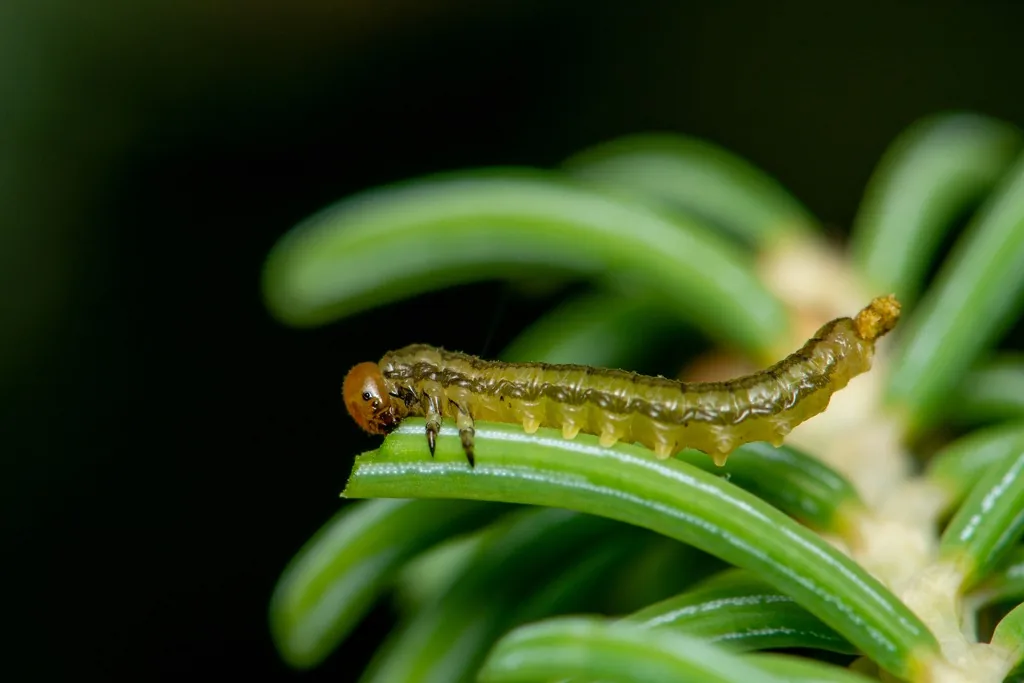
- Larvae grow to about 3/4 inch (18 mm), with a yellow to reddish-brown head and a glossy olive-green body marked with gray-green stripes; UMN counts six.[1][2]
- Newly hatched larvae have a yellow head and an unmarked light yellow-green body.[1]
- Disturbed larvae arch both ends of the body and give off a drop of liquid from the mouth.[1]
- Damaged shoots show a distinctive pattern: needles are stripped from one side of the developing shoot first, and by late season the shoot is bare.[3]
- Adults look like small flies with four shiny, clear wings and a body ranging from straw yellow to nearly black.[1]
Where it lives
From Maine and New Brunswick west through the Great Lakes states to Wyoming and Idaho, and north to British Columbia and Alaska. University of Minnesota Extension covers it among Minnesota sawflies.[1][2]
Biology and life cycle
It spends the winter as a prepupa in a cocoon in the soil; adults emerge from late May to mid-June and lay eggs in slits in the new needles.[1][2]
Larvae hatch in 5 to 10 days and feed for four to six weeks, from late May or June into July, then drop to the ground to spin cocoons; there is one generation a year.[1][2]
Females prefer to lay eggs in full sunlight, which is why open-grown saplings are the most vulnerable.[3]
Eggs laid in the upper crown are mostly female, and more female larvae move upward from the lower and middle crown to finish growing, where the foliage suits them better.[5]
Late-instar larvae feed by day, from just after dawn to dusk, and rest at night. In a field study 94% fed on the shaded underside of shoots, which probably protects them from heat and drying.[4]
Damage and signs
- It attacks only spruce: white spruce is preferred, and black, blue, red, Norway and Engelmann spruce are also eaten.[1][2]
- Larvae eat new needles first, then old ones; open-grown trees, windbreaks, shade trees and young plantings are hit hardest.[1][2][3]
- Three or four years of heavy defoliation in a row can kill a tree, and the Forest Service reported losses of up to 90 percent in open stands.[1][2]
- In a Québec survey of plantations, sawfly damage was rare, on 2 of 100 monitored trees, but reached 15% of new foliage where it occurred.[3]
Health risk
Control
Prevention
Check spruces in spring and early summer for larvae on the new shoots, especially open-grown yard trees and windbreaks.[2][3]
Biological control
At least 10 wasp and 5 fly species parasitize the larvae, a tiny wasp attacks the eggs, and small mammals likely eat cocoons, but they rarely hold numbers down when weather favors the sawfly.[1]
Pesticides
Treat larvae with an insecticide only if needed. UMN notes a fall soil application of imidacloprid or dinotefuran can prevent larvae the next spring where infestations keep returning.[2]
Where it lives
From Maine and New Brunswick west through the Great Lakes states to Wyoming and Idaho, and north to British Columbia and Alaska.[1]
Canadian researchers say it can severely defoliate young spruce across Canada, in plantations and under forest canopies.[3]
Where sources disagree
Closed forests: the Forest Service says most natural and closed stands are typically free from attack, while a Québec study found sawflies slightly more abundant on understory spruce than in open plantations, and says the sawfly attacks young spruce in both settings.[1][3]
Old needles: the Forest Service says larvae move onto old foliage once half grown, while UMN says they eat last year's needles when new foliage is scarce.[1][2]
Chemical control: the 1971 Forest Service leaflet said no insecticides were registered for this sawfly, while UMN's current page suggests treating larvae if needed or a fall soil application where it keeps returning.[1][2]
Common questions
- What are the green, striped larvae eating my spruce?
- In early summer, often yellowheaded spruce sawfly larvae; look for their yellow to reddish-brown heads and olive-green striped bodies.[2][1]
- Can yellowheaded spruce sawflies kill a spruce?
- Yes, after three or four years of heavy defoliation in a row.[1][2]
- Why is my lone spruce hit but not the woods behind it?
- Females prefer to lay eggs in full sun, so open-grown trees are the most vulnerable; the Forest Service says closed stands are usually spared, though one Québec study found sawflies on understory spruce too.[3][1]
Sources
- USDA Forest Service (Forest Insect & Disease Leaflets), “Yellow-Headed Spruce Sawfly (Forest Pest Leaflet 69, revised March 1971).” www.fs.usda.gov/foresthealth/docs/fidls/FIDL-69-YellowHeadedSawfly.pdf (accessed 2026-11-12)
- University of Minnesota Extension, “Sawflies (Yard and Garden Insects).” extension.umn.edu/yard-and-garden-insects/sawflies (accessed 2026-11-11)
- Insects (MDPI), via PubMed Central, “Limited differences in insect herbivory on young white spruce growing in small open plantations and under natural canopies in boreal mixed forests (Ndiaye et al. 2024).” pmc.ncbi.nlm.nih.gov/articles/PMC10971650/ (accessed 2026-11-11)
- Environmental Entomology, via PubMed, “Temporal and spatial variations in microclimate influence the larval foraging behaviors and performance of a conifer-feeding sawfly (Johns et al. 2012, Natural Resources Canada).” pubmed.ncbi.nlm.nih.gov/22732618/ (accessed 2026-11-11)
- Oecologia, via PubMed, “Intra-tree variation in foliage quality drives the adaptive sex-biased foraging behaviors of a specialist herbivore (Johns et al. 2010).” pubmed.ncbi.nlm.nih.gov/20422222/ (accessed 2026-11-11)
- iNaturalist, “Euura alaskensis taxon page (order and family).” www.inaturalist.org/taxa/1354475 (accessed 2026-11-11)