On this page
How to identify it
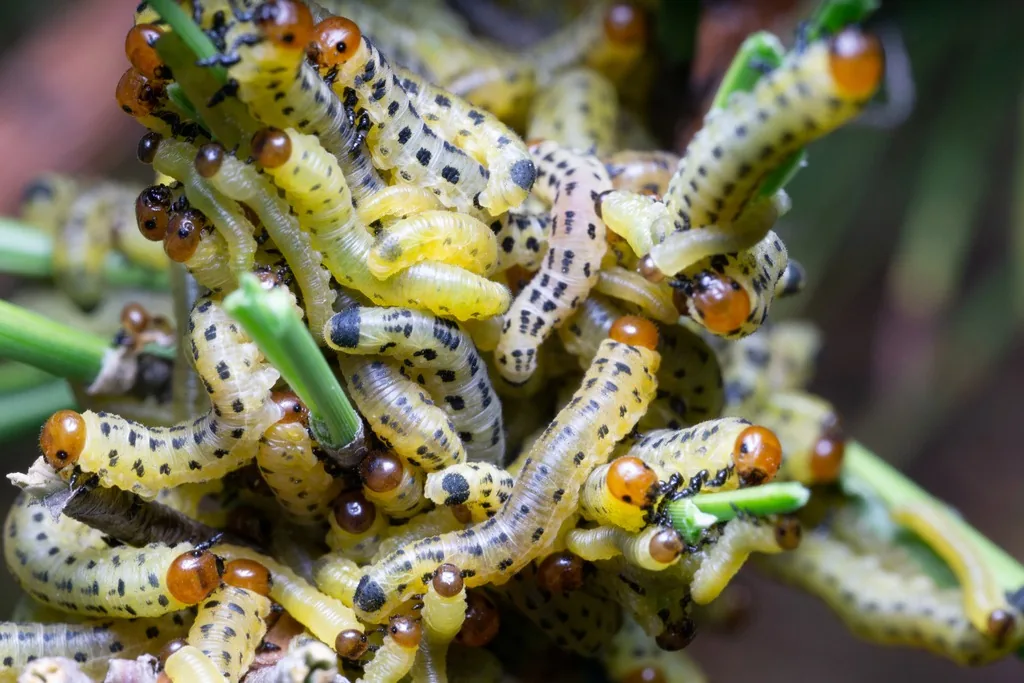
- Larvae look like caterpillars but have more legs; they feed in groups.[1]
- Adult females are about 1/3 inch long, broad-waisted, with a reddish-brown head and mostly black body.[2]
- Eggs sit in a row in slits in the needles, each slightly swollen and discolored.[1][2]
- Natural Resources Canada describes mature larvae as about 25 millimetres long, pale to deep yellow, with a reddish-brown head and four to eight rows of black spots on each segment. Adults are 5 to 10 millimetres long; females have a red head and thorax and black abdomen, and males are entirely black with feathery antennae.[3]
- To tell sawfly larvae from caterpillars, count the fleshy prolegs under the abdomen: sawfly larvae have either none or a pair on six or more abdominal segments, while caterpillars have five or fewer pairs.[3][2]
Where it lives
It is native to eastern North America, from Ontario to Prince Edward Island in Canada and to the states mainly east of the Great Plains, south to Florida. GBIF holds 781 U.S. records since 1990 from 30 states, led by Florida (124), North Carolina (102) and Virginia (101).[3][5][1]
Biology and life cycle
Egg numbers are given a little differently: NC State says females usually lay 120 or so eggs in the needles of one twig, UMass says approximately 100 eggs in rows on several needles, and Natural Resources Canada says more than 100 eggs may be laid at a time. Eggs hatch in 2 to 3 weeks (Natural Resources Canada) or within approximately 1 month (UMass).[1][2][3]
Mature larvae drop to the soil and spin brown, papery cocoons about 1/2 inch long; prepupae overwinter in the litter, and some wait two or more years before developing.[1][2]
Generations vary by region and source: four or five a year in North Carolina (NC State), about three in the South (Mississippi State), one to three depending on location (UMass), and a single generation in Canada with as many as three in Florida (Natural Resources Canada).[1][4][2][3]
When threatened, a larva raises the front and rear of its body in a defensive posture and regurgitates a chemical to discourage predators, and the larvae in a colony communicate with pheromones to stay together.[3]
Damage and signs
- Hosts include many hard pines (shortleaf, loblolly, slash, red, Scotch, jack, mugo and others), and occasionally spruce, cedar and larch growing near preferred hosts.[1][2]
- Large pines may be noticeably defoliated, and small trees may be killed.[1]
- Small trees are most at risk: Natural Resources Canada says trees less than 3 metres tall are particularly susceptible, and Mississippi State says attacks focus on saplings up to 12 to 15 feet tall. Trees recover from defoliation, but growth slows and they look unsightly for a while.[3][4]
Health risk
Control
Prevention
Mississippi State says treatment is usually only justified on small, recently planted trees, and that you have to react quickly to prevent heavy damage.[4]
Traps and physical control
When only a few colonies are on small ornamental pines, pick or shake them off and crush them.[1]
Because the larvae feed in groups, UMass suggests removing them by hand where they can be safely reached and dropping them into a bucket of soapy water.[2]
Biological control
Natural enemies are abundant: UMass notes at least 46 parasites recorded, rodents that eat the pupae and virus outbreaks among the larvae. Natural Resources Canada says a naturally occurring virus found in 1950 was developed into the control product Lecontvirus, used against this sawfly in Canada.[2][3]
Pesticides
NC State says they are not particularly resistant to insecticides and that products labeled for caterpillars in the landscape should give more than adequate control. But Bt kurstaki (Btk) products will not work: UMass points out that Btk kills only moth and butterfly caterpillars, not sawfly larvae. Mississippi State recommends spinosad (sold by Fertilome, Monterey, Bonide and Greenlight), because it is less likely than carbaryl, acephate or pyrethroids such as bifenthrin, permethrin or cyfluthrin to set off spider mite outbreaks, and notes that younger larvae are easiest to kill.[1][2][4]
Common questions
- What are the groups of larvae eating my pine needles?
- Often redheaded pine sawfly larvae, which feed in groups.[1][2]
- Can redheaded pine sawflies kill a pine?
- They can kill small trees; large pines are usually just defoliated.[1]
- How do I control a few colonies?
- Pick or shake them off small pines and crush them.[1]
- Will Bt kill pine sawfly larvae?
- No. Bt kurstaki kills only the caterpillars of moths and butterflies, and sawfly larvae are related to wasps. Use another labeled product, such as spinosad, or remove the colonies by hand.[2][4]
Sources
- NC State Extension, “Redheaded Pine Sawfly (PDIC Factsheet).” content.ces.ncsu.edu/redheaded-pine-sawfly (accessed 2026-11-12)
- UMass Extension Landscape, Nursery and Urban Forestry Program (Landscape Insect & Mite Guide), “Neodiprion lecontei (Redheaded Pine Sawfly).” www.umass.edu/agriculture-food-environment/landscape/publications-resources/insect-mite-guide/neodiprion-lecontei (accessed 2026-11-12)
- Natural Resources Canada, Canadian Forest Service, “Redheaded pine sawfly (Trees, insects and diseases of Canada's forests; revision 2024).” tidcf.nrcan.gc.ca/en/insects/factsheet/6571 (accessed 2026-11-12)
- Mississippi State University Extension Service, “Redheaded Pine Sawfly (Bug's Eye View, Vol. 2, No. 7).” extension.msstate.edu/newsletters/bugs-eye-view/2016/redheaded-pine-sawfly-vol-2-no-7 (accessed 2026-11-12)
- Global Biodiversity Information Facility (GBIF), “Neodiprion lecontei: U.S. occurrence records since 1990 by state (GBIF occurrence search).” api.gbif.org/v1/occurrence/search?taxonKey=1249727&country=US&hasGeospatialIssue=false&occurrenceStatus=PRESENT&year=1990%2C2026&facet=stateProvince&facetLimit=400&limit=0 (accessed 2026-11-12)
- iNaturalist, “Neodiprion lecontei taxon page (order and family).” www.inaturalist.org/taxa/135292 (accessed 2026-10-06)