On this page
How to identify it
- Caterpillars reach about 1 1/2 inches. Young ones are pinkish with shiny black heads; older ones are darker with pinkish stripes and six long white hairs on most segments, longest near the head and tail.[1]
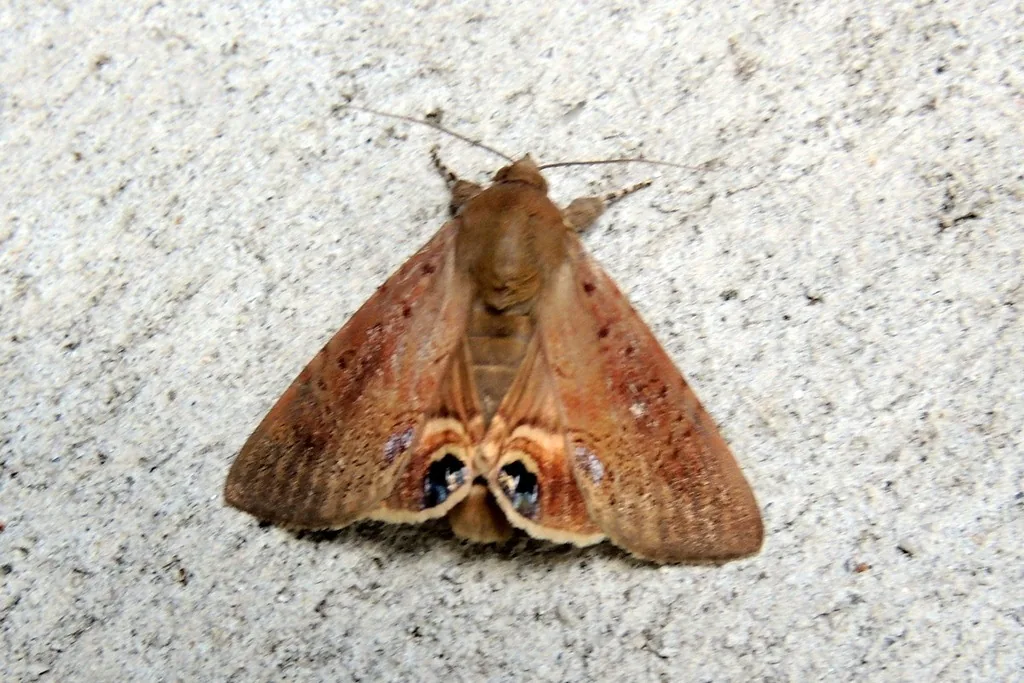
- Adult moths are tan with a wingspan of about 2 inches, some darker mottling on the forewings, and a dark eyespot about 3/16 inch across on each hind wing.[1]
Where it lives
GBIF's 1990-2026 U.S. records (413) come mostly from Texas (158) and Florida (141), then South Carolina, Georgia, Alabama, North Carolina, Louisiana and Mississippi. NC State notes it has turned up in North Carolina.[4][1]
Biology and life cycle
Females lay eggs on the fronds in masses of about 17, just as flower buds start to form, and cover them with scales. Newly hatched caterpillars eat their eggshells.[1]
Caterpillars go through about six stages, hide by day and feed at dusk, binding frass into a shelter. They also bore into stems and feed on fronds; cabbage palm and saw palmetto seem to be the only hosts.[1]
They eat each other when food runs short, a social habit NC State notes. In container experiments, larger caterpillars cannibalized smaller ones; only a physical size advantage gave them the chance.[1][3]
Grown caterpillars drop on a silk thread and crawl off to build a tough silk cocoon that works in fibers from whatever is nearby.[1]
They even chew on decaying palm fronds in the leaf litter.[1]
Damage and signs
- NC State calls it sometimes a serious pest in Florida, where cabbage palm flowers supply nectar for cabbage palm honey.[1]
- Wandering caterpillars may shred draperies, rugs, upholstered furniture, bedding and clothing for cocoon material, have been seen chewing drywall, and leave reddish-brown stains where they crawl.[1]
Health risk
NC State treats it as a pest of palms and a nuisance indoors and mentions no bite, sting or health risk.[1]
Control
Traps and physical control
Once caterpillars are inside a flower stalk, prune out the infested stalk and destroy the caterpillars. Indoors, pick up or vacuum wandering caterpillars before they settle into fabrics.[1]
Biological control
A tachinid fly parasite, red imported fire ants, lacewing larvae and spiders usually keep numbers acceptable.[1]
Pesticides
Don't spray palms in bloom, because pollinators can be killed. A systemic insecticide applied after damage shows would act too slowly and could move into the flower nectar. NC State suggests spraying the flower stalks the next spring, before the buds open, with a pyrethroid labeled for residential landscape use.[1]
Keep pyrethroids away from pools, ponds and streams. NC State notes they are hazardous to fish, NPIC calls bifenthrin highly toxic to fish and small aquatic organisms, and EPA has required drift and runoff measures for pyrethroids because of risks to aquatic invertebrates and fish.[1][5][6]
Common questions
- Why are caterpillars coming into my house from the palms?
- Grown cabbage palm caterpillars leave the palm to find a place to spin their cocoons and may gather fibers from fabrics indoors.[1]
- Should I spray my palms when the caterpillars show up?
- Not while they're blooming: pollinators can be killed. Prune out infested stalks now and, if needed, treat stalks before the buds open next spring.[1]
Sources
- NC State Extension, “Cabbage Palm Caterpillar or Palmetto Borer.” content.ces.ncsu.edu/cabbage-palm-caterpillar-or-palmetto-borer (accessed 2026-11-12)
- iNaturalist, “Litoprosopus futilis taxon page (order and family).” www.inaturalist.org/taxa/177311 (accessed 2026-11-12)
- Oecologia, via PubMed, “Semlitsch RD, West CA (1988), Size-dependent cannibalism in noctuid caterpillars, Oecologia 77(2):286-288.” pubmed.ncbi.nlm.nih.gov/28310386/ (accessed 2026-11-12). Cited from the PubMed abstract.
- Global Biodiversity Information Facility (GBIF), “Litoprosopus futilis (cabbage palm caterpillar): occurrence records in the U.S., 1990-2026 (GBIF occurrence search).” api.gbif.org/v1/occurrence/search?taxonKey=1766845&country=US&hasGeospatialIssue=false&occurrenceStatus=PRESENT&year=1990%2C2026&facet=stateProvince&facetLimit=400&limit=0 (accessed 2026-11-12). Few U.S. records; state counts are records reported (iNaturalist research-grade, museum specimens), not abundance; South Carolina appears twice with different capitalization and was combined.
- National Pesticide Information Center, “Bifenthrin General Fact Sheet.” npic.orst.edu/factsheets/bifgen.html (accessed 2026-11-12)
- U.S. Environmental Protection Agency, “Registration Review of Pyrethrins and Pyrethroids.” www.epa.gov/ingredients-used-pesticide-products/pyrethrins-and-pyrethroids (accessed 2026-11-12)