On this page
How to identify it
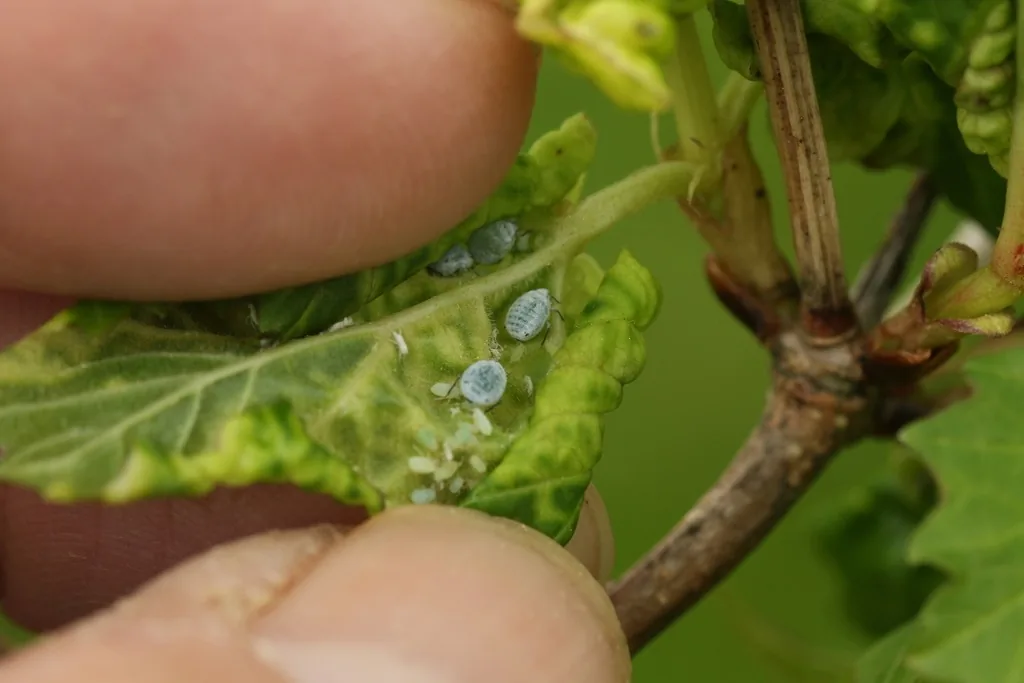
- Leaves and shoots are twisted, curled, distorted or cupped soon after budbreak, and on badly infested plants the leaf stems or branches can be bent like a corkscrew.[1][2][3]
- The mature aphids (stem mothers) are plump, ash gray to bluish white and look dusted with white powder; UMass gives their length as about 2.5 mm (roughly 1/10 inch).[1][2][3]
- Young aphids are whitish or very light green, and the overwintering eggs are dark and shiny.[1][2]
Look-alikes
| Look-alike | How to tell them apart |
|---|---|
| Viburnum aphid | A different aphid, Aphis viburniphila, lives on viburnum all year but doesn't distort the leaves.[1] |
| Black bean aphid | Can also distort the leaves of some viburnums; check the aphids' color and powdery coating.[1] |
| Viburnum downy mildew | A disease that also crinkles young leaves, but it starts as yellow, then brown, leaf spots with grayish fuzz on the underside.[3] |
Where it lives
UMass reports it from the northeastern United States into parts of Canada, and Washington State University's entomology department also covers it.[1][2]
Biology and life cycle
Eggs overwinter on the twigs and buds and hatch as the buds open in spring; the young aphids feed in the opening buds.[1][2]
The mature aphids are stem mothers that produce large numbers of young without mating, so many generations overlap in a short time, and leaf distortion shows within about three weeks of budbreak.[1][2]
Within about two months of egg hatch, all the aphids grow wings and leave viburnum for a secondary host that hasn't been identified; winged aphids return in September and produce the sexual forms that lay the overwintering eggs.[1][2]
Damage and signs
- The worst damage is on snowball and European cranberrybush viburnum (Viburnum opulus), blackhaw and mapleleaf viburnum; doublefile viburnum is not susceptible.[1][2]
- Heavy numbers can check the shrub's early growth completely, and once the leaves are fully expanded and curled, the damage for that year is done.[2][1]
Health risk
It feeds only on plants; neither source reports any harm to people or pets.[1][2]
Control
Prevention
Where the aphid damages viburnums every year, plant doublefile viburnum or other resistant types, and check susceptible shrubs for curling as soon as the leaves start to expand.[1]
Biological control
Little is known about the snowball aphid's natural enemies, possibly because they aren't active yet this early in spring.[1]
Pesticides
Treatment only works early, just as the buds open: wet all buds, leaves and stems thoroughly and repeat 7 to 10 days later; once the leaves have curled, the aphids are protected inside and sprays won't reach them.[2][1]
Common questions
- Why are my snowball viburnum's leaves curled and twisted?
- Early-spring curling of new leaves on snowball or cranberrybush viburnum is the classic sign of snowball aphid; uncurl a leaf and look for powdery, bluish-gray aphids underneath.[1][2][3]
- Is it too late to spray once the leaves have curled?
- Usually, yes: the aphids are protected inside the curled leaves, the damage is already done, and they leave the shrub within about two months of hatching anyway.[1][2]
Sources
- UMass Extension Landscape, Nursery and Urban Forestry Program (Landscape Insect & Mite Guide), “Ceruraphis viburnicola (Snowball Aphid).” www.umass.edu/agriculture-food-environment/landscape/publications-resources/insect-mite-guide/ceruraphis-viburnicola (accessed 2026-10-17)
- Washington State University Department of Entomology, “Snowball Aphid (Bug Info; adapted from G. R. Nielsen, University of Vermont, 1998).” entomology.wsu.edu/outreach/bug-info/snowball-aphid/ (accessed 2026-10-17)
- University of Minnesota Extension (What's wrong with my plant?), “Viburnum: twisted and curled leaves.” apps.extension.umn.edu/garden/diagnose/plant/deciduous/viburnum/twistedcurledleaves.html (accessed 2026-10-17)
- iNaturalist, “Neoceruraphis viburnicola taxon page (order and family).” www.inaturalist.org/taxa/1640946 (accessed 2026-10-06)