On this page
How to identify it
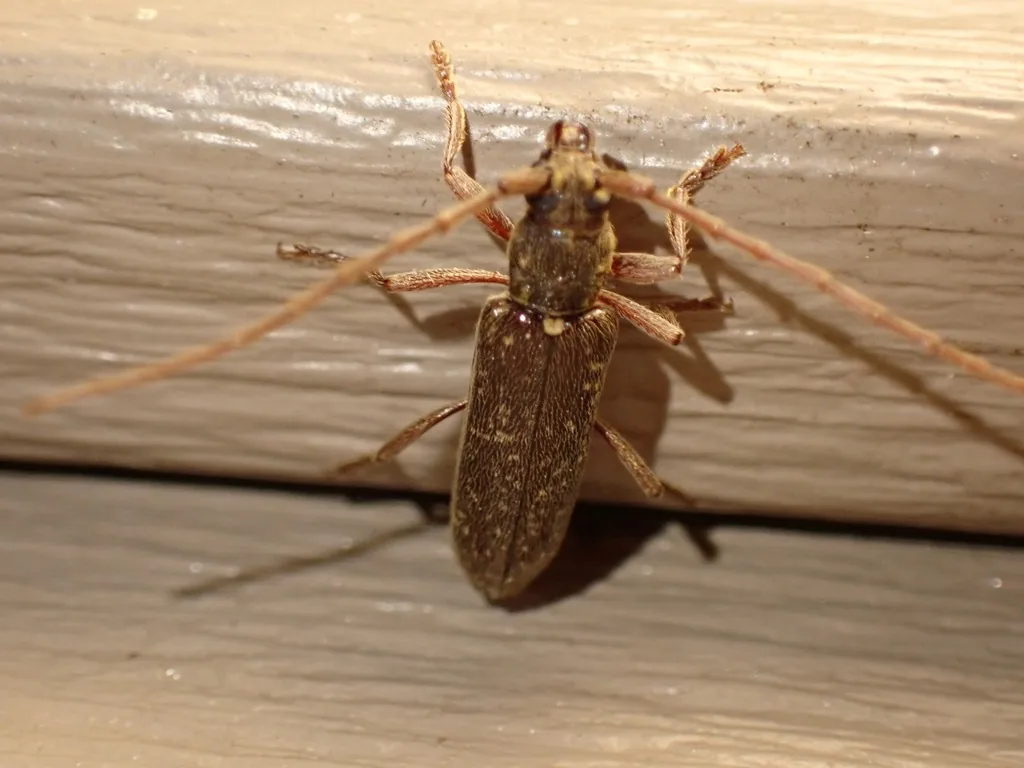
- Adults are slender, grayish to grayish-yellow longhorned beetles about 1/2 inch long, with long antennae.[1][2]
- Fallen twigs have a clean, smooth cut end with a small oval hole, usually packed with a plug of sawdust-like frass, where the grub sits.[1][2]
- Larvae are slender, legless, cream-white roundheaded borers; UMass notes long lemon-yellow hairs behind the head.[1][2]
- Sources give the size of the severed branches as 5/8 to 2 inches across (NC State), 1/2 inch to 2 inches (University of Missouri) or 0.24 to 1.97 inches (UMass).[1][3][2]
- University of Missouri Extension notes spines on the first few joints of the antennae and at the tips of the wing covers (elytra).[3]
Look-alikes
| Look-alike | How to tell them apart |
|---|---|
| Twig girdler | A twig pruner works from inside: its fallen twigs have a smooth cut end with a small oval hole plugged with frass and a grub inside. Compare the outside damage described on the twig girdler page.[1][2] |
Where it lives
NC State and UMass Extension report it on shade and ornamental trees in North Carolina and New England, and University of Missouri Extension covers it in Missouri. GBIF holds 1,483 U.S. records since 1990 from 37 state-level areas, the most from Texas (230), Alabama (110) and North Carolina (96).[1][2][3][4]
Biology and life cycle
In North Carolina, adults were caught at light traps from late April. In late spring the female slits the bark at a leaf axil and lays one egg in each slit.[2][1]
The grub bores into the center of the twig and tunnels toward its base. By fall it chews concentric cuts outward through the wood, leaving only the thin bark holding the twig, then retreats into the part that will fall and plugs the hole with frass. Eventually the branch breaks free and falls.[2][1]
The larva keeps feeding inside the fallen twig for a while, then pupates there and spends the winter; adults emerge the next spring. There is one generation a year in New England, though UMass notes the life cycle is not fully understood.[1][2]
A close relative, the oak twig pruner (Anelaphus parallelus), does the same thing to oak and hickory in New England and southern Ontario.[2]
University of Missouri Extension says adults start to emerge in spring, about the time of budding and new growth, and that during the fall small branches with smooth, concave cuts pile up under infested trees.[3]
Damage and signs
- Hosts include oak, hickory and pecan, maple, elm, hackberry, honeylocust, black locust, linden, redbud, sweetgum, walnut, chestnut, persimmon, quince, sassafras, wisteria and other ornamental and fruit trees.[1][2]
- The main sign is a scatter of leafy twigs with clean-cut ends under the tree late in the growing season. Pruning like this makes dormant buds grow and can thicken the canopy, but heavy pruning can change the tree's shape.[2]
- Twig pruners are considered secondary pests of stressed trees. Drought-stressed young trees seem more attractive, and both sources note that fast-growing, heavily fertilized trees may be too.[2][1]
Health risk
It is a twig-boring beetle. NC State, UMass and University of Missouri Extension don't mention any risk to people or pets.[1][2][3]
Control
Prevention
Keep trees healthy: water drought-stressed trees where watering is allowed, and avoid pushing fast growth with too much fertilizer.[2][1]
To confirm the cause, carefully split a fallen twig lengthwise and look for the creamy white grub inside.[2]
Sanitation
Rake up fallen twigs and branches and destroy them or send them to the landfill before spring. Do not leave them in a brush pile nearby, because the overwintering beetles emerge from them.[1][2]
University of Missouri Extension says to gather fallen branches during the fall or winter, prune suspected infested branches still in the tree, and burn them.[3]
Biological control
Braconid parasitic wasps are known to attack the related oak twig pruner, and UMass says natural enemies of this species presumably exist too.[2]
Pesticides
Where twig pruners have been active, NC State says spraying susceptible plants with a pyrethroid the following spring could be considered, and to keep pyrethroids away from pools, ponds and streams because they are toxic to fish. UMass says chemical management of this insect may be very difficult and is often unnecessary.[1][2]
Where the sources disagree
Branch size: NC State says 5/8 to 2 inches in diameter; University of Missouri says 1/2 inch to 2 inches; UMass says twigs and small branches 0.24 to 1.97 inches across are often preferred.[1][3][2]
Egg site: NC State says the female slits the bark at leaf axils; UMass says she chews a small niche in the bark at a leaf axil; University of Missouri says she chews a hole in the bark at a leaf axil near a twig tip.[1][2][3]
When the cut is made: University of Missouri says the full-grown larva starts its concentric cuts in late summer; UMass says by the fall.[3][2]
Disposing of fallen twigs: NC State says destroy them or send them to a landfill; University of Missouri says burn them; UMass says not to leave them in a nearby brush pile.[1][3][2]
Sprays: NC State says a pyrethroid the following spring could be considered; UMass says chemical management may be very difficult and is often unnecessary; University of Missouri's twig pruner advice is sanitation only.[1][2][3]
Common questions
- Why are small branches with clean cut ends falling from my oak?
- A twig pruner grub inside likely cut the branch from within. Look for a small oval hole plugged with frass at the cut end.[1][2]
- How do I control twig pruners?
- Rake up and destroy the fallen twigs before spring, since the beetles overwinter inside them.[1][2]
- Will twig pruners kill my tree?
- Usually not. UMass says twig pruners are not the primary cause of concern for tree health and favor stressed trees, but University of Missouri Extension says heavily damaged trees look ragged and young trees can become deformed by repeated attacks.[2][3]
Sources
- NC State Extension, “Twig Pruner (PDIC Factsheet).” content.ces.ncsu.edu/twig-pruner (accessed 2026-11-13)
- UMass Extension Landscape, Nursery and Urban Forestry Program, University of Massachusetts Amherst, “Anelaphus villosus (twig pruner): Insect & Mite Guide.” www.umass.edu/agriculture-food-environment/landscape/publications-resources/insect-mite-guide/anelaphus-villosus (accessed 2026-11-13)
- University of Missouri Extension, “Twig Girdler and Twig Pruner, G7276 (B. A. Barrett; reviewed April 2022).” extension.missouri.edu/publications/g7276 (accessed 2026-11-13)
- Global Biodiversity Information Facility (GBIF), “Anelaphus villosus: U.S. occurrence records since 1990 by state (GBIF occurrence API).” api.gbif.org/v1/occurrence/search?taxonKey=1099921&country=US&hasGeospatialIssue=false&occurrenceStatus=PRESENT&year=1990%2C2026&facet=stateProvince&facetLimit=400&limit=0 (accessed 2026-11-13). 1,483 records from 37 state-level areas; Texas 230, Alabama 110, North Carolina 96; fetched 2026-11-13.
- Global Biodiversity Information Facility (GBIF), “Anelaphus villosus (Fabricius, 1793) (GBIF Backbone Taxonomy).” api.gbif.org/v1/species/1099921 (accessed 2026-11-13). ACCEPTED; family Cerambycidae
- Global Biodiversity Information Facility (GBIF), “Elaphidionoides villosus Linsley, 1957 (GBIF Backbone Taxonomy).” api.gbif.org/v1/species/1099926 (accessed 2026-11-13). GBIF marks this name a SYNONYM of Anelaphus villosus (Fabricius, 1793)