On this page
How to identify it
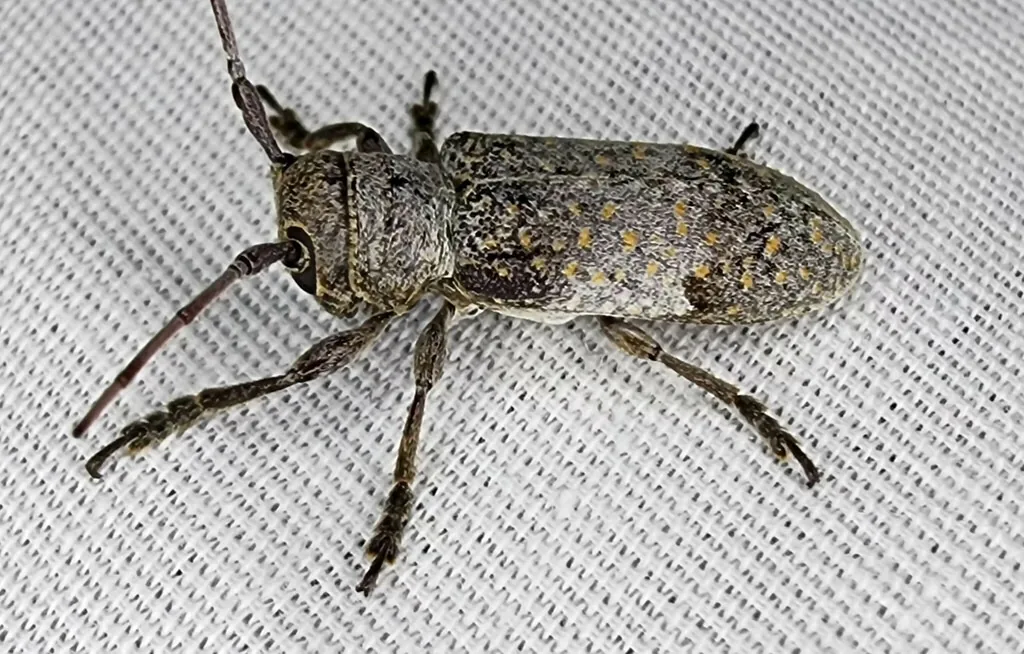
- The adult is a stout, grayish-brown longhorned beetle about three-quarters of an inch long, with a lighter band across the wing covers and antennae as long as its body. UF/IFAS describes Oncideres cingulata cingulata as gray to brown with small yellow spots across the wing covers, a grayer middle third from dense hairs, and a length of about 1 to 1.5 cm (0.4 to 0.6 inch); males' antennae can be much longer than the body.[2][4][6]
- The fallen twigs are about pencil-sized and often one to three feet long. The cut end looks sawed or pruned: smooth on the outside, with a small ragged core in the center where the twig finally snapped. UF/IFAS adds that the cut runs perpendicular to the branch and the bark of the fallen twig carries many small, scattered notches parallel to the cut, mostly in the middle of the twig. The holes that actually hold eggs are larger and lens-shaped.[3][2][4][6]
- Leaves on a girdled twig die and dry, usually staying attached, and turn brown before the twig drops.[3][4]
- The egg is white and elliptical, about 2.5 mm (0.1 inch) across. Larvae are mostly white with black jaws and very short dark hairs you can see with a hand lens; pupae look similar but carry spines along the sides.[6]
Look-alikes
| Look-alike | How to tell them apart |
|---|---|
| Twig pruner | Another longhorned beetle that drops twigs, but here the larva does the cutting from the inside out. Twig pruner cuts are smooth and concave inside with ragged edges near the bark, and the inside of the twig is chewed; twig girdler cuts are smooth on the outside with a ragged center.[2][3][4] |
| Squirrel damage | Squirrels also gnaw twigs off trees, but their cut is diagonal and ragged and the leaves are usually still green when the twig drops.[4] |
Where it lives
Arkansas Extension calls it native to Arkansas and much of the surrounding region. Missouri and Mississippi State extension cover it, and Iowa State says dropped twigs show up especially in southern Iowa. UF/IFAS says its range runs from Missouri to Texas through the eastern U.S., with records as far north as Iowa and New England, and that it is common in Florida. Only three genera and eight species of twig girdlers are native to the United States.[1][2][3][4][6]
Biology and life cycle
Adults emerge from mid-August into early October. The female chews a V-shaped groove around a small twig, then lays an egg under the bark beyond the cut, because the larva can't develop in healthy sapwood. The girdled tip dies and falls in wind or under its own weight. UF/IFAS says females find host trees by smell and pick twigs about 7 to 11 mm (0.3 to 0.4 inch) thick at the girdle, leaving part of the underside attached; the male stays close but doesn't help.[2][4][3][6]
The larva hatches, overwinters in the fallen twig, resumes feeding the next spring and eats out most of the wood, packing its tunnel with shavings and waste. It pupates inside the twig, and new adults emerge in late summer and early fall: one generation a year.[2][4][3][1]
Hosts include persimmon, pecan, hickory, elm, oak, honeylocust, hackberry, poplar, linden, redbud, basswood, dogwood and various fruit trees. Mississippi State names hickory, pecan and elm as the favorites. UF/IFAS adds birch and Nuttall oak, and says Texas populations also use mesquite, where less than 1% of beetles reach adulthood.[2][3][6]
UF/IFAS says the newly hatched larva stays put and mostly doesn't feed until late autumn. Only after its first molt does it tunnel into the wood; it overwinters at that stage and molts twice more in spring. Before pupating it chews a small opening and plugs the tunnel behind it with shavings.[6]
Twigs that get too wet or too dry, or too hot or too cold, kill the developing larvae.[6]
UF/IFAS suggests girdling may trap nitrogen that the tree would otherwise pull back out of the twig in autumn, and larval survival seems to rise with twig nitrogen. Other beetles move into girdled twigs, some competing with the girdler's own larva, and flickers, woodpeckers, checkered beetles, clown beetles and parasitoid wasps all attack it.[6]
Damage and signs
- Large numbers of girdled twigs can pile up under a tree each day during egg-laying. Heavily attacked trees look ragged, and repeated attacks can deform young trees.[2][4]
- On healthy, established trees the damage is not severe; the main nuisance is cleaning up the twigs. A small, newly planted tree is the exception: losing its leader can set it back badly. UF/IFAS says girdled twigs are common in Florida pecan groves, where the injury may reduce growth, but no robust data on its impact have been published and the damage is small compared with other common pecan pests.[4][3][1][6]
Health risk
It feeds only inside tree twigs; none of the sources describes any harm to people or pets.[2][3][1]
Control
Prevention
Raking helps less where woods are close by, because girdlers from the woodland can keep coming; it still clears the twigs off the lawn.[3][4]
Sanitation
Gather and destroy fallen twigs, which hold the eggs and larvae. Missouri suggests beginning in September, and no later than May, and pruning out infested twigs still in the tree where practical. UF/IFAS lists burning, burying, chipping or dry heat as ways to destroy them.[2][4][3][1][6]
Pesticides
Spraying isn't effective or justified in home landscapes. Insecticide use is for commercial pecan orchards with severe damage, where Missouri describes two or three applications at two-week intervals starting in August, only after damage or beetles are seen. Follow the label. UF/IFAS says insecticide against twig girdlers isn't very cost-effective even in pecan orchards, and treatment is unnecessary in backyards and forests where tree growth rate isn't a concern.[4][3][2][6]
Do I need to do anything?
Usually not. Arkansas Extension says the girdler does no real damage to an established tree even though it loses twigs and small branches; collecting and destroying the fallen twigs is the one useful step, and it's optional.[1][3]
Where the sources disagree
Adult size: Missouri and Iowa State describe the adult as about three-quarters of an inch long; UF/IFAS gives 1 to 1.5 cm (0.4 to 0.6 inch), less than half an inch.[2][4][6]
Generations: this page's other sources describe one generation a year; UF/IFAS says most beetles pupate for two weeks in late summer, but some spend a second winter as larvae and emerge as adults the following spring.[2][3][6]
Common questions
- Why are twigs with clean cut ends falling from my pecan?
- Most likely a female twig girdler chewed a groove around them so her egg could develop in a dead twig. Look for a smooth outer cut with a small broken core in the middle.[2][3][4]
- How do I control twig girdlers?
- Pick up and destroy the fallen twigs, which hold the next generation. Spraying shade trees isn't effective.[2][4]
- Is it twig girdlers or squirrels?
- Squirrel-cut twigs have a diagonal, ragged end and usually still-green leaves; girdled twigs have a neat cut end and leaves that turned brown before they fell.[4][3]
- How can I find the beetle itself?
- UF/IFAS says some, especially males, come to lights at night. When disturbed they drop off the tree and play dead, and when handled they make a chirping sound by rubbing the back edge of the plate behind the head against a ridged patch at the base of the wing covers.[6]
Sources
- University of Arkansas Division of Agriculture Cooperative Extension Service, “No one’s been pruning your trees, Arkansas: It’s just the twig girdler.” www.uaex.uada.edu/media-resources/news/2018/october2018/10-12-2018-Ark-twig-girdler.aspx (accessed 2026-11-11)
- University of Missouri Extension, “Twig Girdler and Twig Pruner (G7276, reviewed April 2022).” extension.missouri.edu/publications/g7276 (accessed 2026-11-11)
- Mississippi State University Extension Service, “Twig Girdler, Bug's Eye View Vol. 7, No. 24 (Blake Layton, 2021).” extension.msstate.edu/newsletters/bugs-eye-view/2021/twig-girdler-vol-7-no-24 (accessed 2026-11-11)
- Iowa State University Extension and Outreach, Yard and Garden, “Twig Girdlers and Dropped Twigs (Donald Lewis, 2007; adapted from Missouri G7276).” yardandgarden.extension.iastate.edu/article/2007/10-8/TwigGirdler.html (accessed 2026-11-11)
- iNaturalist, “Oncideres cingulata taxon page (order and family).” www.inaturalist.org/taxa/179369 (accessed 2026-11-11)
- University of Florida IFAS Extension, EDIS (Featured Creatures), “Twig Girdler: Oncideres spp. (Insecta: Coleoptera: Cerambycidae: Onciderini), EENY-817/IN1446 (Featured Creatures).” ask.ifas.ufl.edu/publication/IN1446 (accessed 2026-11-14)