On this page
How to identify it
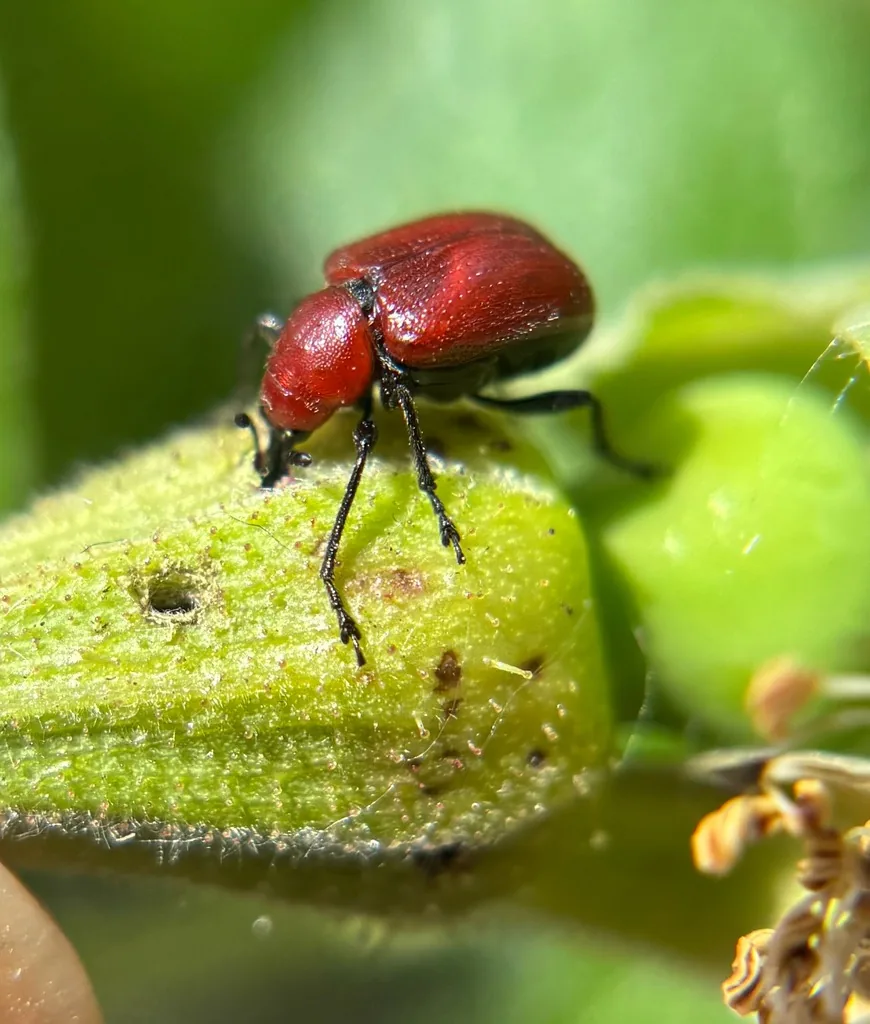
- Adults are red and black, hard-bodied snout weevils about 1/4 inch long, with a long snout, distinct antennae and long black legs; the PNW handbook adds that one form is entirely black.[2][3]
- Washington State says the name bicolor comes from the bright red wing covers and thorax set against a black head and snout.[4]
- Eggs are oval, about 1/25 inch long, hidden in the bracts and buds of flowers. Larvae are legless, plump, pale orange to whitish with a brown head and grow to about 1/4 inch; rose midge larvae look similar but reach only 1/16 inch.[2]
- Which roses they prefer: UC IPM says yellow and white ones, Washington State says pink and yellow roses with hips; wild roses are the main host, and caneberries such as blackberries and raspberries are attacked too.[1][2][4]
Look-alikes
| Look-alike | How to tell them apart |
|---|---|
| Fuller rose beetle | Pale brown, flightless weevils about 3/8 inch that chew notched edges on leaves and flowers at night.[1] |
Where it lives
A native North American weevil: UC IPM covers it in California gardens, Washington State in the Northwest, and Montana State records it in the Greater Yellowstone region; wild roses are its main host.[2][4][5]
Biology and life cycle
Adults emerge from the soil in spring and seek young flower buds; they can be present from about April through July. Females chew small holes in buds or hips to feed and lay eggs there, and the eggs hatch within a few days.[2]
Larvae feed hidden inside buds, both on the plant and in buds that have fallen, and later in the season in rose hips. Montana State notes that both adults and larvae feed on rose flowers.[2][5]
Where they spend the winter: UC IPM and the PNW handbook say mature larvae drop to the ground and overwinter in the soil, pupating as it warms in spring, while Washington State says the larvae overwinter in the rose hips. All agree there is one generation a year.[1][2][3][4]
Damage and signs
- Adults chew and puncture buds, calyxes and flower stems; injured buds may drop or stay on the plant, and buds that open show round holes and ragged areas in the petals. Larva-infested buds commonly drop instead of flowering.[2][1]
- When buds are scarce, adults feed on and kill the tips of new shoots; the damage is often missed until the buds open.[2][3]
Health risk
It feeds only on roses and caneberries; none of these sources mentions any bite, sting or risk to people or pets.[1][2][4]
Control
Keep them out
Step 3, protect prized buds or whole bushes with netting that lets in light and water but keeps insects out, and replace the cultivars that are hit hardest.[2]
Sanitation
Step 2, clip and toss damaged buds, rose hips and spent blossoms to remove the larvae inside, and check nearby blackberries and raspberries too.[2][1]
Traps and physical control
Step 1, hand-pick: once buds appear, check them regularly and pick off the weevils. They drop when disturbed, so hold a wide-mouth container half full of soapy water under the bud and tap the plant.[2][1]
Biological control
Insect-parasitic nematodes (Heterorhabditis or Steinernema) drenched onto well-drained soil under the bushes can reduce the larvae; the soil must be at least 60°F and moist.[2]
Pesticides
Step 4, only if needed: UC IPM says a systemic insecticide such as imidacloprid applied to the soil may control both adults and larvae, and foliar sprays are generally not recommended; for very susceptible plants a persistent broad-spectrum insecticide such as carbaryl mixed with horticultural oil can be used (carbaryl is a restricted-use material in California since August 1, 2020). Washington State says registered home-garden rose insecticides control it easily. Carbaryl products such as Sevin are toxic to bees, so keep them off blooming plants.[2][4][6]
Common questions
- What's drilling holes in my rose buds?
- Most likely the rose curculio, a red-and-black snout weevil about 1/4 inch long; when the damaged buds open, the petals have round holes where the weevil chewed in.[1][2][3]
- How many generations of rose curculio are there?
- Only one a year; adults emerge in spring.[1]
- Do I need to spray for rose curculios?
- Usually not. Hand-picking adults and clipping off damaged buds and hips works well; save insecticides for bushes that are badly hit every year.[2][3][4]
Sources
- University of California Statewide IPM Program, “Roses: Insects and Mites (Pest Notes).” ipm.ucanr.edu/home-and-landscape/roses-insects-and-mites/ (accessed 2026-11-12)
- University of California Statewide IPM Program, “Rose Curculios: Merhynchites species.” ipm.ucanr.edu/home-and-landscape/rose-curculiosmerhynchites-species/ (accessed 2026-11-12)
- Pacific Northwest Pest Management Handbooks (OSU, WSU, University of Idaho), “Rose (Rosa)-Rose curculio.” pnwhandbooks.org/insect/hort/landscape/hosts-pests-landscape-plants/rose-rosa-rose-curculio (accessed 2026-11-12)
- Washington State University Department of Entomology, “Rose Curculio (Bug Info).” entomology.wsu.edu/outreach/bug-info/rose-curculio/ (accessed 2026-11-12)
- Montana State University, “Merhynchites bicolor (Insects of the Greater Yellowstone Ecosystem).” montana.edu/yellowstoneinsects/coleoptera/curculionidae/merhynchites_bicolor.html (accessed 2026-11-12)
- Washington State University Extension, “Arborvitae: Cypress tip moth (Hortsense).” hortsense.cahnrs.wsu.edu/fact-sheet/arborvitae-cypress-tip-moth/ (accessed 2026-11-12)
- iNaturalist, “Merhynchites bicolor taxon page (order and family).” www.inaturalist.org/taxa/70051 (accessed 2026-10-06)