On this page
How to identify it
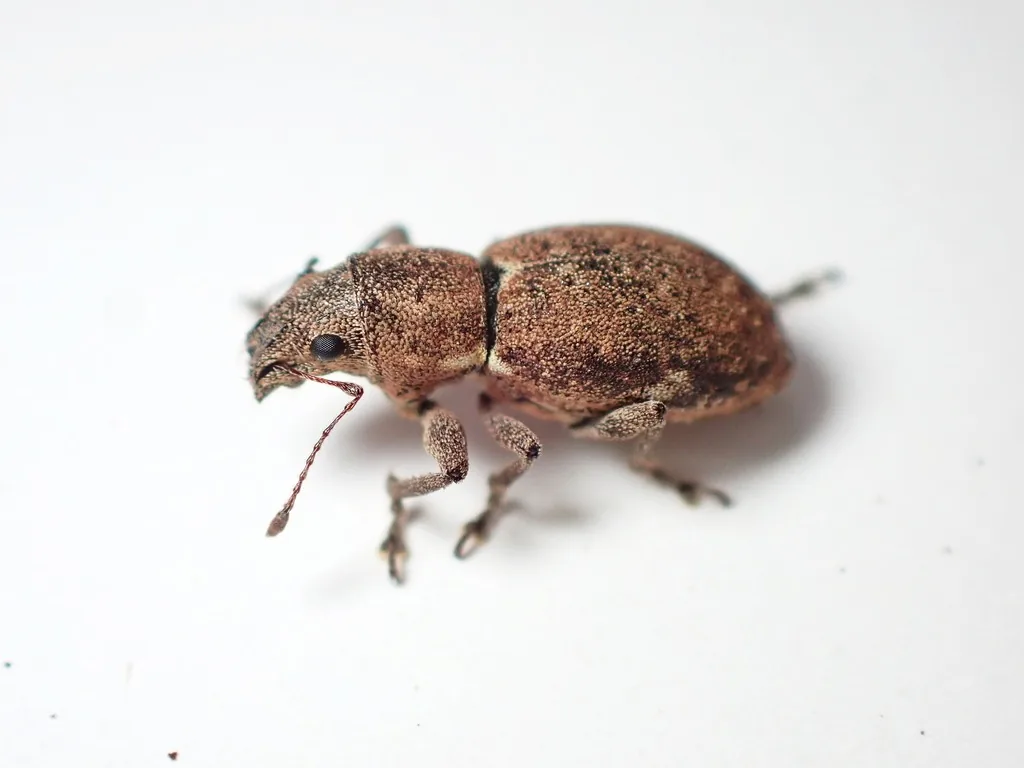
- Adults are brown to gray, hard-bodied weevils about 3/8 inch long with bulging eyes. UF/IFAS gives adults as 6 to 8.5 mm long, brownish gray with white scales mixed in, with a slightly down-curved snout. Its wing covers are fused, so it can't fly.[1][2][9]
- Eggs are yellowish, about 1/25 inch long, and laid in masses of several dozen in bark cracks or, on citrus, under the button (sepals) of the fruit. UF/IFAS adds that each mass is covered with a white sticky material and may also be tucked between leaves, under stones or in curled dead leaves.[1][2][9]
- Larvae are plump, legless, whitish to yellow grubs with a brown head, up to 1/2 inch long. UF/IFAS describes the legless white larva with a yellowish head and contrasting black jaws, 10 to 12 mm long when full grown.[1][9]
Look-alikes
| Look-alike | How to tell them apart |
|---|---|
| Cribrate weevil and vegetable weevil | Both are brown to grayish snout beetles common in California. Seen from above, the cribrate weevil has a teardrop-shaped head with its eyes set close together; seen from the side, the vegetable weevil's snout points down more sharply than the Fuller rose beetle's. Neither damages citrus.[1][2] |
Where it lives
Hosts include acacia, avocado, box elder, citrus, oak, photinia, Prunus and Pyrus species, Rhaphiolepis and rose. UF/IFAS calls it a cosmopolitan species, found in North and South America, Europe, Mediterranean countries, southern Africa, Australia and many Pacific islands, and present in at least 30 U.S. states. It was first recorded in California in 1879 and in Florida in 1916.[1][9]
Biology and life cycle
Every Fuller rose beetle is a female, and they lay fertile eggs without mating. In a genetic study of beetles from the southern U.S., 97 percent of the samples carried the same widespread 'invader' genotype.[1][2][3]
Larvae drop to the soil after hatching and feed on roots for about 6 to 10 months or longer, then pupate in the soil for 1 1/2 to 2 months.[1][2]
Adults emerge mostly in summer and fall, feed at night, hide in litter by day and can't fly. In California's San Joaquin Valley about 53 percent of them come out in August; in Southern California emergence runs about a month later and is more spread out.[1][2]
There is one generation a year.[1][2]
The larvae eat the roots of many plants. In New Zealand kiwifruit orchards, few larvae survived to adulthood on groundcover plants, and white clover was a better host for them than ryegrass.[4]
A female lays more than 200 eggs over an egg-laying period of three to five months, and up to 1000 eggs in her lifetime have been reported. Eggs take two to six weeks to hatch, depending on temperature, and adults live three to eight months.[9]
In citrus, one study found 83% of egg masses on fruit, 16% on leaves and 1% on branches. Larvae can be active down to 61 cm (2 feet) in the soil and move up near the surface to build a smooth-walled cell before pupating.[9]
In Florida, UF/IFAS says adults have been collected almost year round and two generations a year have been reported, with emergence peaks from late May to early June and from late August to early September.[9]
Primary hosts listed by UF/IFAS include citrus, squash and pumpkins (Cucurbita), strawberry, beans, peach, rhubarb, rose and potato; adults also feed on azalea, begonia, gardenia, hibiscus, hydrangea, lily, oak and caneberries.[9]
Damage and signs
- Adults chew notches and ragged edges along leaf margins and sometimes blossoms. Under heavy infestations they can eat the whole leaf down to the midrib. Underground, young larvae chew off root hairs and older ones girdle side roots, which stunts growth; plants with badly damaged roots may die in drought or be more open to fungal root infection.[1][2][9]
- Neither adult nor root feeding usually threatens healthy plants. The exceptions are heavy feeding on young plants, heavily pruned plants pushing new growth, topworked citrus, or a young tree planted into a mature grove.[1][2]
Health risk
It feeds only on plants; UC IPM mentions no effect on people.[1]
Control
Prevention
Feeding on healthy woody plants can generally be ignored; UC IPM recommends no insecticides for this weevil in gardens and landscapes.[1]
Keep them out
Trim branches that touch the ground or other plants, and put a 6-inch sticky band over a trunk wrap so the flightless adults can't climb up. The wrap protects the bark; UC IPM notes that sticky material can last 2 to 10 months, depending on sprinklers, dirt and leaf debris. UF/IFAS calls keeping the flightless weevils out of the canopy the best management strategy and suggests putting the sticky material on a non-absorbent wrap to avoid burning the trunk.[1][2][9]
Traps and physical control
If adults are numerous, trapping may give some control.[1]
Because the adults feed at night, UF/IFAS suggests watching for fresh ragged damage on low-hanging foliage, checking low fruit near the trunk for egg masses under the calyx, using ground traps, and beating ornamental shrubs to knock adults down.[9]
Biological control
A tiny wasp, Fidiobia citri, often parasitizes up to half the eggs in each egg mass. Parasitized eggs turn dark gold, then black shortly before the wasp emerges, and can stay on the plant long after healthy eggs have hatched. UF/IFAS lists other natural enemies too: an assassin bug, praying mantises, parasitic nematodes (Heterorhabditis and Steinernema carpocapsae), and the fungi Beauveria bassiana, which attacks larvae, and Metarhizium anisopliae, which attacks larvae and adults.[1][2][9]
Where it came from
Genetic and niche-modeling studies point to southeastern Brazil as the beetle's original home. It was first reported in the continental United States in 1879 and has since spread to most of the world.[5][3]
Researchers suggest that reproducing without males helps it settle new places, because a successful set of genes is never broken up and a single female can, in principle, found a population.[5][3]
GBIF records since 1990 come mostly from California, followed by North Carolina, Georgia, Virginia, Alabama, South Carolina, Hawaii and Tennessee. Worldwide, after the U.S., the most records come from Australia, Portugal, Mexico and New Zealand.[6][7]
Why citrus exporters watch for it
The beetle rarely harms citrus trees, but its eggs under the fruit button are a quarantine concern. As of October 2025, UC IPM lists Korea as the only country that treats it as a quarantine pest; Japan formerly did. Growers shipping to Korea combine skirt pruning, sticky trunk barriers and timed insecticide sprays.[2]
New Zealand faces the same problem with kiwifruit, where the beetle is an important quarantine pest for exports to Asian markets.[4]
History: UF/IFAS says the beetle became a U.S. issue in 1985, when Japanese inspectors found its eggs on California citrus; any viable eggs led to fumigation of the whole shipment, which raised costs and damaged fruit, especially lemons, and spurred research on irradiation as an alternative.[9]
Where the sources disagree
Name: UC IPM uses Pantomorus cervinus and others use Naupactus cervinus; UF/IFAS's profile uses Naupactus godmanni and notes several older names were folded into Asynonychus cervinus in 1947 and 1955.[1][9]
Generations: UC IPM gives one a year in California; UF/IFAS says two a year have been reported in Florida, where adults turn up almost year round.[1][9]
Larval feeding time: UC IPM gives about 6 to 10 months on roots; UF/IFAS gives eight to ten months where there is a single generation.[1][9]
Adult size: UC IPM says about 3/8 inch; UF/IFAS gives 6 to 8.5 mm (about 1/3 inch).[1][9]
Peak emergence: UF/IFAS gives Florida peaks of late May to early June and late August to early September, but also cites April and May as the peak emergence period in a later study.[9]
Common questions
- What is eating notches in my rose leaves at night?
- The Fuller rose beetle is a common culprit; it feeds at night and hides in litter during the day.[1]
- Can Fuller rose beetles fly?
- No. Adults are flightless and reach foliage by climbing trunks or branches that touch the ground or other plants.[1][2]
- Why can't I find any male Fuller rose beetles?
- There aren't any. The species is all female and reproduces without mating.[1][3]
- Where do Fuller rose beetles lay eggs on citrus?
- Mostly on the fruit. UF/IFAS says eggs go beneath the calyx (button) and rarely on the navel; in one study 83% of egg masses were on fruit.[9]
Sources
- University of California Statewide IPM Program, “Fuller Rose Beetle (Pests in Gardens and Landscapes).” ipm.ucanr.edu/PMG/GARDEN/PLANTS/INVERT/fullerrosebeetle.html (accessed 2026-11-11)
- University of California Statewide IPM Program, “Fuller Rose Beetle, Citrus: Agriculture Pest Management Guidelines.” ipm.ucanr.edu/agriculture/citrus/fuller-rose-beetle/ (accessed 2026-11-11)
- Insects, via PubMed, “Genetically depauperate and still successful: few multilocus genotypes of the introduced parthenogenetic weevil Naupactus cervinus (Rodriguero et al. 2023).” pubmed.ncbi.nlm.nih.gov/36835682/ (accessed 2026-11-11)
- Journal of Insect Science, via PubMed, “Larval survival of Fuller's rose weevil, Naupactus cervinus, on common groundcover species in orchards of New Zealand kiwifruit (2008).” pubmed.ncbi.nlm.nih.gov/20298112/ (accessed 2026-11-11)
- Ecology and Evolution, via PubMed, “Out of the forest: past and present range expansion of a parthenogenetic weevil pest, or how to colonize the world successfully (Rodriguero et al. 2016).” pubmed.ncbi.nlm.nih.gov/27551394/ (accessed 2026-11-11)
- Global Biodiversity Information Facility (GBIF), “Naupactus cervinus: U.S. occurrence records since 1990 by state (GBIF occurrence search).” api.gbif.org/v1/occurrence/search?taxonKey=1210685&country=US&hasGeospatialIssue=false&occurrenceStatus=PRESENT&year=1990%2C2026&facet=stateProvince&facetLimit=400&limit=0 (accessed 2026-11-11)
- Global Biodiversity Information Facility (GBIF), “Naupactus cervinus: occurrence records since 1990 by country (GBIF occurrence search).” api.gbif.org/v1/occurrence/search?taxonKey=1210685&hasGeospatialIssue=false&occurrenceStatus=PRESENT&year=1990%2C2026&facet=country&limit=0 (accessed 2026-11-11)
- iNaturalist, “Pantomorus cervinus taxon page (order and family).” www.inaturalist.org/taxa/318474 (accessed 2026-10-06)
- University of Florida IFAS Extension, EDIS (Featured Creatures), “Fuller Rose Beetle, Naupactus godmanni (Crotch), EENY-375/IN678 (Featured Creatures).” ask.ifas.ufl.edu/publication/IN678 (accessed 2026-11-14)