On this page
How to identify it
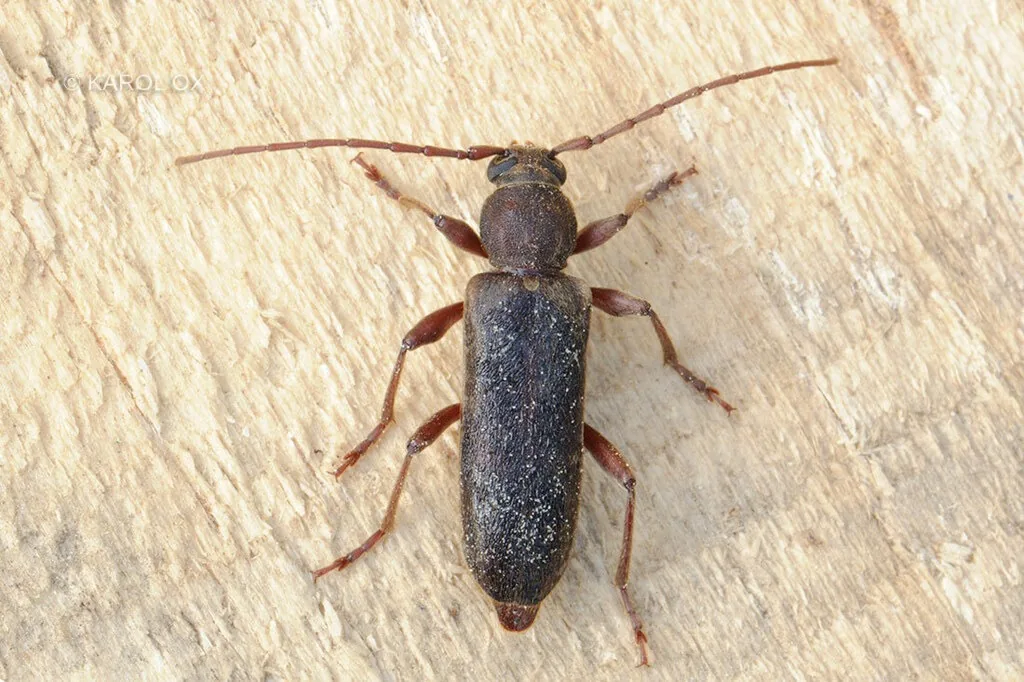
- Adults are 1/2 to 3/4 inch long and dark brown to brownish orange, with legs and antennae lighter than the body.[2][1]
- Fine hairs scattered over the body and wing covers form light patches, the source of the name velvet.[2][1]
- Adults leave round exit holes about 3/8 inch across in trunks and branches.[1]
Look-alikes
Where it lives
Utah State Extension says it was first found in North America in Quebec in 2002 and in the U.S. in Rhode Island in 2006; a 2022 Minnesota study says it has been in the U.S. since the 1990s. The Minnesota Department of Agriculture considers it established in Utah, Illinois and Minnesota, with trap finds in other states and Canadian provinces.[1][4][3]
Biology and life cycle
Adults emerge from June to August (May to August in Utah) and fly at night. In traps around Minneapolis and St. Paul, catches had a single peak in early July.[2][1][4]
Females lay eggs on trunks and branches of healthy, stressed or dying trees and on cut timber; larvae tunnel under the bark and into the wood.[1]
Larvae can take two or more years to develop and pupate in late winter to spring.[2][1]
It copes well with dry wood. The Minnesota Department of Agriculture says some infested furniture showed no beetle activity until 18 months after it was bought.[3]
Damage and signs
- Utah State lists round exit holes, frass at the tree base, peeling bark, sprouts from dormant buds and a thinning canopy. Minnesota Extension adds larval tunnels and a yellowing canopy.[1][2]
- Larval feeding can weaken branches so they break in wind, and can reduce fruit yield and tree life.[1]
- How serious it will be is still unclear. The Minnesota Department of Agriculture says its pest potential is undetermined and that tree damage has been documented only in Utah, where it attacks living cherry and peach.[3]
Health risk
Minnesota Extension, Utah State and the Minnesota Department of Agriculture treat it only as a pest of trees and wood. None of them mentions any risk to people or pets.[2][1][3]
Control
Prevention
Don't move firewood. Utah State suggests collecting or buying it within 25 to 50 miles of where you'll burn it.[1]
Pesticides
Utah State says it is hard to control because it spends most of its life inside wood, and no insecticide is labeled specifically for it.[1]
When to call a professional
Report suspects to your state department of agriculture or extension diagnostic lab. Minnesota and Utah both ask for reports, and Minnesota's Department of Agriculture runs a Report a Pest line.[2][1][3]
Quarantines and how it spreads
There is no quarantine to follow in Minnesota. Its Department of Agriculture says no regulations apply to the velvet longhorned beetle.[3]
Immature beetles travel inside wood moved in trade. In 2016, rustic log furniture made in China and sold in Minnesota turned out to be infested, and it was tracked down and destroyed.[5][3]
Since 2010 it has been found in twelve Minnesota counties, Hennepin and Ramsey among them. In Utah it occurs in parts of Utah, Salt Lake, Davis and Tooele counties.[3][1]
Survey traps are getting better. Researchers identified a male-made pheromone, trichoferone, that drew more beetles than ethanol lures, mostly females, and a Minnesota study caught more beetles in traps hung in basswood (Tilia) than in oak.[5][4]
Common questions
- How do I identify a velvet longhorned beetle?
- Look for a 1/2- to 3/4-inch brownish beetle with lighter legs and antennae and patches of fine hair; many look-alikes exist, so have it confirmed.[2][1]
- What trees does it attack?
- Apple, cherry, mulberry, peach, maple and many other hardwoods and conifers, plus cut and dried wood.[2][1]
- What should I do if I find one?
- Report it to your state department of agriculture or extension diagnostic lab.[2][1]
- Is there a quarantine for velvet longhorned beetle?
- Not in Minnesota, where the Department of Agriculture says no regulations apply to it. It still spreads in firewood and wood products, so don't move them.[3][1]
Sources
- Utah State University Extension, “Velvet Longhorned Beetle, Trichoferus campestris (Rodman et al., July 2020).” extension.usu.edu/planthealth/research/velvet-longhorned-beetle.php (accessed 2026-11-13)
- University of Minnesota Extension, “Velvet longhorned beetle.” extension.umn.edu/natural-resources/forestry-and-wildlife/invasive-species/velvet-longhorned-beetle (accessed 2026-11-13)
- Minnesota Department of Agriculture, “Velvet Longhorned Beetle.” www.mda.state.mn.us/plants-insects/vlb (accessed 2026-11-13)
- Environ Entomol 2022;51(3):531-536, via PubMed, “Seasonal phenology of velvet longhorned beetle, Trichoferus campestris, in Minnesota (Haynes et al., 2022).” pubmed.ncbi.nlm.nih.gov/35569029/ (accessed 2026-11-13)
- Sci Rep 2019;9:4459, via PubMed, “Isolation and identification of a male-produced aggregation-sex pheromone for the velvet longhorned beetle, Trichoferus campestris (Ray et al., 2019).” pubmed.ncbi.nlm.nih.gov/30872772/ (accessed 2026-11-13)
- Global Biodiversity Information Facility (GBIF), “Trichoferus campestris (Faldermann, 1835) (GBIF Backbone Taxonomy).” api.gbif.org/v1/species/1151427 (accessed 2026-11-13)
- iNaturalist, “Trichoferus campestris taxon page (order and family).” www.inaturalist.org/taxa/447062 (accessed 2026-10-06)