On this page
How to identify it
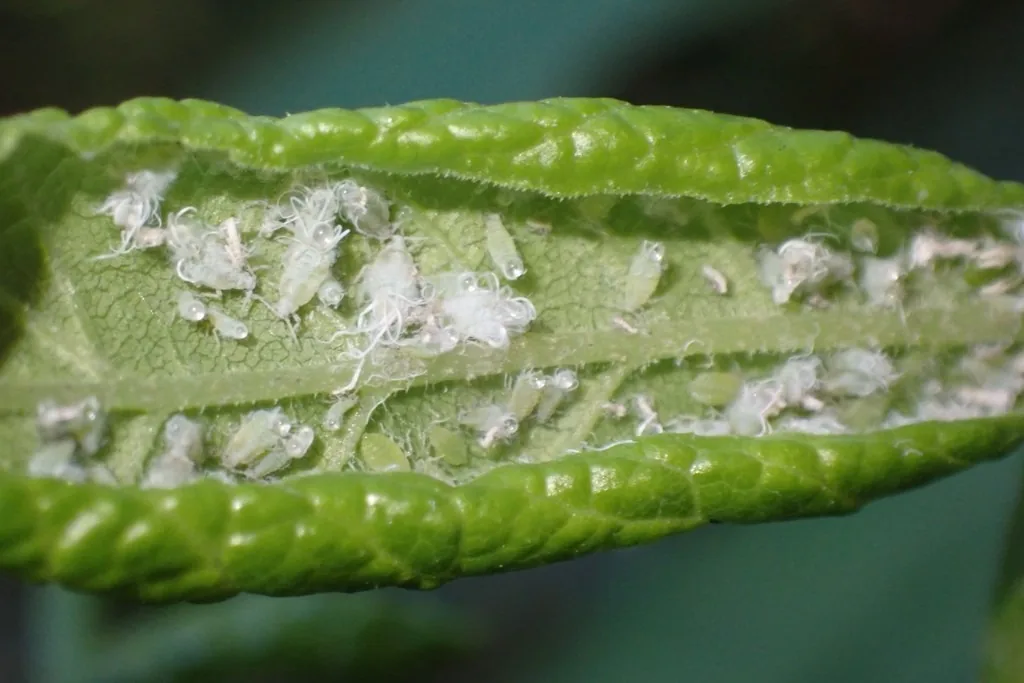
- The aphids are small (Utah State gives about 1/8 inch for this group), light green and covered with off-white waxy threads. They stay on the undersides of the leaves, hidden inside the curls.[1][2][3]
- Clusters of tightly coiled leaflets at twig tips are noticeable through the second half of summer.[1]
Where it lives
Iowa State calls it a consistent pest of green ash, and Colorado State lists green ash as its host. Utah State covers it among the woolly aphids of Utah landscapes.[1][3][2]
Biology and life cycle
Aphids arrive on new growth in mid to late May; only leaves that emerge after they arrive curl, so expanded leaves are not affected.[1]
It doesn't spend the winter as eggs on the branches, Colorado State says. Utah State describes the aphids moving back down to ash roots from midsummer through fall to overwinter, and winged adults that may come up from the roots in fall to mate.[3][2]
When colonies get crowded, winged aphids fly off to nearby hosts.[2][3]
Damage and signs
Health risk
It feeds on ash sap. None of the cited extension sources describes any risk to people or pets.[1][2][3]
Control
Traps and physical control
Prune off and discard the deformed tips if they bother you.[1]
Biological control
Syrphid fly larvae and lady beetle larvae are often abundant in the colonies and usually bring them under control. Green lacewing larvae and tiny parasitic wasps also attack aphids.[1][3]
Pesticides
Iowa State says spraying generally isn't warranted: by the time curling shows it is too late, curled leaves won't flatten even if the aphids die, and sprays harm natural enemies. Utah State also advises tolerating it but lists a spring systemic insecticide as an option, since the wax and curled leaves make cover sprays less effective.[1][2]
Dormant oil won't help, because this aphid doesn't overwinter as eggs on the tree. Short-lived contact sprays such as insecticidal soap or pyrethrins can't reach aphids inside curled leaves.[3]
Common questions
- Why are the leaves at my ash branch tips curled into knots?
- Leafcurl ash aphids feeding on new leaves cause tight coils at the twig tips in early summer.[1][2]
- Will the curled leaves recover?
- No, but the damage is cosmetic and limited to a small part of the tree.[1]
- Should I spray?
- Usually not. Iowa State says it's too late once leaves curl and sprays kill the predators that control the aphids; Utah State also advises tolerating it.[1][2]
- Will a dormant oil spray prevent leafcurl ash aphid?
- No. Colorado State notes that the leafcurling aphids on ash don't overwinter as eggs on the tree, so there's nothing for the oil to smother.[3]
Sources
- Iowa State University Extension and Outreach (Yard and Garden), “Leafcurl ash aphid.” yardandgarden.extension.iastate.edu/encyclopedia/leafcurl-ash-aphid (accessed 2026-11-13)
- Utah State University Extension, “Leafcurl Ash, Woolly Apple and Woolly Beech Aphids (Ornamental Pest Guide).” extension.usu.edu/planthealth/ipm/ornamental-pest-guide/arthopods/aphids-adelgids/leafcurl-ash-woolly-apple-woolly-beech-aphids.php (accessed 2026-11-13)
- Colorado State University Extension, “Aphids on Shade Trees and Ornamentals (Fact Sheet 5.511).” extension.colostate.edu/topic-areas/insects/aphids-on-shade-trees-and-ornamentals-5-511/ (accessed 2026-11-13)
- Global Biodiversity Information Facility (GBIF), “Prociphilus fraxinifolii (Riley, 1879) (GBIF Backbone Taxonomy).” api.gbif.org/v1/species/2069682 (accessed 2026-11-13)