On this page
How to identify it
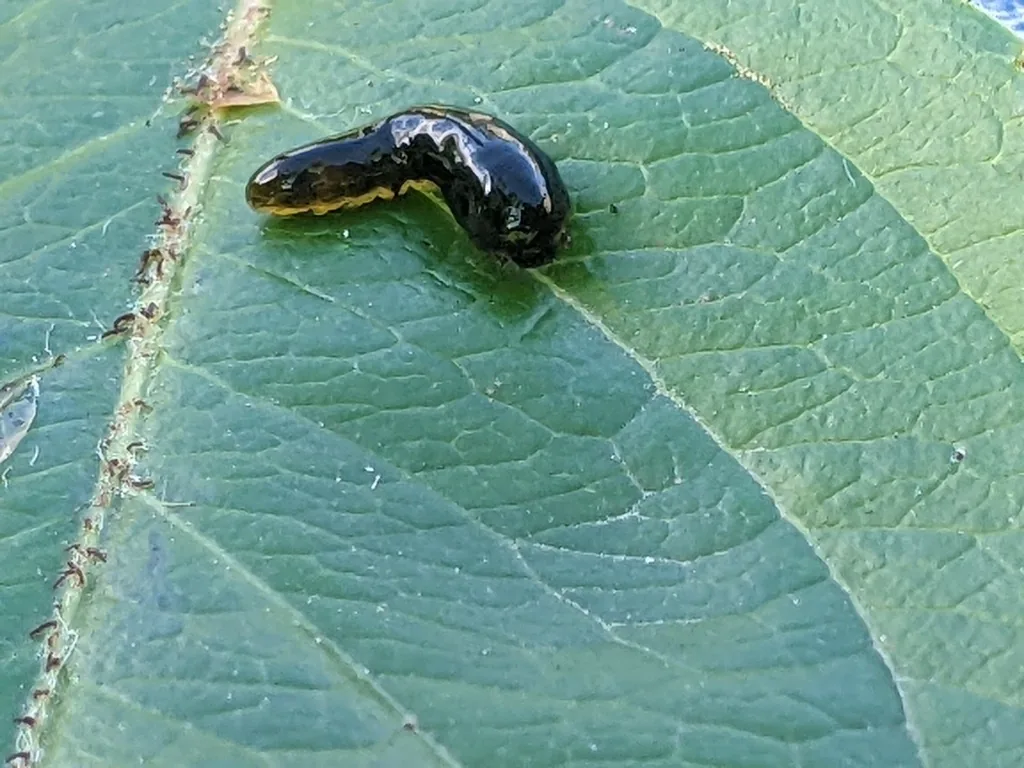
- Larvae grow to about 3/8 inch (NC State says 3/8 to 1/2 inch) and are covered with a slimy coating that makes them look like small slugs. UC IPM calls the coating olive green; NC State describes a greenish slime that looks blackish, and says newly hatched, newly molted and full-grown larvae are bare and yellowish.[1][2]
- The thorax behind the head is wider than the rest of the body.[1]
- Larvae have seven pairs of prolegs behind the three pairs of true legs (NC State counts 10 pairs of legs in all), more than the five or fewer prolegs of most caterpillars.[1][2]
- Adults are small, shiny black sawflies with a broad waist. UC IPM says they are about 1/5 inch long and black with yellow; NC State says females are almost 3/16 inch long, black with very dark feet and lower legs, and hold their translucent dark wings flat over the back.[1][2]
Look-alikes
| Look-alike | How to tell them apart |
|---|---|
| California pear sawfly | Its larvae are bright green and lack the olive-green slimy coat.[1] |
Where it lives
UC IPM lists cherry and pear plus cotoneaster, hawthorn, mountain ash, plum and quince as hosts, and says damage in California is mostly in coastal and northern areas. NC State lists pear, cherry, hawthorn, plum, quince and occasionally apple, and says eggs are sometimes laid on peach, where larvae don't seem to do well.[1][2]
Biology and life cycle
Mature larvae overwinter in cells in topsoil and emerge as adults in early spring.[1]
Females insert eggs in the leaves, and larvae pass through five instars. Sources differ on where: UC IPM says the undersides of leaves, while NC State says the upper surface or the lower surface near a ridge, most often in the upper canopy, with each egg making a small tan, oval blister.[1][2]
There are generally two generations a year, with larvae most common in mid to late spring and mid to late summer.[1]
Damage and signs
- Larvae chew the upper leaf surface down to the veins, leaving brownish to gray patches.[1]
- Sources weigh the damage differently. UC IPM says heavy feeding can reduce fruit size that season and the next but doesn't seriously threaten otherwise healthy plants; NC State says heavily infested trees turn brown, leaves wither and drop early, and defoliation can weaken the tree.[1][2]
Health risk
The larvae feed on leaves, and no cited source describes any risk to people or pets.[1][2]
Control
Traps and physical control
When numbers are low, pick them off or wash them off with a strong stream of water.[1]
Biological control
UC IPM says pear sawfly is often controlled by natural enemies.[1]
Pesticides
Thorough sprays of horticultural oil, neem oil, insecticidal soap or spinosad control them; don't spray spinosad on flowering plants.[1]
Bt does not work on sawfly larvae, because they aren't caterpillars.[1]
Sources differ on broad-spectrum sprays. NC State says pearslugs are reportedly susceptible to insecticides and that a product labeled for landscape plants should control them; UC IPM advises avoiding broad-spectrum, persistent insecticides such as carbaryl, malathion and pyrethroids because they harm bees and natural enemies and some can contaminate surface water. Follow the label.[2][1]
More from NC State Extension
Eggs hatch in 10 to 15 days; grown larvae drop and burrow 2 or 3 inches into the soil to spin a cocoon, and there are at least two generations a year, the second usually the most damaging.[2]
Common questions
Sources
- University of California Statewide IPM Program, “Pear Sawfly (Pearslug) (Pests in Gardens and Landscapes).” ipm.ucanr.edu/PMG/GARDEN/FRUIT/PESTS/pearslug.html (accessed 2026-11-13)
- NC State Extension, “Pearslug.” content.ces.ncsu.edu/pear-slug (accessed 2026-11-13)
- Global Biodiversity Information Facility (GBIF), “Caliroa cerasi (Linnaeus, 1758) (GBIF Backbone Taxonomy).” api.gbif.org/v1/species/1249682 (accessed 2026-11-13)