On this page
How to identify it
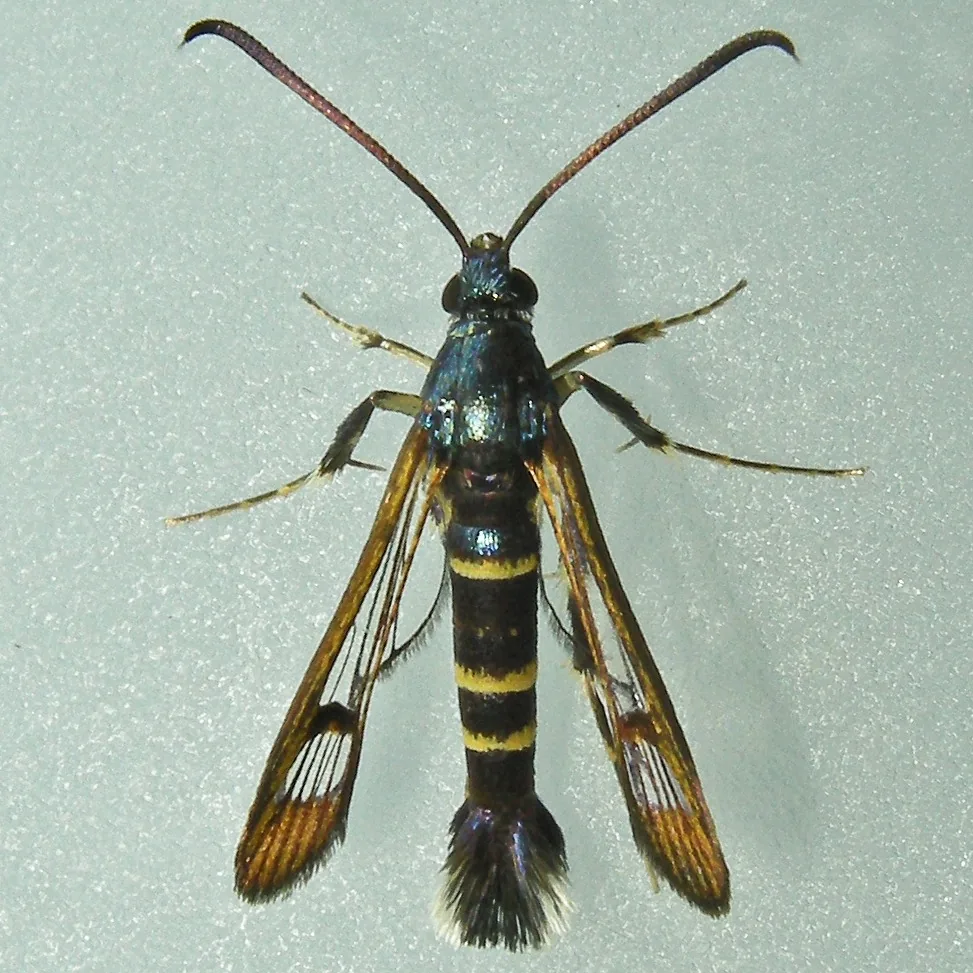
- Adults are small, wasp-like clearwing moths with a steel-blue to black body, thin yellow bands on abdominal segments 2, 4 and 5, and clear wings. Penn State gives a wingspread of 10 to 15 mm and calls it one of the smallest clearwing borers in Pennsylvania; UMass says females have broader yellow bands than males.[2][3][1]
- Larvae are yellowish white with a reddish brown or dark head. Clemson and UMass say they grow to about 1/2 inch; Penn State gives 10 mm (about 3/8 inch) at maturity.[1][3][2]
- Signs include holes near branch crotches or old wounds, reddish or sawdust-like frass, empty pupal skins sticking halfway out of holes, and shallow lengthwise scars in the bark of twigs and branches.[3][2]
Look-alikes
| Look-alike | How to tell them apart |
|---|---|
| Paper wasps | The adult moth resembles a wasp, but its clear wings have only a few scales on the veins. Penn State says the adults don't feed and live only a day or two.[1][2] |
Where it lives
Penn State calls it a native pest of rhododendron in the eastern United States, first described from Pennsylvania specimens in 1909. Clemson covers it in South Carolina, and UMass Extension covers it in its landscape guide.[2][1][3]
Biology and life cycle
Moths emerge from mid-May through June (Penn State) or from May into July depending on temperatures (UMass). Females lay up to about 40 eggs each at pruning cuts, narrow branch crotches, bark crevices and old wounds.[2][3]
Larvae bore through the bark into the inner tissue, making long tunnels within branches, and by late fall move into the sapwood to overwinter.[1][3][2]
Feeding resumes in spring, in late March per Penn State or around mid-March per UMass. Mature larvae cut an exit hole and pupate in a cocoon covered with frass and wood chips. There is one generation a year.[2][3]
Damage and signs
- Leaves on infested branches turn off-color and wilt, like drought stress, and branch growth is stunted; damage is most noticeable in fall. Clemson says the borer prefers twigs and small branches but may infest larger branches and main stems, and UMass says larvae often bore near the base of the plant.[1][3]
- Penn State says branches can be girdled, small plants may be killed by a light infestation, and infested plants produce fewer blooms. Injury tends to grow from year to year if it isn't managed, and fast-growing cultivars seem more susceptible.[2][3]
Health risk
It feeds inside rhododendrons and related shrubs, and no cited source describes any risk to people or pets.[1][2][3]
Control
Prevention
Penn State says good plant health care may limit damage.[2]
Sanitation
Prune and destroy wilted or infested branches. Penn State says to do this from fall through early spring and to remove heavily infested plants.[1][2][3]
Traps and physical control
Cut open wilted branches to look for larvae, and use pheromone traps to detect male moths. Clemson says catching males means management is needed.[1][2]
Biological control
Woodpeckers and parasitic wasps are the main natural enemies, according to Penn State and UMass.[2][3]
Pesticides
Sprays target newly hatched larvae on the bark of the trunk and branches. Clemson lists permethrin and says to treat in May and June; Penn State says to spray 7 to 10 days after the first male is caught in a pheromone trap, and UMass says about a week after. Follow the label.[1][2][3]
Common questions
- Why are some rhododendron branches wilting in fall?
- Rhododendron borer larvae tunneling inside can cause wilting that looks like drought stress.[1]
- How do I confirm rhododendron borer?
- Prune a wilted branch and cut it open to look for pale yellow larvae.[1]
- Does it attack azaleas and mountain laurel?
- Sometimes. Penn State and UMass say it occasionally attacks mountain laurel and deciduous azaleas, mainly when they grow next to infested rhododendrons.[2][3]
Sources
- Clemson Cooperative Extension, Home & Garden Information Center, “Azalea & Rhododendron Insect Pests (HGIC 2051).” hgic.clemson.edu/factsheet/azalea-rhododendron-insect-pests/ (accessed 2026-11-13)
- Penn State Extension, “Rhododendron Borer.” extension.psu.edu/rhododendron-borer (accessed 2026-11-13)
- UMass Amherst Extension (Center for Agriculture, Food, and the Environment), “Synanthedon rhododendri (Insect & Mite Guide).” www.umass.edu/agriculture-food-environment/landscape/publications-resources/insect-mite-guide/synanthedon-rhododendri (accessed 2026-11-13)
- Global Biodiversity Information Facility (GBIF), “Synanthedon rhododendri (Beutenmüller, 1909) (GBIF Backbone Taxonomy).” api.gbif.org/v1/species/1940569 (accessed 2026-11-13)