The short answer
- Antennae: ALB antennae are long and boldly banded black and white. The whitespotted sawyer's are long with only faint banding, the cottonwood borer's are solid black, and the eyed click beetle's are short.[8][4][9][6]
- The spot between the wing covers: the whitespotted sawyer has a single white spot (the scutellum) at the base of the wing covers. On ALB that spot is black.[8][3][7][9]
- Body: ALB is shiny black, like patent leather, with scattered white spots and bluish feet. The cottonwood borer is mostly white or cream with black bars; the eyed click beetle has two large black false eyes on the thorax.[2][5][4][6][7]
- If it still looks like ALB, photograph it, freeze it in a durable container and report it to USDA APHIS.[1]
Profiles on this site
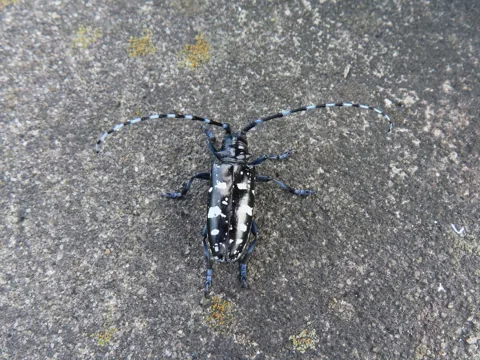 Asian Longhorned Beetle
Anoplophora glabripennis
The Asian longhorned beetle is an invasive wood borer that attacks live, healthy maples and other hardwoods and eventually kills them. Infested trees can't be saved, so finding and reporting it early is what matters.
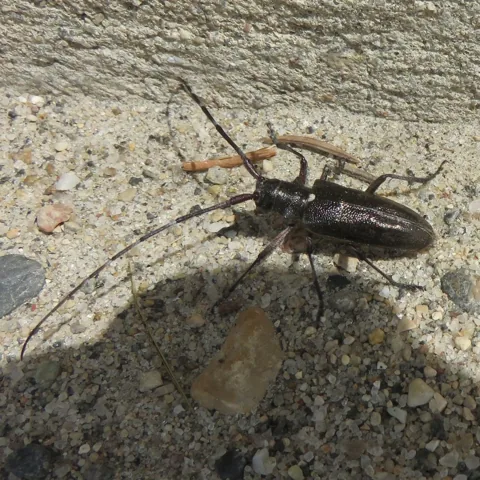 Pine Sawyers
Monochamus species (e.g., M. scutellatus, the whitespotted sawyer)
Pine sawyers are large longhorned beetles whose grubs bore into recently killed, dying or freshly cut pines and other conifers; healthy trees are not attacked. They sometimes chew their way out of firewood or new-construction lumber indoors, but they can't reinfest the wood in a house.
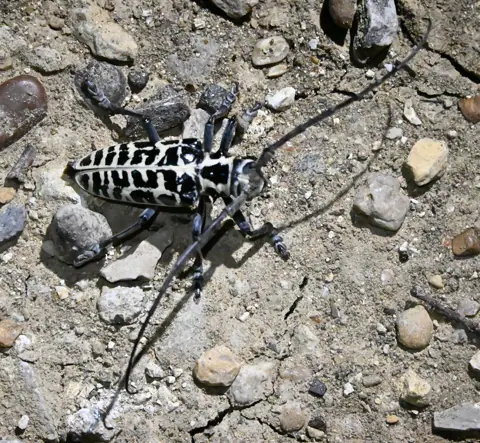 Cottonwood borer
Plectrodera scalator
The cottonwood borer is a large black-and-white longhorned beetle whose larvae tunnel into the bases and roots of cottonwoods, other poplars and willows. Severely infested young trees can be badly damaged or killed, while larger trees tolerate light to moderate infestations.
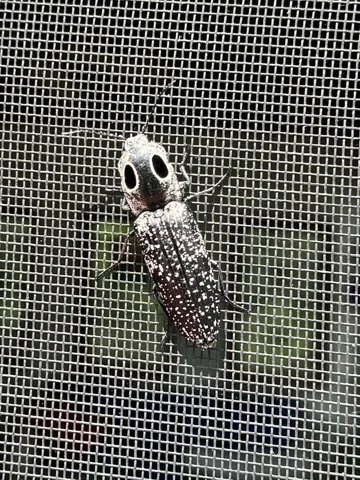 Click Beetles
Elateridae (e.g., Alaus oculatus, the eyed click beetle)
Click beetles are named for the trick they use to escape predators and get back on their feet: a sudden snap that flips them into the air with a click. Adults are mostly nocturnal and do no harm, but the soil-dwelling larvae of some species, called wireworms, are serious pests of potatoes, root crops and grains.
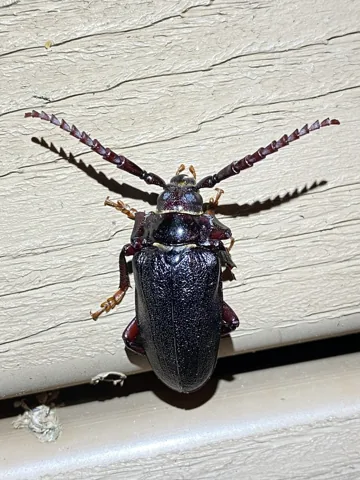 Broad-necked root borer
Prionus laticollis
The broad-necked root borer, Prionus laticollis, is a large, dark longhorn beetle of the eastern United States. Its grubs feed on roots for 3 to 4 years, girdling and hollowing them, and can kill orchard trees and open-grown trees in parks, pastures and along streets.
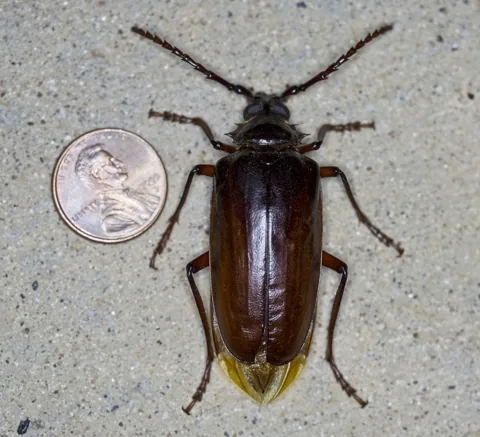 Prionus Root Borers
Prionus spp. (e.g., Prionus californicus, the California prionus)
Prionus root borers are very large brown longhorned beetles whose cream-colored grubs spend three or more years tunneling in roots. The California prionus attacks stone fruits, hops, cottonwoods and other woody plants in the West, while eastern species such as the broad-necked root borer and tilehorned prionus damage apple, cherry and other trees.
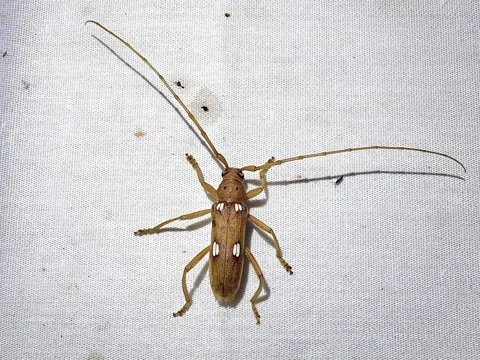 Ivory-Marked Borer
Eburia quadrigeminata (iNaturalist: Coeleburia quadrigeminata)
The ivory-marked borer is a golden-brown longhorned beetle, about 1/2 inch long, with four pairs of ivory spots, whose grubs bore into the heartwood of dead hardwood trees. It is harmless to people and pets. It surprises homeowners when an adult chews out of a hardwood floor or piece of furniture, sometimes many years after the wood was milled; NC State says no chemical control is necessary.
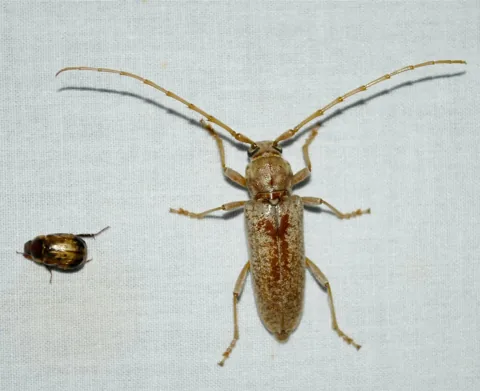 Red oak borer
Enaphalodes rufulus
The red oak borer is a native longhorned beetle whose larvae tunnel through the inner bark and wood of living oaks, mainly red oaks. It is usually present at low numbers, but around 2000 an unprecedented outbreak in the Ozark Mountains of Arkansas and Missouri accompanied widespread oak decline.
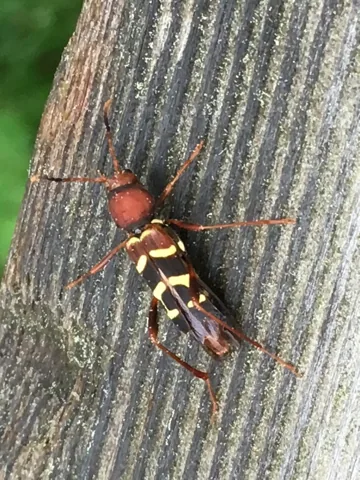 Redheaded Ash Borer
Neoclytus acuminatus
The redheaded ash borer, Neoclytus acuminatus, is a slender longhorned beetle about 1/2 to 5/8 inch long with a reddish head and thorax and yellow bands across dark wing covers; MDC says adults resemble wasps. Its grubs bore in newly planted, stressed, dying or dead hardwoods and bark-covered logs. NC State says beetles that emerge from firewood indoors can be a nuisance, and Kentucky entomologists say firewood borers have a very low potential to infest structural wood in a home. NC State's prevention advice is to keep trees healthy, and NPIC and Kentucky say to inspect firewood before moving it or bringing it in.
Side by side
Asian longhorned beetle: 1 to 1 1/2 inches long (NC State gives 3/4 to 1 1/2 inches), shiny black with white spots and long black-and-white banded antennae up to 4 inches, up to about twice the body length. Black legs, often with blue markings; while alive the feet look blue. The scutellum is black.[6][5][3][8][2]
Whitespotted sawyer (Monochamus scutellatus): 3/4 to 1 inch in the Massachusetts flyer, one inch to an inch and a quarter in UMaine's description. Dull or bronzy black, may be mottled with whitish patches, with long but faintly banded antennae and a white scutellum. It does not have bluish feet, and it has the one distinctive white spot where ALB has about 20 white spots on each wing cover.[8][9][5][4]
Northeastern sawyer (Monochamus notatus): mottled light brown and white with no distinct spots. Sizes differ: the Massachusetts flyer gives 3/4 to 1 1/4 inches, while UMaine describes it as a drab gray beetle close to two inches in body length, larger than the whitespotted sawyer.[8][9]
Cottonwood borer (Plectrodera scalator): 1 to 1 1/2 inches in Arkansas Extension's table, about 1 to 1 3/4 inches in the Forest Service fact sheet, and up to about 2 inches per Clemson. Black bars on a cream background, so far more white than ALB, with solid black antennae and gray, not blue, legs. Clemson says it is the beetle most often confused with ALB in South Carolina.[6][10][5][3][4]
Eastern eyed click beetle (Alaus oculatus): 1 to 1 3/4 inches long, black or gray with white speckles, two large black false eyes on the thorax, and short antennae (about 1/4 inch in the Arkansas table). Its real eyes are much smaller and sit behind the antennae.[6][8][11][4]
Broadnecked root borer (Prionus laticollis): 1 to 1 1/2 inches, black with no white markings and solid black antennae. Brown prionids are light chestnut brown with no spots. Clemson notes prionids are brown, not black, and lack white spots on the body and antennae.[8][5]
Other Arkansas look-alikes: southern pine sawyer (gray and brown mottling, legs with gray, not blue, markings), ivory-marked beetle (brown with 4 pairs of white spots), red oak borer (tan with fine reddish-brown mottles), and white oak borer (light brown with dark mottles). None has blue on the legs.[6]
- The New England look-alike flyer also shows Graphisurus fasciatus, a longhorn that is dark with gray and light brown mottling and does have black-and-white banded antennae, and the western conifer seed bug, which is brown with a geometric wing pattern and flared back legs. Neither is shiny black with bold white spots.[8]
Host trees, damage and exit holes
Unlike many pests, ALB will attack healthy trees. Maples are preferred; red maple is the main host in the South Carolina infestation. It also attacks birch, horse chestnut and buckeye, poplar, willow, elm, ash, mountain ash, sycamore and others.[6][3][4][7]
Whitespotted sawyer larvae tunnel in conifers, especially white pine, balsam fir and spruce, and they use trees that are already weakened, dying or dead.[9][7][4]
Cottonwood borer larvae feed in the lower trunk and roots of cottonwood, poplars and occasionally willows. Eastern cottonwood is the preferred host.[10][4][7]
Eyed click beetle larvae live in decaying logs in deciduous woods and prey on wood-boring beetle grubs; UF cites an older report in which caged larvae each ate more than 200 longhorned beetle larvae during their development.[11][13]
ALB exit holes are round. UMass gives about 3/8 inch, and Iowa DNR says about the size of a dime. Arkansas Extension gives up to about 1/2 inch in one figure caption and up to 3/4 inch in its inspection advice.[2][7][6]
The pencil test: a pencil that fits the hole and goes in at least an inch points to a longhorned beetle. NC State research found more than 90% of measured ALB exit holes were wider than a standard No. 2 pencil, so the test can underestimate them.[4][3]
How to confirm
Look at the antennae first: bold black-and-white bands along the whole length point to ALB; solid black, faint bands or short antennae point to a native beetle.[4][6][9]
Look at the small triangle where the wing covers meet behind the thorax. White there means whitespotted sawyer; black means it could still be ALB.[8][3][7]
Check the tree: a white-spotted beetle on a dying pine or a cottonwood is almost always a native borer, but Ohio State says roundheaded borers found in live maple trunks and branches should not be ignored and should be checked by ALB experts.[9][10][4]
A click beetle placed on its back will snap a spine on its underside into a groove and flip into the air.[12]
Why the ID matters
ALB is a federal eradication target. APHIS and state cooperators run surveys and eradication in four states: Massachusetts, New York, Ohio and South Carolina. Laws limit moving tree material and untreated firewood out of quarantined areas.[1]
NC State says that because APHIS works toward eradication, including removing infested trees on private property, homeowners are not required to manage ALB themselves.[3]
- The native look-alikes are not tree killers of healthy hardwoods. Ohio State says cottonwood borer and whitespotted sawyer larvae infest weakened and dying trees and rarely affect healthy ones; the Forest Service says cottonwood borer-infested plantation trees seldom die, though nursery stock can. Eyed click beetle larvae are predators of borer grubs.[4][10][11][13]
What to do for each
Suspected ALB: report it. APHIS runs an ALB hotline at 1-866-702-9938 and an online report form, and says to photograph the beetle or damage and freeze the beetle if you can. Don't move firewood out of quarantined areas.[1]
Whitespotted or northeastern sawyer: UMaine regards the whitespotted sawyer as a secondary pest, since it breeds in weakened, dying or dead conifers. See the pine sawyer profile.[9]
Cottonwood borer: the Forest Service notes that stands on poor sites are more heavily infested than stands on good sites. See the cottonwood borer profile.[10]
Eyed click beetle: no action is needed. Its larvae eat wood-boring grubs.[11][13]
Common questions
- Is a black beetle with white spots on my pine tree an Asian longhorned beetle?
- Probably not. A white-spotted beetle on pine, fir or spruce is most likely a whitespotted sawyer; check for its single white spot between the wing covers and its faintly banded antennae.[9][8][7]
- Does a click beetle with big eye spots damage trees?
- No. The eyespots on the eyed click beetle are false eyes, and its larvae live in decaying logs, where they eat longhorned beetle grubs.[11][13]
- What is the fastest single check?
- The antennae: long antennae boldly banded black and white along their length are the ALB trait the look-alikes lack.[4][6][5]
- Who do I call about a suspected Asian longhorned beetle?
- USDA APHIS: the ALB hotline is 1-866-702-9938, or use the online report form on the APHIS ALB page.[1]
Photo credits
- Asian Longhorned Beetle: (c) Timur Kalininsky, some rights reserved (CC BY) — via iNaturalist, CC BY 4.0
- Pine Sawyers: (c) Annie Bélair, some rights reserved (CC BY) — via iNaturalist, CC BY 4.0
- Cottonwood borer: Vince Hale, public domain (CC0), via iNaturalist
- Click Beetles: Diane, public domain (CC0), via iNaturalist
- Broad-necked root borer: Samuel Paul Galick, public domain (CC0), via iNaturalist
- Prionus Root Borers: Robbie Hannawacker, public domain (CC0), via iNaturalist
- Ivory-Marked Borer: Samuel Paul Galick, public domain (CC0), via iNaturalist
- Red oak borer: (c) Jay Pruett, some rights reserved (CC BY) — via iNaturalist, CC BY 4.0
- Redheaded Ash Borer: wcmorton, public domain (CC0), via iNaturalist
Sources
- USDA APHIS, “Asian Longhorned Beetle.” www.aphis.usda.gov/plant-pests-diseases/alb (accessed 2026-11-14)
- UMass Amherst Extension Landscape, Nursery and Urban Forestry Program, “Asian Longhorned Beetle.” www.umass.edu/agriculture-food-environment/landscape/fact-sheets/asian-longhorned-beetle (accessed 2026-11-14)
- NC State Extension, “Asian Longhorned Beetle.” content.ces.ncsu.edu/asian-longhorned-beetle (accessed 2026-11-14)
- Ohio State University Extension (Ohioline), “Asian Longhorned Beetle (ENT-75).” ohioline.osu.edu/factsheet/ent-75 (accessed 2026-11-14)
- Clemson Cooperative Extension Home & Garden Information Center, “Asian Longhorned Beetle.” hgic.clemson.edu/factsheet/asian-longhorned-beetle/ (accessed 2026-11-14)
- University of Arkansas Cooperative Extension Service, “Asian Longhorned Beetle (FSA-5032).” www.uaex.uada.edu/publications/pdf/FSA-5032.pdf (accessed 2026-11-14)
- Iowa Department of Natural Resources, “Asian Longhorned Beetle.” www.iowadnr.gov/programs-services/forestry-resources/forest-tree-health/asian-longhorned-beetle (accessed 2026-11-14)
- Connecticut Agricultural Experiment Station, “Asian Longhorned Beetle Look-alikes (flyer by Mass. Dept. of Agricultural Resources).” portal.ct.gov/-/media/caes/documents/special_features/alb/alblooklookalikesjune232010pdf.pdf (accessed 2026-11-14)
- University of Maine Cooperative Extension, “Sawyer Beetles.” extension.umaine.edu/home-and-garden-ipm/fact-sheets/common-name-listing/sawyer-beetles/ (accessed 2026-11-14)
- USDA Forest Service, Rocky Mountain Region, “Cottonwood Borer.” www.fs.usda.gov/sites/nfs/files/legacy-media/r02/2pager%20-%20Cottonwood%20Borer.pdf (accessed 2026-11-14)
- Missouri Department of Conservation, “Eyed Click Beetle (Eyed Elater).” mdc.mo.gov/discover-nature/field-guide/eyed-click-beetle-eyed-elater (accessed 2026-11-14)
- Missouri Department of Conservation, “Click Beetles (Elaterids).” mdc.mo.gov/discover-nature/field-guide/click-beetles-elaterids (accessed 2026-11-14)
- University of Florida IFAS Extension (Featured Creatures), “Click Beetles, Alaus spp., EENY-085 (R. E. Woodruff).” journals.flvc.org/edis/article/view/108217 (accessed 2026-11-14)