On this page
How to identify it
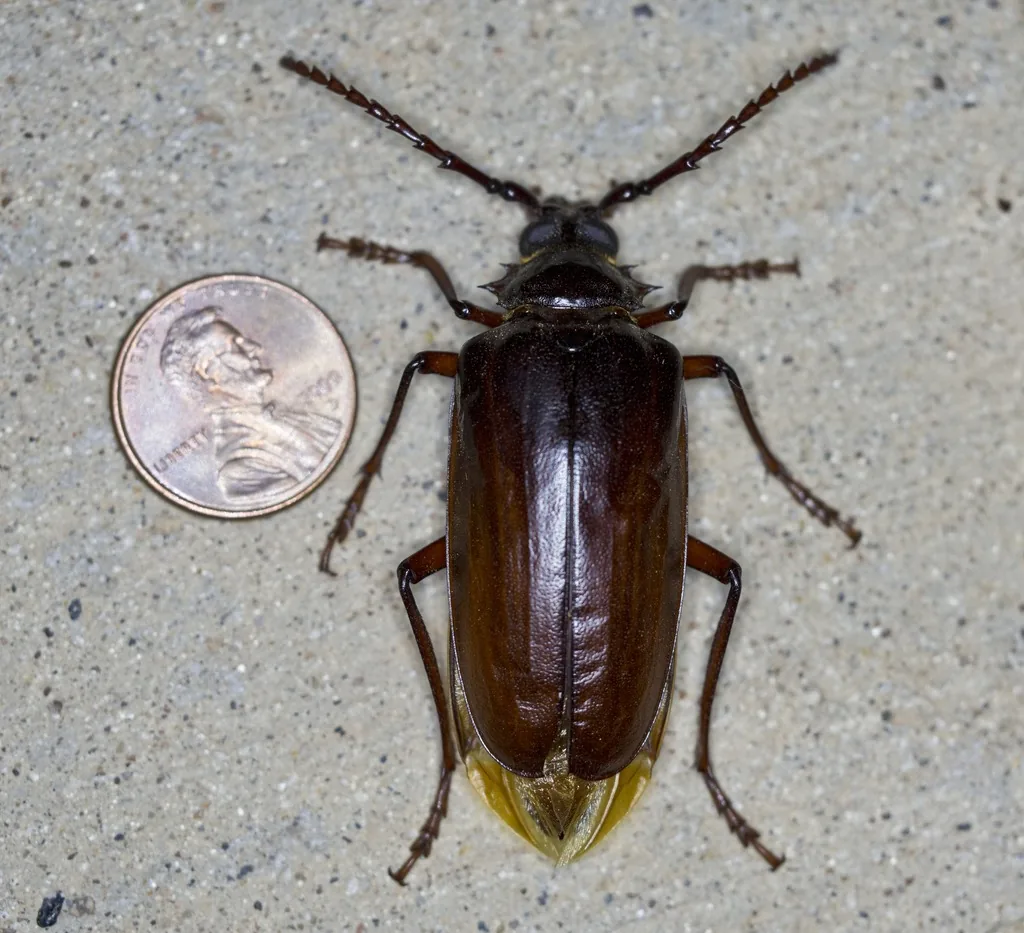
- Adults are brown, from light reddish brown to nearly black, with long, deeply notched or saw-like antennae. Males are smaller than females but have much larger and more elaborate antennae.[1][2][4]
- Size varies by species. Colorado State gives 35 to 50 mm for the California prionus, one of the largest, and 20 to 25 mm for Prionus emarginatus; NC State gives up to 2 inches for the broad-necked root borer and says the tilehorned prionus is similar in size.[1][4]
- The tilehorned prionus is told from the broad-necked root borer by its segmented, saw-like antennae.[4]
- Larvae are legless, cream-colored or whitish roundheaded borers with a small head made up almost entirely of powerful dark jaws, about 3/4 inch thick when grown.[1][2]
Look-alikes
| Look-alike | How to tell them apart |
|---|---|
| Blueberry stem borer and flatheaded borers | In blueberries, NC State notes these borers feed on the bushes for only a few weeks, while prionus grubs feed on roots and crowns for years.[4] |
Where it lives
Colorado State lists eight Prionus species in Colorado. NC State describes the broad-necked root borer as common in the eastern US, the tilehorned prionus across the eastern and central US and the California prionus mainly in the West. GBIF holds about 16,000 US records of the genus since 1990 from 43 states, most from California, Massachusetts and New York.[1][4][8]
Biology and life cycle
After mating, females use an extendable egg-laying tube to push eggs in small groups a few centimeters into the soil near host plants. The young larvae tunnel to the roots, start on small roots and work inward and upward along larger ones toward the root crown.[1][2][3]
After several years of feeding, the grub pupates in a soil chamber near the roots, close to the soil surface.[1][2][3][4]
Adults are mostly active at night and live about 1 to 2 months; NC State says they may or may not feed. Females release a powerful sex pheromone, and in a hop-yard study males reached pheromone-baited traps from as far as 585 m away.[4][7][6]
In Utah, California prionus adults fly from July to September. NC State says eastern species are active from late June through the first week of August, peaking in mid-July, and can emerge as early as April or May in the warmer Southeast. In Colorado, heavy rain can set off sharp spikes in adult emergence of some grassland species.[2][4][1]
Hosts vary by species. In Colorado, P. palparis, P. fissicornis and P. emarginatus develop on grass roots, P. integer appears to use rangeland shrubs such as rabbitbrush and sage, and the California prionus has the widest range: serviceberry, sumac, pines, fir, Douglas-fir, stone fruits, oak, willows and poplars and cottonwoods.[1]
Damage and signs
- Larvae carve deep, sometimes spiraling furrows in roots and the root crown, cutting water and nutrient uptake, girdling plants and opening them to root rot.[2][3]
- Symptoms include limb dieback, thinning or yellowing foliage and loss of vigor, and badly damaged plants may be easily uprooted. Utah State says damage is worse on sandy soils.[2][3][4]
- Hosts include sweet cherry, peach, apricot, plum and other stone fruits, apple, pecan, hops, hazelnut, cottonwood and poplar, willow, oak, hickory and other hardwoods, and pines.[1][2][4]
- Researchers call the California prionus an economically important pest of hop and sweet cherry in the Pacific Northwest and Intermountain West.[5]
- In North Carolina, growers reported prionus grubs severely damaging the roots and crowns of highbush blueberries in 2010 and 2013, and again in 2024. NC State says this is the only report it knows of prionus on commercial blueberries, and infested bushes show almost no sign until they wilt or are knocked over.[4]
Health risk
None of the sources describes harm to people or pets; the damage is done to plant roots by the grubs.[1][2][4]
Control
Prevention
Keep trees healthy and unstressed; NC State notes that most prionus species are drawn to mature and stressed plants. Watch for canopy dieback or sudden loss of vigor.[2][3][4]
Watch for adult beetles from early July. Utah State monitors with a pheromone and bucket light trap; NC State uses pheromone lures in panel traps and pitfall traps.[2][3][4]
Traps and physical control
On a small scale, NC State says digging soil away from the roots and pulling out the grubs can work. Remove and destroy badly infested plants.[4]
Biological control
Synthetic female sex pheromone is being tested for mating disruption. In commercial hop yards and sweet cherry orchards it lowered male trap catches, and three seasons of treatment reduced larvae in hop yards.[5][6]
Pesticides
Utah State's ornamental guide lists trunk-base and soil sprays against egg-laying adults and a systemic root-zone treatment for young larvae, but its fruit sheet says no insecticides are currently registered for prionus root borers. NC State says none are registered for prionus in blueberries and that systemic insecticides don't work on large grubs.[2][3][4]
Where sources disagree
How long the grubs feed: Colorado State and NC State give 3 to 5 years; Utah State's ornamental guide says one generation takes 3 years and its fruit sheet says 3 or more years.[1][4][2][3]
Size of the California prionus: Colorado State gives 35 to 50 mm, Utah State 1 3/4 to 2 1/4 inches (45-60 mm), and NC State up to 3 inches. Grubs reach 4 1/4 inches in Utah State's account and 3.5 inches in NC State's.[1][2][3][4]
When California prionus adults fly: July to September in Utah, late June through August according to NC State.[2][4]
Systemic insecticides: Utah State's ornamental guide suggests a systemic root-zone treatment for younger larvae; NC State says these don't work on large grubs and that little is known about smaller ones.[2][4]
Common questions
- What is the giant brown beetle with long antennae I found in July?
- Possibly a prionus beetle, one of the largest longhorned beetles; adults fly in summer.[1][2]
- Can prionus kill a tree?
- Heavy root feeding can girdle trees, cause dieback and invite root rot, especially on sandy soils.[2][3]
- How long do the grubs live?
- Colorado State and NC State say 3 to 5 years in the roots before pupating; Utah State says about 3 years.[1][4][2]
- Can traps control prionus beetles?
- Pheromone traps catch males and are mainly used to monitor. In commercial hop yards, surrounding a lure with eight pheromone traps cut the number of wild males reaching it by 88%, which suggests mass trapping may reduce mating, but it is still a research result.[6]
Sources
- Colorado State University Extension (Colorado Insects of Interest, W. Cranshaw), “Prionus Longhorned Beetles (Colorado Insects of Interest).” wci.extension.colostate.edu/wp-content/uploads/sites/14/2017/03/PrionusLonghorns.pdf (accessed 2026-11-11)
- Utah State University Extension (Integrated Pest Management), “Prionus Borers (Ornamental Pest Guide).” extension.usu.edu/planthealth/ipm/ornamental-pest-guide/arthopods/wood-borers/prionus-borers.php (accessed 2026-11-11)
- Utah State University Extension (Integrated Pest Management), “Prionus Root Borer.” extension.usu.edu/planthealth/ipm/notes_ag/fruit-prionus-root-borer.php (accessed 2026-11-11)
- NC State Extension (Blueberries), “The Root of the Problem: Prionus Longhorn Beetles in Blueberries.” blueberries.ces.ncsu.edu/news/the-root-of-the-problem-prionus-longhorn-beetles-in-blueberries/ (accessed 2026-11-11)
- Journal of Economic Entomology, via PubMed, “Mating disruption for managing Prionus californicus in hop and sweet cherry (Barbour et al. 2019).” pubmed.ncbi.nlm.nih.gov/30689896/ (accessed 2026-11-11). Cited from the PubMed abstract.
- Journal of Economic Entomology, via PubMed, “Evaluation of mass trapping and mating disruption for managing Prionus californicus in hop production yards (Maki et al. 2011).” pubmed.ncbi.nlm.nih.gov/21735913/ (accessed 2026-11-11). Cited from the PubMed abstract.
- Journal of Chemical Ecology, via PubMed, “Identification and synthesis of a female-produced sex pheromone for the cerambycid beetle Prionus californicus (Rodstein et al. 2009).” pubmed.ncbi.nlm.nih.gov/19396491/ (accessed 2026-11-11). Cited from the PubMed abstract.
- Global Biodiversity Information Facility (GBIF), “Prionus (genus): US occurrence records since 1990 by state (GBIF occurrence search API).” api.gbif.org/v1/occurrence/search?taxonKey=1097026&country=US&hasGeospatialIssue=false&occurrenceStatus=PRESENT&year=1990%2C2026&facet=stateProvince&facetLimit=400&limit=0 (accessed 2026-11-11). State counts are records reported (iNaturalist research-grade, museum specimens, surveys), not abundance.
- iNaturalist, “Prionus taxon page (order and family).” www.inaturalist.org/taxa/59893 (accessed 2026-11-11)