On this page
How to identify it
- Adults are long and narrow, with fairly parallel sides, rounded or tapered at each end. The rear corners of the shield behind the head (the pronotum) extend backward into points.[1]
- Most are drab brown, black or gray, some with patterns. MDC says most are under 1 inch long, though some reach 2 1/2 inches; the wireworm adults in UC IPM's potato guidelines are reddish brown to black and 0.25 to 0.5 inch long, and Alberta's prairie pest species are black and 8 to 12 mm.[1][3][4]
- The antennae are usually saw-toothed, sometimes threadlike or tipped with small combs.[1]
- Placed on their backs, they snap a spine on the underside of the thorax into a groove and flip into the air with an audible click.[1][4]
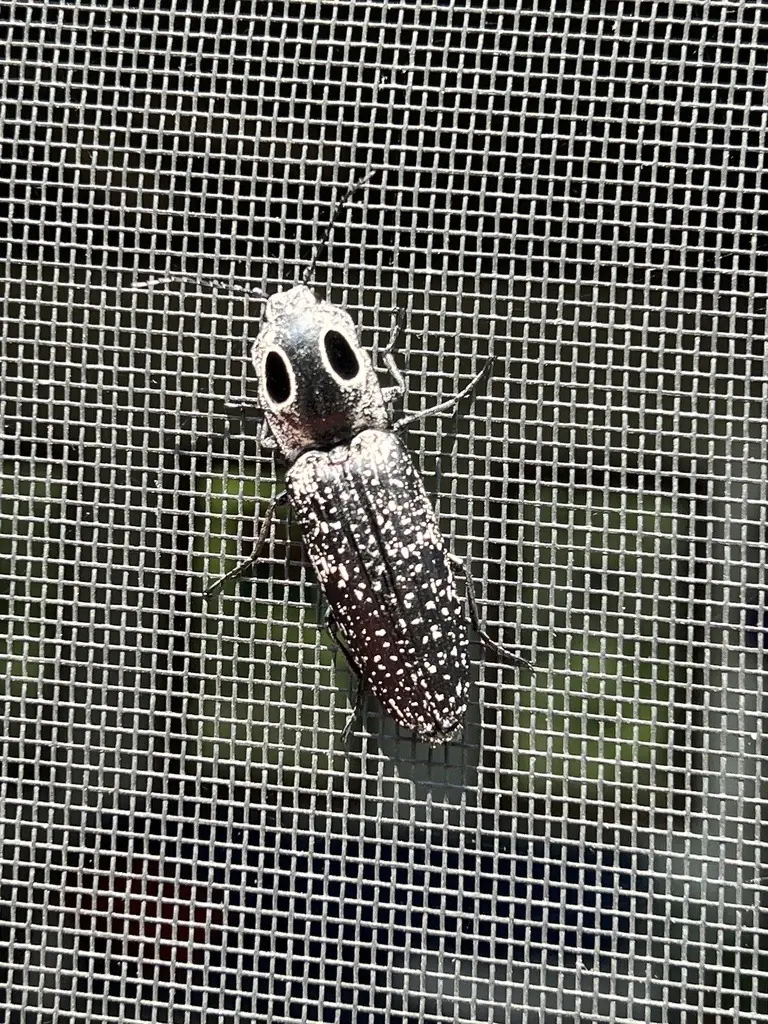
- The eyed click beetle (Alaus oculatus), common in the East, can be 1 3/4 inches long and has two big eyespots on the shield behind its head; its real eyes are much smaller and sit behind the antennae. Its larvae live in decaying logs and prey on longhorned beetle grubs.[5]
Look-alikes
| Look-alike | How to tell them apart |
|---|---|
| Mealworms (larvae) | Wireworms look a bit like the mealworms sold at bait and pet shops, but they turn up in garden soil, roots and potato tubers.[1][2] |
| Soil centipedes | MDC says wireworms can also be mistaken for soil centipedes, but a wireworm has only six tiny legs, all close behind the head.[1][2] |
| Cutworm damage | Both leave thin seedling stands. Pull up a damaged seedling: cutworms usually cut off the whole plant below the surface, while wireworms shred the stem but seldom cut it through.[4] |
Where it lives
A large family with about 1,000 species in North America, living in many habitats; in Missouri different species have different habitats and distributions. Pest wireworms include the Pacific Coast, sugarbeet and dryland wireworms of western potato soils and the prairie species that damage grain crops in western Canada.[1][3][4]
Biology and life cycle
Larvae, called wireworms, are slender, shiny, hard-bodied and segmented, whitish, tan, yellowish or brown, with three pairs of tiny legs just behind the head. Full-grown size depends on the species: about 0.75 inch in UC IPM's potato guidelines, about 1 inch in the Pacific Northwest handbook, and 1 to 4 cm for Alberta's species, whose last segment is flattened with a keyhole-shaped notch.[1][3][6][4]
The sources give different life spans. MDC says larvae feed and grow for 1 to 4 years, UC IPM says common species need 3 to 4 years to complete the life cycle, the Pacific Northwest handbook says 2 to 6 years depending on species, and Alberta says larvae can live 4 to 11 years in soil, though most live 3 to 5.[1][2][6][4]
Mature larvae pupate in a cell of soil, and adults that form in fall stay underground through the winter. In spring and summer adults come to the surface to mate, and females burrow back into the soil to lay eggs. Alberta reports 200 to 400 eggs per female, laid from late May through June and hatching in 3 to 7 weeks.[2][4]
Wireworms move up and down with soil temperature and moisture. The Pacific Northwest handbook says they move upward in spring once soil at 6 inches reaches 50°F and go deeper than 6 inches when it reaches 80°F; Alberta says they do the most damage in early spring, when they are near the surface.[6][4][2]
Adults are mostly nocturnal and live near plants or under bark. If they eat at all they take nectar, plant juices or foliage, and the Pacific Northwest handbook says they do little or no crop damage. Not all larvae eat crops: some feed on decaying matter in logs and soil, and some prey on other beetle grubs.[1][6]
Damage and signs
- Wireworms feed on sprouting seeds and seedlings and bore into stems, roots and potato tubers; damage is most common in soil high in organic matter.[2]
- MDC lists beets, potatoes, carrots, onions, lettuce, snap beans, melons, peas, strawberries, corn, wheat and cotton among the crops they damage. The Pacific Northwest handbook says no crop is immune, but beans, corn, grain and watermelons suffer most.[1][6]
- In potatoes they bore straight or diagonally into the tuber to depths up to 0.5 inch without tunneling all the way through, and Alberta notes the holes let disease organisms in.[3][4]
- Losses are often worst in the first year or two after sod or long-term grass is broken for planting.[4]
- Adult click beetles don't damage plants; UC IPM says they do not weaken older plants.[2][6]
Health risk
None of the sources describe click beetles biting, stinging or damaging anything indoors. Adults found around a house have usually been drawn by lights.[1]
Control
Prevention
Adults need no control. MDC notes they are attracted to lights at night and often rest in the morning on the side of a house where a light was on all evening.[1]
Reduce soil organic matter where wireworms are a problem, and flooding an area before planting can help lower numbers.[2]
Rotate crops. Wireworms build up quickly under red and sweet clover and small grains such as barley and wheat. MDC also suggests clearing out old plants in fall, cultivating the soil and planting winter cover crops.[6][1]
Traps and physical control
To check for wireworms, Alberta suggests burying whole potatoes 10 to 15 cm deep, digging them up after a couple of weeks and looking for tunnels. A low catch is not proof of a clean bed: baits work poorly in cold soil, and in soil rich in organic matter the larvae may not leave it for the bait.[4]
In the garden, bury nearly full-grown carrots every 2 1/2 to 3 feet, pull them every 2 to 3 days, remove the wireworms, and replant the carrots to trap more.[2]
Dig potatoes soon after the vines die; tubers left in the ground for weeks after vine death can be re-infested.[6]
Biological control
Birds eat many wireworms in freshly plowed ground, but the Pacific Northwest handbook says that does not bring a heavy infestation below damaging levels, and field tests of beneficial nematodes have not controlled them.[6]
How the click works
Lying on its back, a click beetle locks a hinge in its body to store elastic energy, then releases it abruptly to launch itself into the air without using its legs.[7]
In a study of nine beetles, the takeoff angle stayed close to vertical at 79.9 degrees, directing 98 percent of the jumping force against gravity, but the spin in the air varied widely. The authors conclude the beetle can control its takeoff speed but not how it lands.[7]
A 2022 study filmed 38 click beetles from 7 to 37 mm long and found that body mass did not predict jump height, takeoff angle or takeoff speed.[8]
Why wireworms are hard to control
Wireworms have been major soil pests worldwide for centuries. Reviews in the Annual Review of Entomology point to their hidden life underground, their resilience, differences in biology between species, their wide host range and the lack of objective economic thresholds.[9][10]
Alberta warns that no sampling method gives a full picture of wireworm numbers, partly because larvae are sometimes inactive and ignore baits. An action threshold of about 32 wireworms per square metre has been recommended in the past.[4]
Researchers report progress, including a new effective class of insecticides, better species identification, and work on sex pheromones, larval attractants and biological control.[10]
Common questions
- Why do click beetles click?
- The snap startles predators and helps the beetle escape, and it also flips the beetle back onto its feet when it lands on its back.[1]
- Why are click beetles around my house?
- Adults are attracted to lights at night, so you often find them in the morning resting on a wall near an outdoor light.[1]
- What are wireworms?
- They are the larvae of click beetles: hard, slender, yellowish worms with six tiny legs that live in soil and tunnel into seeds, roots and potatoes.[2][1]
- How long do wireworms live in the soil?
- Years. Estimates run from 1 to 4 years (MDC) and 3 to 4 years (UC IPM) up to 2 to 6 years (Pacific Northwest handbook), and Alberta reports some larvae living 4 to 11 years.[1][2][6][4]
Sources
- Missouri Department of Conservation, “Click Beetles (Elaterids) (Field Guide).” mdc.mo.gov/discover-nature/field-guide/click-beetles-elaterids (accessed 2026-11-11)
- University of California Statewide IPM Program, “Wireworms (Home and Landscape: vegetable garden pests).” ipm.ucanr.edu/home-and-landscape/wireworms/ (accessed 2026-11-11)
- University of California Statewide IPM Program, “Potato Pest Management Guidelines: Wireworms.” ipm.ucanr.edu/agriculture/potato/wireworms/ (accessed 2026-11-11)
- Government of Alberta, Agriculture and Irrigation, “Wireworm.” www.alberta.ca/wireworm (accessed 2026-11-11)
- Missouri Department of Conservation, “Eyed Click Beetle (Eyed Elater) (Field Guide).” mdc.mo.gov/discover-nature/field-guide/eyed-click-beetle-eyed-elater (accessed 2026-11-11)
- Pacific Northwest Pest Management Handbooks (Oregon State, Washington State and University of Idaho Extension), “Potato, Irish-Wireworm (Pacific Northwest Insect Management Handbook).” pnwhandbooks.org/insect/vegetable/irish-potato/potato-irish-wireworm (accessed 2026-11-11)
- PLoS One, via PubMed, “Jumping without using legs: the jump of the click-beetles (Elateridae) is morphologically constrained (Ribak and Weihs 2011).” pubmed.ncbi.nlm.nih.gov/21698194/ (accessed 2026-11-11)
- Integrative and Comparative Biology, via PubMed, “Scaling of jumping performance in click beetles (Coleoptera: Elateridae) (Bolmin et al. 2022).” pubmed.ncbi.nlm.nih.gov/35675324/ (accessed 2026-11-11)
- Annual Review of Entomology, via PubMed, “Biology, ecology, and control of elaterid beetles in agricultural land (Traugott et al. 2015).” pubmed.ncbi.nlm.nih.gov/25341096/ (accessed 2026-11-11)
- Annual Review of Entomology, via PubMed, “Pest elaterids of North America: new insights and opportunities for management (Rashed and van Herk 2024).” pubmed.ncbi.nlm.nih.gov/37562049/ (accessed 2026-11-11)
- iNaturalist, “Alaus oculatus taxon page (order and family).” www.inaturalist.org/taxa/81706 (accessed 2026-10-06)